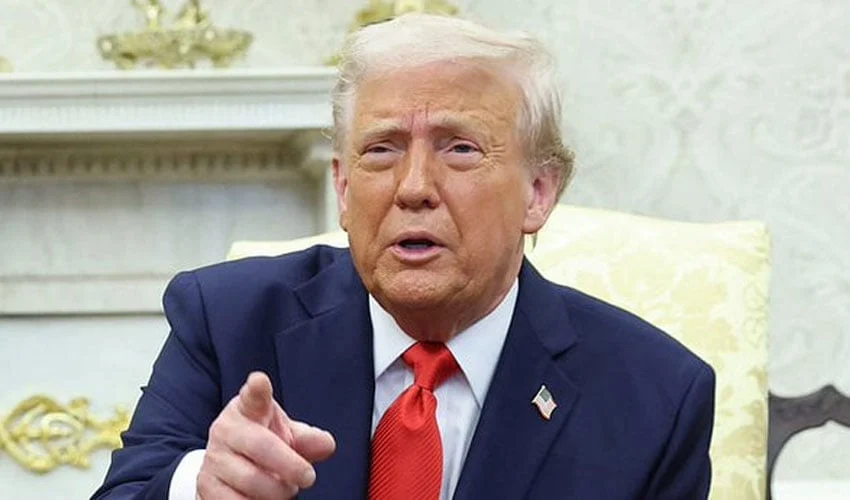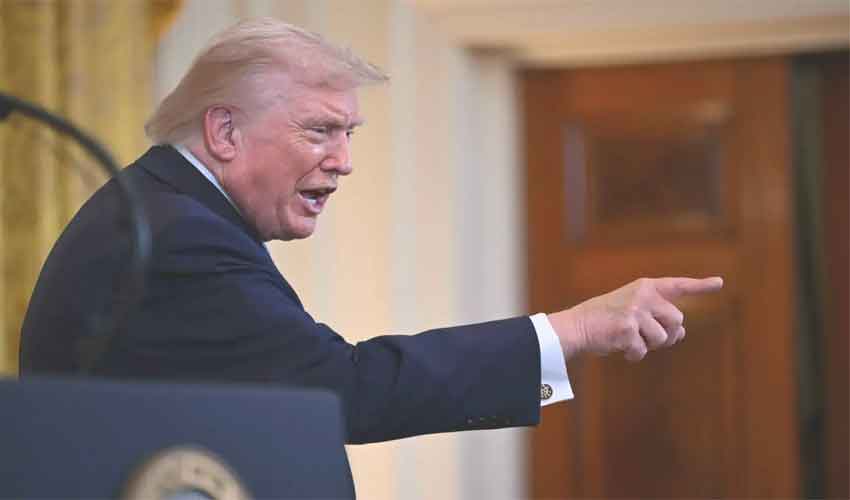





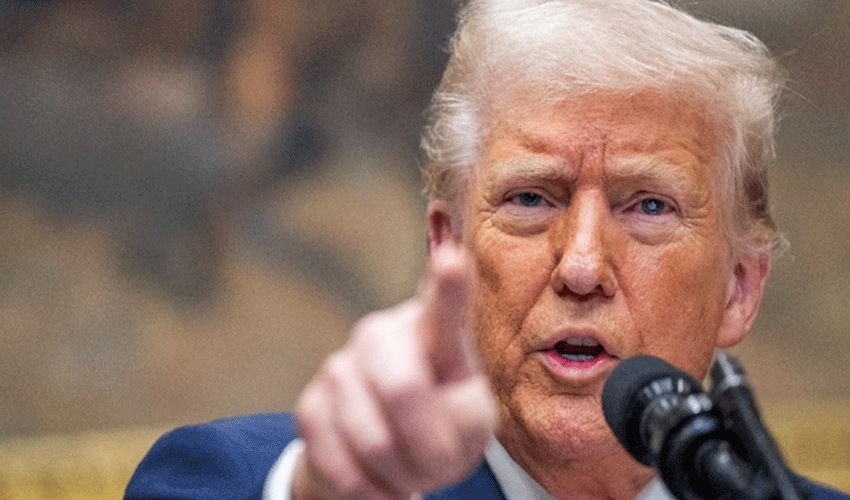
US President Donald Trump’s administration on Friday unveiled a sweeping $163 billion federal budget cut proposal for the upcoming fiscal year, sharply curtailing domestic programs in education, housing, medical research, and taxation enforcement, while significantly bolstering spending on defense and border security.
According to the White House Office of Management and Budget (OMB), the proposed cuts would reduce non-defense discretionary spending by 23%—bringing it to its lowest levels since 2017.
The administration has proposed a near 65% surge in homeland security funding, citing the need to clamp down on illegal immigration.
The proposal, which represents Trump's first formal budget request since returning to office, outlines a dramatic shift in fiscal priorities. “At this critical moment, we need a historic budget — one that ends the funding of our decline, puts Americans first, and delivers unprecedented support to our military and homeland security,” said OMB Director Russ Vought.
Vought, a former Heritage Foundation official and key architect of the right-leaning Project 2025 plan to shrink the federal government, has been tapped by Trump to spearhead the budget overhaul despite the former president disavowing the plan during his campaign.
Domestic programs face deep cuts
The proposed budget calls for steep reductions in key public sector agencies. Funding for the Internal Revenue Service would be cut by $2.49 billion, a move the administration says is intended to end what it calls the “weaponization” of tax enforcement under the previous administration. However, independent analysts warn that weakening the IRS may impair tax collection and increase the national deficit.
Similarly, the National Institutes of Health and the Centers for Disease Control and Prevention would see their budgets slashed by more than 40%, raising concerns about the nation’s capacity to respond to health crises.
The Department of Education, long a target of Trump’s reform agenda, is slated to lose around 15% of its funding, furthering Trump's pledge to scale back or eliminate the department. The Department of Housing and Urban Development would see its budget nearly halved, a decision critics say would severely impact low-income families relying on federal housing assistance.
The State Department, meanwhile, would absorb the U.S. Agency for International Development (USAID), with a $50 billion budget cut projected as part of the consolidation.
Mixed reactions in congress
Congressional Democrats were quick to condemn the budget plan. Senate Majority Leader Chuck Schumer denounced the proposals as "an all-out assault on hardworking Americans."
“Donald Trump’s days of pretending to be a populist are over,” Schumer said in a statement, accusing the administration of prioritising tax cuts for the wealthy and military expansion over essential services.
Within Republican ranks, reactions were mixed. Senator Susan Collins of Maine, the top Republican appropriator, raised objections over the budget’s timing and content. “This request has come to Congress late, and key details still remain outstanding,” she said. “I have serious objections, particularly about cuts to programs that help low-income Americans heat their homes and what I see as inadequate defense funding.”
Senator Roger Wicker, a Republican from Mississippi and chairman of the Senate Armed Services Committee, echoed concerns about defense spending, stating the proposed figures merely maintain levels set under the Biden administration and would effectively shrink in real terms due to inflation.
Defense and border security prioritised
Despite concerns, the administration aims to increase discretionary defense spending by 13% and bolster funding for border operations. The proposal includes an additional $500 million in discretionary funds for border security and mass deportation efforts, $766 million for border security technology, and support for maintaining 22,000 border patrol agents along with new hires for Customs and Border Protection.
The budget plan is seen as a precursor to the Republican push to pass a tax cut bill, with GOP lawmakers aiming for passage by July 4. However, intra-party divisions remain over how to balance proposed tax relief with deep domestic spending cuts.
The federal government’s total outlays for fiscal year 2024 stood at $6.8 trillion, according to the Congressional Budget Office, while national debt continues to climb, now standing at $36 trillion. Critics argue that Trump’s proposed extension of his 2017 tax cuts could further exacerbate the fiscal burden.
Legislative outlook
While the budget sets forth the administration’s priorities, it is Congress that holds the constitutional power of the purse. Lawmakers historically alter or reject portions of the White House’s request, although Trump retains strong influence over Republican legislators.
A separate rescission package is also in the works, according to White House officials. This would formalise spending cuts already implemented by the newly formed Department of Government Efficiency.
As the budget debate unfolds, Republicans must not only bridge internal disagreements but also contend with rising economic uncertainty driven by Trump’s aggressive tariff policies, which have disrupted global trade.