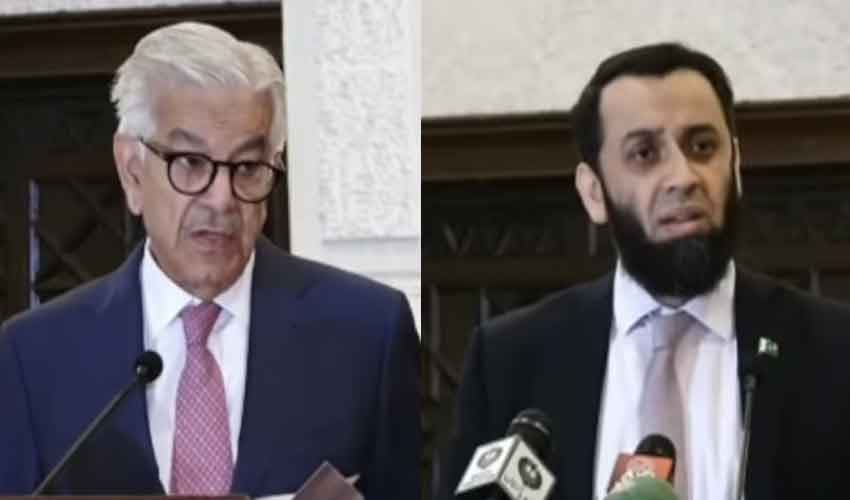
Federal Information Minister Attaullah Tarar and Defence Minister Khawaja Asif have said that India continues its conspiracies and aggression against Pakistan, but the country has emerged more resilient, victorious, and diplomatically stronger in the aftermath of recent conflicts.
Speaking at a special seminar on 'Pakistan’s Continued Achievements in International Relations' at the Institute of Regional Studies in Islamabad, both ministers praised Pakistan’s foreign service for its role in strengthening ties with global partners and countering false Indian propaganda.
India’s aggression, espionage exposed
Information Minister Attaullah Tarar said India is “still busy conspiring against Pakistan” and continues to commit aggression as usual. He revealed that an arrested fisherman confessed to being used by Indian agencies for espionage along Pakistan’s coastal areas.
“India imposed the war on us, and Pakistan brought it to a victorious end,” Tarar said, adding that Indian aggression and false propaganda were exposed before the world.
He praised Pakistan’s armed forces and particularly the Pakistan Air Force, saying their role in Marka-e-Haq would be “written in golden letters.” He added that Pakistan achieved victory “under the leadership of Field Marshal Asim Munir,” while the Indian media’s disinformation was countered by Pakistan’s responsible and fact-based reporting.
Pakistan’s foreign policy enters new phase
Defence Minister Khawaja Asif said Pakistan’s foreign policy has entered a new phase following Marka-e-Haq. He highlighted that Pakistan’s relations with the United States, China, Saudi Arabia, the UAE, Turkey, Iran, and Central Asian states have all improved significantly.
“Pakistan is emerging as a reliable global partner,” he said. “Our relations with Saudi Arabia have entered a new era, with increasing investment in various sectors.”
He added that relations with Qatar and the UAE are exemplary, based on mutual trust and understanding, while China remains Pakistan’s all-weather friend. Both countries are determined to advance work on CPEC Phase III.
Pakistan’s diplomatic access to Azerbaijan, Turkmenistan, and other Central Asian states has also improved, and ties with Turkiye and Iran are being further strengthened.
Pakistan as global voice against Islamophobia
Khawaja Asif said Pakistan has become an effective international voice against Islamophobia, while its foreign policy reflects confidence and stability.
“The prime minister has positioned Pakistan as a trade and energy corridor between Central and South Asia,” he said. “Our diplomatic efforts are now focused on converting international relations into economic opportunities.”
He noted that Pakistan’s diplomatic stance on Palestinian rights and humanitarian assistance for Gaza and Afghanistan has strengthened its moral standing in the global community.
Economic diplomacy, foreign investment focus
Information Minister Tarar said Pakistan is now entering a phase where economic diplomacy is the centerpiece of its foreign relations. He emphasized the launch of the Economic Strategic Framework with Saudi Arabia as a key step toward promoting foreign investment.
“Our goal now is to strengthen economic and trade ties with friendly countries,” he said, highlighting Pakistan’s ports as essential gateways for regional trade with Central Asian states.
Tarar added that Pakistan’s foreign service has earned global recognition for professionalism and competence. “The world acknowledges that Pakistan’s foreign service is among the best in the world,” he said. “We are proud of its great traditions and of the officers who continue to raise Pakistan’s profile internationally.”
Pakistan’s resilience after aggression
Referring to India’s May aggression, Atta Tarar said India “made a mistake by attacking and was exposed globally.” Pakistan’s diplomatic, narrative, and military response won the 'battle' and reshaped international perceptions.
He emphasized that Pakistan was wrongly accused of terrorism, especially after the Pahalgam incident, despite being the biggest victim of terrorism itself. The premier, he noted, had even offered India an independent international investigation, a stance supported by friendly nations.
Former federal minister Khurram Dastgir, also speaking at the seminar, said that information warfare has become a critical front globally. “Pakistan has changed after Marka-e-Haq,” he remarked. “Even US policy toward Pakistan has shifted positively, and we now have the capability to perform even better.”