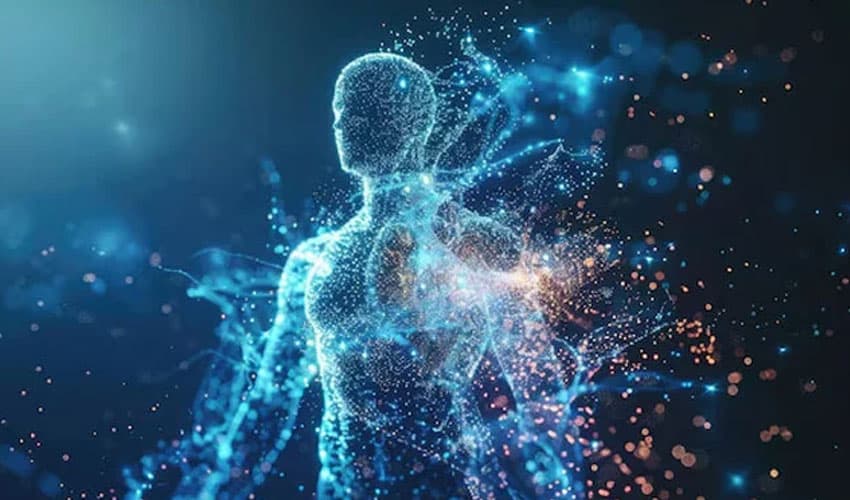
A new scientific study has revealed that the human body, like other living organisms, emits a faint glow during life which disappears at the time of death.
The research, published in The Journal of Physical Chemistry Letters, highlights a phenomenon known as ultraweak photon emission (UPE), also called biophoton emission.
Biophotons are faint particles of light emitted by living cells, believed to be a by-product of metabolic processes involving reactive oxygen species (ROS). These light particles fall within a wavelength range of 200 to 1,000 nanometers, making them invisible to the naked eye and detectable only with specialized equipment such as electron multiplying charge-coupled device (EMCCD) cameras.
Research methodology
The study was conducted by researchers from the University of Calgary and the National Research Council of Canada.
-
Mice Experiment: Four mice were placed in a dark box and photographed for an hour while alive, followed by another round of imaging after death. Results showed a clear decrease in biophoton emission post-mortem.
-
Plant Study: The researchers also studied leaves from thale cress (Arabidopsis thaliana) and dwarf umbrella tree (Heptapleurum arboricola). Over a 16-hour period, healthy leaves emitted more biophotons than damaged leaves, further linking photon emission to biological vitality.
Why it matters
Scientists suggest that understanding biophoton emissions could provide insights into cellular health, stress responses, and the processes that occur during the transition from life to death. The study opens new avenues for exploring how light at the microscopic level reflects the state of living organisms.