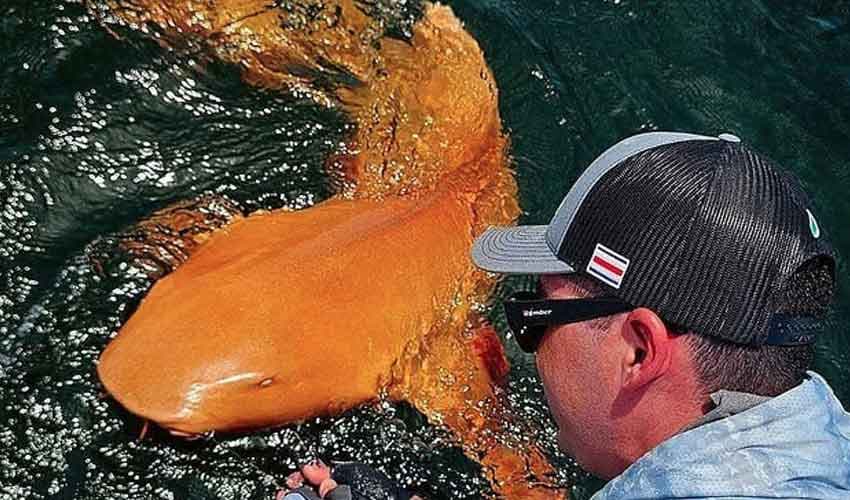
A nurse shark displaying an unusual bright orange hue due to a rare pigmentation disorder has been caught off the coast of Costa Rica, sparking scientific interest across the marine biology community.
The shark, which measured over six feet in length, was caught during a sport fishing expedition near Tortuguero National Park, at a depth of 37 metres. Its striking colour sharply contrasted with the species’ typical brown skin.
Researchers have identified the pigmentation as xanthism, also known as xanthochroism—a rare genetic condition marked by the absence of red pigmentation and an overproduction of yellow or golden tones in the skin. This marks the first documented case of xanthism in cartilaginous fish—including sharks, rays and skates—in the Caribbean region, according to a study by the Federal University of Rio Grande.
The shark also exhibited traits consistent with albinism, most notably a pair of white eyes, further increasing its visibility in the wild. Typically, nurse sharks rely on their brown colouring to blend into the seabed. Bright orange pigmentation or white eyes may heighten exposure to predators.
Nurse sharks differ from most shark species by using a specialised buccal pump, which enables them to draw water over their gills and breathe without swimming.
Although some researchers claim that xanthism may reduce survival rates in affected animals, this specimen appears to challenge that assumption, having reached adulthood despite its condition. Its capture has raised further questions about the genetic composition of local nurse shark populations.
While genetic mutation remains the primary explanation for xanthism, other influences—such as diet—may also affect pigmentation. Researchers have called for further studies to explore possible genetic and environmental factors behind the anomaly.
Xanthism remains exceedingly rare in the animal kingdom, with recorded cases limited to a small number of fish, birds and reptiles. In freshwater environments, it has produced bright yellow variants in fish. Birds such as parrots and canaries have shown golden feathers, while isolated cases of yellow-coloured snakes and lizards have also emerged.