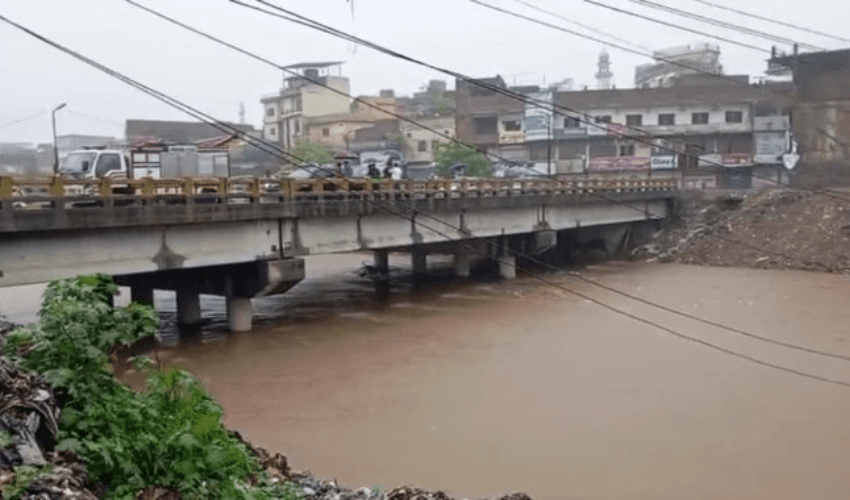
A relentless spell of heavy monsoon rains lasting over 16 hours wreaked havoc in the twin cities, leaving behind a trail of destruction, flooding, and tragedy.
Streets turned into rivers, low-lying neighbourhoods were submerged, and several lives were lost to the floodwaters, triggering a full-scale emergency response by the administration and armed forces.
Rawalpindi underwater: Nullah Leh surges to 21 feet
The water level in Nullah Leh surged to a dangerous 21 feet, prompting evacuation orders for residents in Gowalmandi and Katarian. Sirens blared, and mosque loudspeakers were used to urge families to leave immediately. However, as rainfall eased and water levels dropped to seven feet in Katarian and five feet in Gowalmandi, the evacuation orders were withdrawn, offering a sigh of relief to residents.
The monsoon rain caused widespread flooding in low-lying areas, including Morgah, Dhamial, and the cantonment zone, with water entering homes -- some up to four feet deep. Roads collapsed, houses were damaged, and residents were seen climbing onto rooftops to save their lives.
“No government servant or rescue team came to help us. Our children haven’t eaten since morning. Everything I had is gone, only God knows our suffering,” said a labourer from Morgah in a heart-wrenching account.
Casualties mount as rain-related accidents increase
Tragedy struck in several locations:
-
A boy drowned while bathing in floodwater near Chungi No. 4. His body was later recovered.
-
An eight-year-old boy, Hassan Ali, was swept away in Bhoosa Mandi Sadar; search operations are ongoing.
-
Another man drowned in Gulshan-e-Iqbal Dhamial.
-
In Islamabad, a nine-year-old girl named Shazia slipped and fell into a storm drain near Sabzi Mandi police station. Her body was recovered after a two-hour search.
According to Rescue 1122, the overall death toll has climbed due to multiple drownings in both cities.
Chahan Dam overflows, bridge collapses
In Chakri, the Chahan Dam overflowed, releasing a strong flood stream that damaged a bridge in a private housing society and submerged adjacent villages. A car was swept away in Saham Mohalla Rajputan, but all passengers survived.
Helicopter rescues by Pakistan Army
The Pakistan Army, along with Rescue 1122, launched helicopter rescue missions in several flood-hit areas:
-
In Ladian village (Chakri), 18 people, including children, were stranded on rooftops; all were rescued after a two-hour operation.
-
In Rajar village, five people were airlifted to safety.
-
In Sawarian village on Adiala Road, 12 people were rescued after being trapped in rising water.
-
In Morgah, five people were rescued by Rescue 1122 after being stuck for over an hour.
Islamabad also battered by stormy rain
The federal capital recorded heavy rainfall and strong winds, uprooting large trees in several sectors and disrupting traffic. A section of the newly completed Tayyip Erdogan Flyover in F-8 collapsed due to soil erosion beneath the road, leading to further travel chaos.
Dozens of graves in H-11 cemetery were submerged due to lack of drainage, causing distress to residents who rushed to check on loved ones' resting places.
The Pakistan Meteorological Department (PMD) recorded 173mm of rain in Islamabad, while Gowalmandi in Rawalpindi received the highest rainfall of 230mm.
Emergency declared, schools closed
In view of the disaster, the Rawalpindi district administration declared a rain emergency and issued a one-day holiday for all schools and government institutions. All relevant agencies, including the NDMA, Pakistan Army, and Rescue 1122, were placed on high alert.
PMD and NDMA issue high flood alert
The Meteorological Department has predicted intermittent heavy rain for the next 24 to 48 hours and issued a high flood alert for Mangla Dam and the Swan River, warning that water inflow may exceed 350,000 cusecs.
The NDMA has directed provincial and local administrations to remain vigilant and ensure timely evacuations in high-risk areas.
Since June 26, monsoon rains have continued across Pakistan, bringing widespread downpours with intensity ranging from light showers to torrential rains. According to the Meteorological Department, rainfall this season has been recorded at 80% above normal levels.
The storms and resulting flash floods have claimed 116 lives and left 253 people injured nationwide. The Met Office reports that except for Sindh, most regions in the country have experienced higher-than-average rainfall.
Farooq Dar, the deputy director of the Meteorological Department, stated that the northern and central parts of Pakistan have witnessed significant rainfall increases.
"Rainfall is 22% higher in Kashmir, 142% in Balochistan, 55% in Gilgit-Baltistan, 33% in KP, and a striking 124% increase in Punjab. However, Sindh remains drier than usual," he said.
The ongoing monsoon spell is expected to last until July 17, but a new system is also poised to enter the country soon, raising fears of urban flooding in major cities.
"There is a risk of flash flooding next week in Rawalpindi, Islamabad, Kashmir, and the upper regions of Khyber Pakhtunkhwa," Farooq Dar warned.