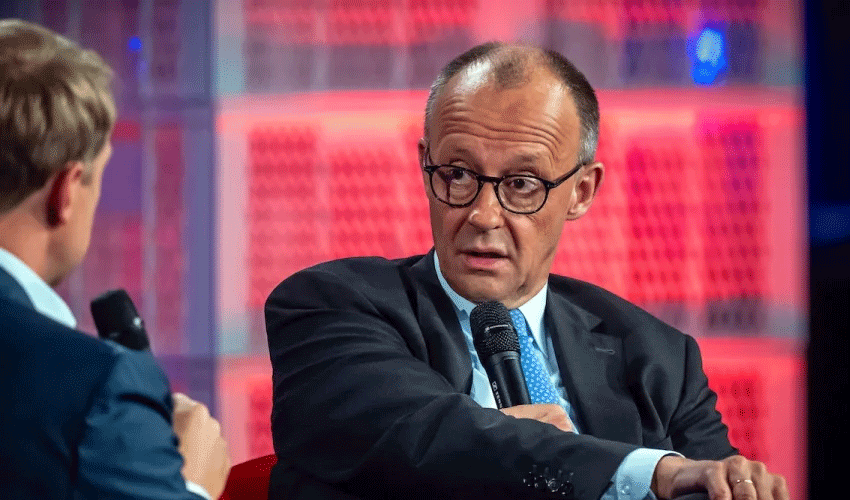
Germany issued its strongest rebuke yet of Israel’s conduct in Gaza on Tuesday, with top leaders warning of potential consequences and suggesting Berlin could halt arms exports that risk violating international humanitarian law.
In a notable departure from its longstanding pro-Israel stance, Chancellor Friedrich Merz and Foreign Minister Johann Wadephul criticised Israel’s ongoing military campaign in Gaza, calling the situation “unbearable” and urging a reassessment of Germany’s policy.
The remarks mark a significant shift in tone from a country that has historically maintained what it terms a “Staatsraeson” — a doctrine of special responsibility for Israel rooted in the legacy of the Holocaust.
Speaking to Germany’s WDR broadcaster, Foreign Minister Wadephul said Berlin’s support for Israel “must not be instrumentalised,” referring to the massive air strikes and dire shortages of food and medicine in Gaza. “We are now at a point where we have to think very carefully about what further steps to take,” he said.
He warned that while no new weapons deliveries are under consideration at present, Germany would “certainly not supply weapons so that there will be further harm.”
Earlier in the day, Chancellor Merz, speaking in Turku, Finland, described Israel’s current military operations as “no longer comprehensible,” stating they appeared detached from the original goal of combating Hamas.
“The massive military strikes by the Israelis in the Gaza Strip no longer reveal any logic to me – how they serve the goal of confronting terror,” Merz said, in his most pointed criticism to date.
While he stopped short of announcing concrete measures, the chancellor’s remarks suggest a possible policy recalibration is underway. He is expected to speak with Israeli Prime Minister Benjamin Netanyahu later this week.
The public shift comes amid growing domestic pressure. Members of the Social Democratic Party (SPD), part of the ruling coalition, have demanded an arms embargo on Israel, arguing that continued weapons sales risk implicating Germany in potential war crimes.
In parallel, public sentiment appears to be moving in the same direction. A recent Civey poll published in Tagesspiegel found that 51% of Germans now oppose arms exports to Israel. Another survey by the Bertelsmann Foundation revealed that only 36% of Germans currently view Israel positively — a sharp decline from 46% in 2021.
The report also noted a divergence in perceived obligations: while just 25% of Germans believe their country bears a special responsibility towards Israel, 64% of Israelis believe such an obligation exists.
Germany’s move comes as the European Union reassesses its Israel policy, and as other Western powers, including Britain, France, and Canada, threaten “concrete actions” over the worsening situation in Gaza.
A U.N.-backed monitor has warned that Gaza’s 2.3 million residents face growing levels of hunger and potential famine. Despite renewed efforts to broker a ceasefire, talks in Doha have yet to yield a breakthrough since a short-lived truce collapsed in March.
Israel’s ambassador to Berlin, Ron Prosor, acknowledged the shift in tone but called for continued dialogue. “When Friedrich Merz raises this criticism of Israel, we listen very carefully because he is a friend,” Prosor told the ZDF broadcaster.
The diplomatic unease is particularly striking given Merz’s previous support for Netanyahu. Following his electoral win in February, Merz had promised to host the Israeli premier in Germany despite an outstanding arrest warrant issued by the International Criminal Court (ICC).
A photograph of Zikim beach — the site of Hamas’s seaborne infiltration on October 7, 2023 — still hangs in Merz’s office, symbolising his emotional connection to the conflict. The Hamas attack claimed around 1,200 Israeli lives, sparking Israel’s ongoing military campaign in Gaza.
While Germany has not announced any formal suspension of arms exports, the statements from Merz and Wadephul indicate that such a step is under consideration — a move that would mark a dramatic pivot in Berlin’s foreign policy.




.jpg&w=256&q=75 "PML-N wins 9, PPP secures 4 seats in first phase of AJK elections")