




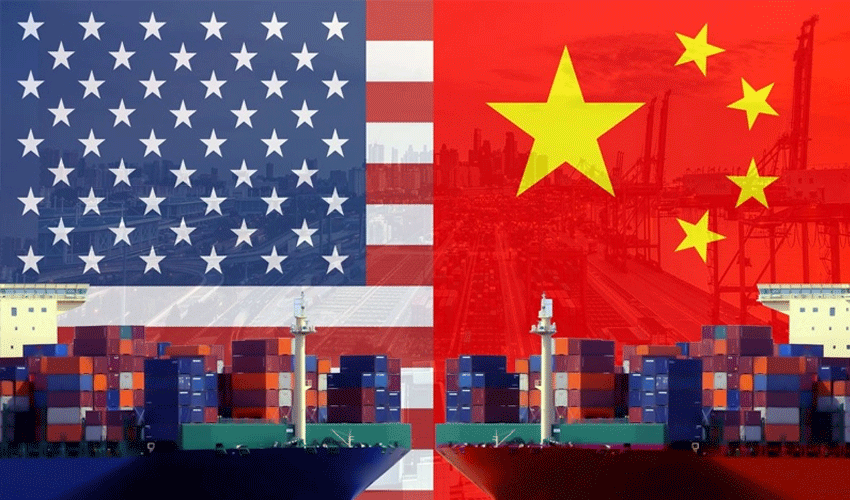
Global equity markets rallied on Monday after the United States and China agreed to a temporary truce in their protracted trade war, slashing steep tariffs for a period of 90 days. The pause, while celebrated by investors, left key structural disputes unresolved, fuelling caution among businesses and analysts.
Under the deal finalised during weekend talks in Geneva, the US will reduce tariffs on Chinese imports from 145 per cent to 30 per cent, while China will scale back its duties from 125 per cent to 10 per cent. The agreement, brokered by US Treasury Secretary Scott Bessent and his Chinese counterparts, marks a significant—but temporary—de-escalation in a conflict that had frozen nearly $600 billion in bilateral trade and shaken global markets.
Wall Street responded with a strong rally. The S&P 500 closed at its highest since March 3, and the Nasdaq Composite reached levels not seen since late February. The US dollar firmed on the news, while safe-haven gold prices fell, reflecting a sigh of relief among investors.
However, analysts warned the deal merely buys time rather than resolving fundamental rifts over trade imbalances, intellectual property protections, and market access.
Underlying issues unresolved
President Donald Trump, who has long accused China of unfair trade practices and contributing to the US fentanyl crisis, hailed the agreement as a "win-win" for both countries.
“They've agreed to open China—fully open China,” Trump said during a briefing at the White House. “I think it’s going to be fantastic for both countries and great for peace.”
Despite the optimistic rhetoric, senior US officials acknowledged the limited scope of the agreement. “It will take years to reset Washington’s trade relationship with Beijing,” Treasury Secretary Bessent said in post-talks remarks. He added that the 90-day pause is meant to facilitate further negotiations without escalating the trade war further.
China’s state media also appeared to soften its stance. “Economic and trade cooperation between China and the US has a deep foundation, great potential, and broad space,” Chinese broadcaster CCTV noted, contrasting with its earlier confrontational tone.
Impact on business and consumers
The business community, while cautiously welcoming the pause, expressed a need for clearer policy direction. Retailers, manufacturers, and logistics providers remain wary of long-term planning under an unpredictable tariff regime.
Gene Seroka, Executive Director of the Port of Los Angeles—the busiest in the US and a key hub for Chinese imports—said retailers may adopt a “wait-and-see” approach.
“Thirty per cent tariffs are still significant,” Seroka said. “Retailers might avoid large-scale restocking until more certainty is achieved.”
Similarly, Mike Abt, co-president of Abt Electronics in Chicago, noted that his company had stockpiled inventory in anticipation of tariff hikes. “Everyone wants consistency, and that’s been the hard part of this whole thing,” he said. “It’s so fluid—like a game of Risk.”
Shipping industry leaders indicated that some businesses may restart shipments during the 90-day reprieve, but many would refrain from expanding orders until a more durable agreement is reached.
Political context
The tariff rollback also has implications for the 2024 US presidential race. Trump, who is seeking re-election on a platform of reviving US manufacturing and confronting China, has drawn both praise and criticism for his confrontational trade stance.
The administration’s hardline approach has resonated with blue-collar voters in key battleground states such as Michigan and Pennsylvania, where manufacturing job losses have long been a political flashpoint.
However, Trump's on-and-off tariff strategy has rattled markets and alarmed small businesses. Critics argue that the costs of tariffs are ultimately borne by American consumers, with prices of goods ranging from electronics to household items climbing steadily.
Scott Kennedy, a trade expert at the Center for Strategic and International Studies, said the truce represented a tactical retreat. “This is 100 per cent a retreat by the US, not a Chinese cave,” he said. “The US launched and escalated the trade war, and is now the one stepping back.”
Former Trump trade adviser Kelly Ann Shaw defended the move, stating the president was simply fulfilling campaign promises. “This is about resolving disparities in the trading relationship,” she said, though she admitted that 90 days was insufficient to address complex issues such as Chinese subsidies and non-tariff barriers.
Next steps
The Geneva agreement also saw China commit to lifting post-April 2 export countermeasures, including restrictions on rare earth minerals and magnets critical to high-tech manufacturing.
The White House confirmed that further talks were expected, though no date has been set. “The consensus from both delegations this weekend is that neither side wants a decoupling,” Secretary Bessent said. “We want more balanced trade, and both sides are committed to achieving that.”
Despite the fanfare, major sticking points—including legacy tariffs imposed under both Trump and former president Joe Biden—remain in place. Tariffs of 100 per cent on electric vehicles and 50 per cent on solar products continue to affect US-China trade flows.