
As Pakistan’s job market evolves, certain university degrees are becoming more employable than others.
While technology-focused programs remain in demand, a growing number of experts are raising red flags about a mismatch between higher education and the needs of the labor market , especially by 2026, when skills demand is expected to intensify.
According to the World Bank’s Pakistan Skills Assessment for Economic Growth, programming skills remain among the most in-demand across the formal sector, with software and app development cited as critical shortage areas.
This suggests that Computer Science (CS) and IT degrees will continue to be highly relevant for Pakistani graduates.
However, the picture isn’t all rosy: the State Bank of Pakistan revealed that only 10% of IT graduates are actually employable for export-facing or high-skill roles.
Similarly, a PASHA Skills Survey (2025) found that just 18.3% of IT or CS graduates landed jobs with PASHA-member companies, exposing a major gap between academic output and real job opportunities.
Rise of skills-based training
Meanwhile, Pakistan is also witnessing a shift away from conventional four‑year university degrees in some fields. Several reports showed this has led to a drop in university admissions, as more students and parents question the value of theoretical degrees.
In its wake, skill-based learning , short courses, vocational training, and technical education , is gaining traction.
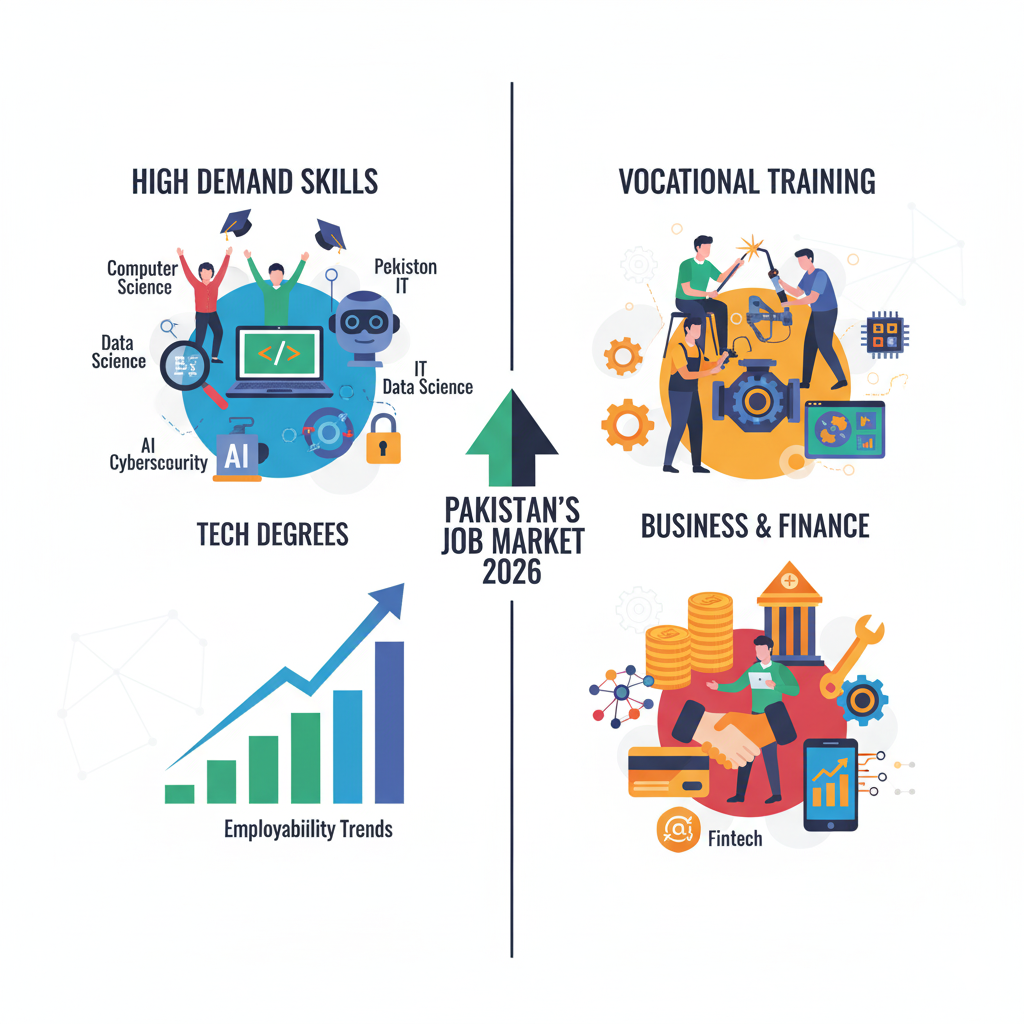
Supporting this, Skilling Pakistan’s national data indicates that demand for vocational trades (NVQF-level jobs) is growing rapidly , with projected demand of over 800,000 jobs in 2025‑2026 in skilled trades.
This signals that vocational education could be an important pathway for students looking for employable skills by 2026.
Business & finance degrees
While in countries like India, MBA employability has reportedly dipped, the situation in Pakistan is more nuanced. Experts say traditional business degrees remain relevant, but many business school graduates face fierce competition without complementary tech or digital skills.
According to PEDIASTAN, degrees like Accounting & Finance, or FinTech, are increasingly attractive because of Pakistan’s growing digital-economy and fintech sector.
Yet, as some critics argue in Pakistani business commentary, colleges and universities often lag behind the rapidly evolving needs of employers.
Emerging fields: Data Science, AI & Cybersecurity
LinkedIn analysts and career experts in Pakistan highlight data science, AI / machine learning, and cybersecurity as some of the most in-demand skills.
Given this trend, degrees (or certifications) in Data Science, AI, Cybersecurity, or similar tech‑specialized areas may see significantly higher employability by 2026.
Why the skills crisis persists
-
Mismatch Between Curriculum and Industry: According to the British Council’s 2024 report, many Pakistani universities emphasize theoretical foundations, while industry needs change rapidly , leaving many graduates underprepared.
-
Soft Skills Are Lacking: The World Bank report also cites a deficit in socio-behavioral skills such as communication, problem-solving, and adaptability.
-
Underemployment & Graduate Frustration: Research shows that around 31% of university graduates remain unemployed or underemployed within six months of graduation.