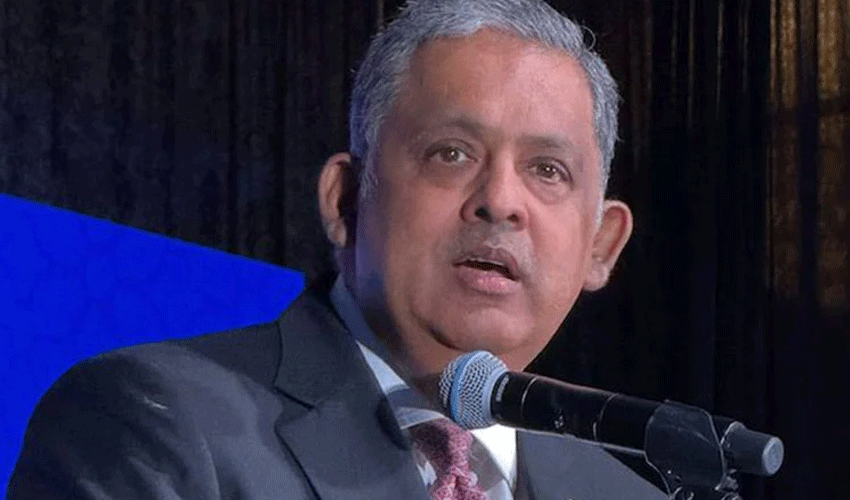
Pakistan’s Ambassador to the United States Rizwan Saeed Sheikh has warned that India’s expansionist agenda poses a serious threat to global peace and stability, while reiterating that the unresolved Kashmir dispute remains the single greatest impediment to lasting peace in South Asia.
In an interaction with senior scholars and policy analysts at leading US think tanks, Ambassador Sheikh stressed that the “unabated Indian stubbornness” and “consistent deviation from United Nations resolutions” are the primary hurdles in resolving the longstanding Kashmir issue.
Highlighting recent developments, Mr Sheikh pointed to the presentation of the controversial ‘Akhand Bharat’ map in the Indian parliament as a “clear manifestation of New Delhi’s expansionist designs.” He warned that such gestures are not only detrimental to regional harmony but also carry dangerous implications for global peace.
“The Akhand Bharat map is not just a political provocation; it is an alarm bell that underscores India’s hegemonic ambitions,” the ambassador remarked. He further asserted that UN Security Council resolutions on Kashmir remain valid and binding. “There is no expiry date on international law. These resolutions are as relevant today as they were seventy years ago,” he said.
Mr Sheikh criticised India’s 2019 move to revoke Article 370 of its constitution, calling it a direct violation of UN Security Council Resolution 122, which obligates parties to refrain from altering the status of Jammu and Kashmir through unilateral actions.
The ambassador further noted that Pakistan had maintained a responsible posture during recent escalations with India, particularly during tensions in May 2025. Despite provocations and mounting public pressure, Pakistan chose not to target civilian populations in response to Indian aggression. “This patience, however, must not be misunderstood as weakness,” he warned. “Pakistan reserves the right to respond with full force to any future misadventure to dismantle India’s so-called ‘new normal’ doctrine.”
On strategic stability, Mr Sheikh maintained that Pakistan’s nuclear capability had played a pivotal role in deterring large-scale conflict in the region. He stressed that this strategic balance was critical in maintaining peace in South Asia.
He also acknowledged the constructive role played by the United States in de-escalating tensions between the two nuclear-armed neighbours. He referenced former President Donald Trump’s calls for peace and regional trade during his Middle East visit, expressing hope that Washington would continue to support dialogue and progress on all unresolved bilateral matters.
“The US has a key role in ensuring the sustainability of the ceasefire agreement and facilitating discussions on core issues, including Kashmir, terrorism, and the Indus Waters Treaty,” Mr Sheikh added.
Turning to India’s alleged involvement in extraterritorial operations, the Pakistani envoy expressed deep concern over reported assassinations and other unlawful activities attributed to Indian agencies in countries such as the US and Canada. “These acts, if proven, are serious violations of international law and demand the attention and accountability of the global community,” he said.
Commenting on the broader regional context, Mr Sheikh reiterated Pakistan’s longstanding position that peace in Afghanistan was vital not just for Islamabad but for the economic connectivity and integration of the entire region with Central Asia.
“Pakistan remains the country most affected by instability in Afghanistan,” he said, adding that durable peace there would unlock immense economic potential across the region.