





Inter-Services Public Relations (ISPR) Director General Lieutenant General Ahmed Sharif Chaudhry Sunday announced that Pakistan's armed forces have fulfilled their commitment to the nation in response to recent Indian aggression by launching operation Banyan-um-Marsoos.
ISPR DG highlighted that on May 6 and 7 Indian missile strikes resulted in the tragic deaths of innocent Pakistani civilians including women and children.
In retaliation, Pakistan initiated Operation Banyan-um-Marsoos, targeting 26 Indian military sites, causing significant damage to Indian military infrastructure.
ISPR DG — Pakistan Army spokesperson — said Pakistan Army launched Fateh F1 and F2 missiles on the enemy (India) in Occupied Jammu Kashmir and India’s mainland including Avantipora, Ambala, Pathankot, Suratgarh, Sirsa, Barnala, and Srinagar.
He also expressed deep condolences to the families of the victims affected by the Indian strikes.
The Director General further detailed that India's attacks targeted three Pakistani airbases: Nur Khan, Shorkot, and Murid. However, due to Pakistan's robust air defense systems, the majority of the missiles were intercepted, and no significant damage was reported to the Pakistan Air Force's assets.
In addition to the military response, General Chaudhry accused India of escalating regional tensions by launching missiles into Afghanistan and conducting drone attacks, actions he described as pushing the region towards a broader conflict.
The press conference also addressed India's internal issues, with General Chaudhry alleging that India's actions were attempts to divert attention from its internal crises and to destabilize the region further. He reaffirmed Pakistan's commitment to peace but warned against continued provocations.
General Chaudhry emphasized the role of Pakistani youth in countering misinformation during this period, stating that they played a pivotal role in the information warfare landscape.
Air Vice Marshal Aurangzeb: PAF score 6-Nil
Air Vice Marshal Aurangzeb, during his briefing, expressed gratitude to Allah for the excellent performance of the Pakistan Air Force (PAF). He stated that the PAF remained fully prepared for both peace and war. He acknowledged that the Air Chief’s instructions were followed, and Pakistan exercised its right to self-defense, targeting the aggressors who attacked Pakistan.

He added that Pakistan’s air defense operations tracked all Indian drones and missiles. The drones were jammed, and the distribution of data was halted. The PAF adopted a "soft and hard kill" policy, where hard kills were only carried out in areas where civilians were not present.
He highlighted that the PAF utilized its operational capabilities in the air, identifying and destroying all drones. Alongside drones, BrahMos missiles were also shot down, which were part of an assault on Pakistan's sovereignty. He also mentioned that Indian missiles launched in Amritsar were targeting civilians within Indian territory, while Pakistan’s hypersonic missiles, drones, and other missiles successfully hit their targets.
Vice Admiral Rab Nawaz: Pakistan Navy foils India’s INS Vikrant ambitions
During the briefing, Navy officer Vice Admiral Rab Nawaz said Pakistan Navy remained successful in defending its maritime borders. He emphasized that the Navy was fully prepared for any aggression from the sea side, maintaining continuous 24-hour surveillance of Pakistan’s maritime boundaries.
Vice Admiral Rab Nawaz mentioned that 8 to 12 MiG aircraft were stationed on the Indian aircraft carrier.
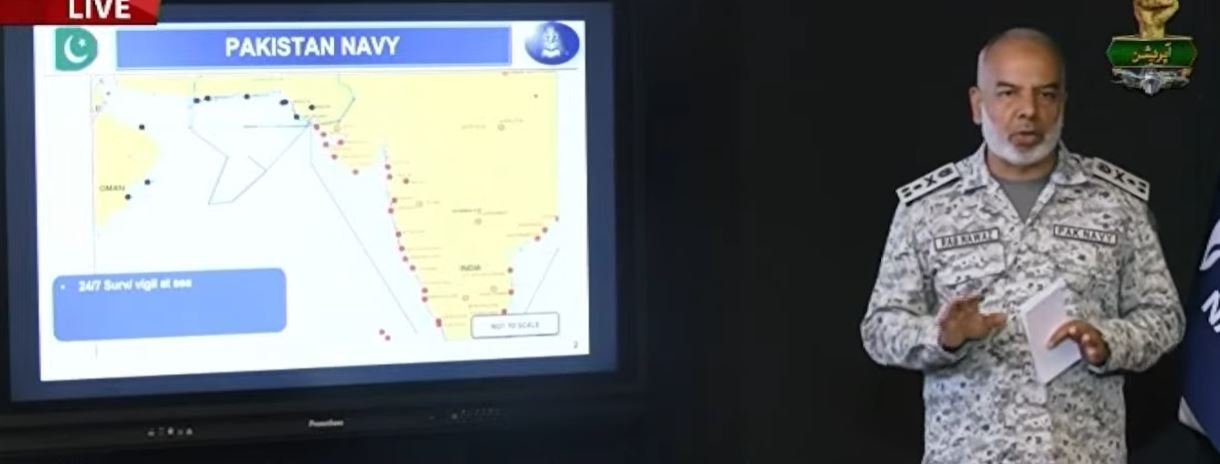
After the attacks on May 6th and 7th, Pakistan was fully prepared. He added that after the attack by the Indian Vikrant, it was pushed beyond our territorial boundaries, but it remained within our target range. The Navy, along with the Air Force, had been monitoring the Vikrant closely.
He said: "On the night of May 6 and 7, it was close to Bombay and on May 9, it was essentially 400 nautical miles from the Pakistani coast and it retreated close to Bombay,” Vice Admiral Nawaz said.
“If a carrier gets within 400 nautical miles, it simplifies our problem. The Navy maritime air arm was proper ready to generate a response at all times and I was in contact with Deputy Chief of Air Staff Aurangzeb at all times. If there was any aggression from the sea we were ready to respond effectively," Vice Admiral Rab Nawaz said.
Vice Admiral Rab Nawaz told national and international media: “As a pro military officer, I don’t want to underestimate the enemy, but let’s put some things in perspective. The Vikrant sails with 8-12 MiG-29s — barely essential to carry out its own air defence.”
“So the enemy fully understood the cost they would have to pay for venturing from the sea, and so they didn’t,” he added.