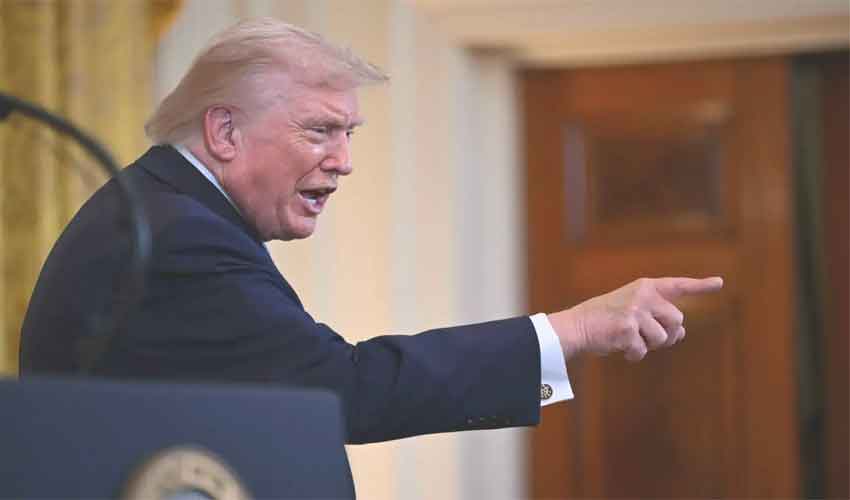






A high-stakes meeting between US President Donald Trump and South African President Cyril Ramaphosa descended into tension on Wednesday after Trump confronted his counterpart with debunked claims of white genocide and farm seizures in South Africa.
During the carefully choreographed Oval Office meeting, President Trump presented a video and a series of printed news clippings purporting to show violence against white South African farmers. The video — played on a television temporarily installed in the Oval Office — showed white crosses and clips of opposition leaders making provocative remarks. Trump described the footage as proof of a campaign of violence against the white minority in South Africa.
However, the crosses shown in the video, produced during a protest in 2020, did not mark actual graves. Protest organisers at the time clarified that they symbolised farmers killed over several decades and were not recent casualties.
Despite the confrontational tone, President Ramaphosa maintained a composed demeanour, watching the video in silence and responding diplomatically. "These are concerns we are willing to talk to you about," he told Trump. "There is crime in South Africa, yes. But the majority of victims are Black."
The meeting came as South Africa sought to reset its strained ties with Washington following a series of decisions by Trump, including the cancellation of aid, the expulsion of South Africa’s ambassador, and vocal criticism of Pretoria’s genocide case against Israel at the International Court of Justice.
Ramaphosa, who brought popular white South African golfers as part of his delegation in a gesture of goodwill, had hoped to steer discussions toward trade. The United States is South Africa’s second-largest trading partner, and Pretoria is facing the possibility of a 30 percent tariff under suspended US import taxes.
But Trump, echoing a conspiracy theory popular in far-right circles and amplified by his South African-born ally Elon Musk — who was also present — accused South Africa of persecuting white farmers. “People are fleeing South Africa for their own safety. Their land is being confiscated, and in many cases, they're being killed,” Trump said, flipping through newspaper clippings and repeating the word "death" as he did so.
South African authorities have firmly rejected such claims. While South Africa does suffer from high levels of violent crime — police recorded 26,232 murders in 2024 — only 44 were linked to farming communities, with eight victims identified as farmers. The overwhelming majority of homicide victims in the country are Black.
The government has introduced a new land reform law that allows for expropriation without compensation in the public interest — such as in cases where land lies unused — but no such seizures have occurred, and all actions are subject to judicial review.
Ramaphosa cited the example of Nelson Mandela and his legacy of reconciliation but did not sway the US president. “Apartheid, terrible,” Trump acknowledged. “This is sort of the opposite of apartheid.”
The meeting drew comparisons to Trump’s ambush-style engagement with Ukrainian President Volodymyr Zelenskiy three months earlier. In contrast to Zelenskiy, who left the meeting early after verbal sparring, Ramaphosa remained calm and even complimented the Oval Office’s gold decor. He also noted his upcoming G20 presidency, but Trump declined to confirm whether he would attend the G20 summit scheduled for November in South Africa.
South African business magnate Johann Rupert, also present at the meeting, stepped in to reinforce Ramaphosa’s stance. “Crime is a problem across the board,” Rupert said, noting that many Black South Africans were also victims of violence.
Speaking to reporters after the meeting, Ramaphosa downplayed the confrontation, choosing instead to focus on areas of agreement. He said both countries had agreed to discuss critical minerals cooperation, while his trade minister announced a proposal to import liquefied natural gas from the US.
But the South African president was unequivocal in dismissing the central allegation put forth during the meeting. “There is just no genocide in South Africa,” Ramaphosa told journalists, firmly rejecting the narrative promoted by Trump and his supporters.