




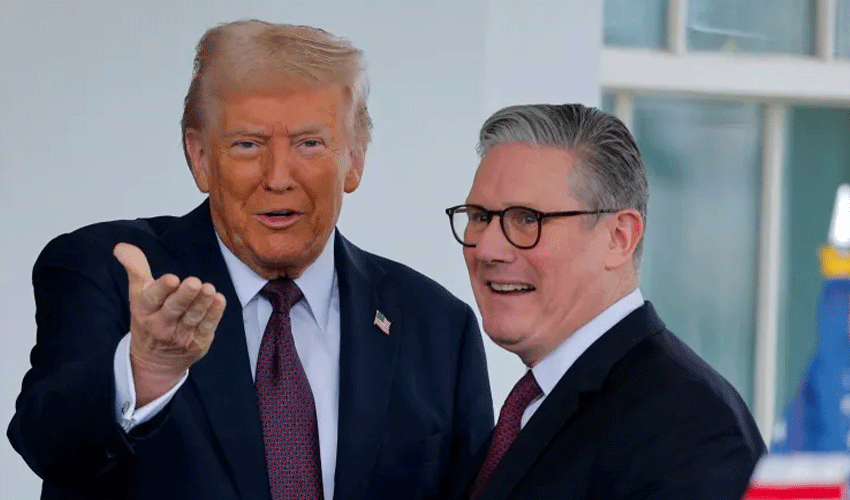
The United Kingdom and the United States on Thursday announced a new trade agreement that will see the partial rollback of tariffs imposed by President Donald Trump since his return to the White House earlier this year, offering relief to several key British industries.
Under the arrangement, the US will lower the controversial 25 percent import tax on British-made cars to 10 per cent for up to 100,000 vehicles annually.
The agreement also includes revised quotas for tariff-free UK steel and aluminium exports to the US and allows for expanded agricultural trade between the two allies.
No formal treaty was signed, and both governments offered only limited information. However, the move was hailed by British Prime Minister Sir Keir Starmer as a “fantastic platform” for future cooperation.
Speaking at a Jaguar Land Rover facility in the West Midlands, Starmer said the deal protects “thousands of British jobs in key sectors including car manufacturing and steel,” adding that the UK has “no greater ally than the United States”.
In Washington, President Trump characterised the accord as a “great deal”, defending it against criticism that it falls short of meaningful change. “This is a maxed-out deal that we're going to make bigger,” he said.
Tariff relief, with limits
The US had raised car tariffs to 25 per cent last month — a move that risked hitting British luxury carmakers such as Jaguar Land Rover and Rolls Royce hard.
The new agreement lowers that tariff to 10 per cent but imposes a cap of 100,000 vehicles per year — roughly equivalent to the UK’s current export volume to the US, limiting potential future growth.
British Business Secretary Jonathan Reynolds said the UK had narrowly avoided significant job losses. “This was very serious,” he told the BBC. “It would have meant people would have lost their jobs without this breakthrough.”
Tariffs on steel and aluminium, which were also raised to 25 per cent earlier this year, will now be managed under quotas, reinstating a system similar to what existed prior to Trump’s latest tariff hikes.
In agriculture, the two countries agreed to allow up to 13,000 metric tonnes of beef to be imported tariff-free each year — a notable expansion from previous limits. The US Trade Representative’s office said this would significantly boost US beef sales to the UK, which had previously faced a 20 per cent tariff and a cap of just 1,000 tonnes.
According to the US, the changes will unlock a $5 billion opportunity for American exports, including $700 million in ethanol and $250 million in other agricultural goods.
US Agriculture Secretary Brooke Rollins said the deal marked “a major milestone for US farmers and ranchers.”
Mixed response
While the agreement drew praise from UK Steel Director General Gareth Stace, who described it as “major relief” for the sector, business leaders offered more cautious reactions.
“It’s better than yesterday but definitely not better than five weeks ago,” said Duncan Edwards, chief executive of BritishAmerican Business, referring to the pre-tariff trade environment. “I’m trying to be excited, but I’m struggling a bit.”
Political reaction in Westminster was similarly divided. Conservative leader Kemi Badenoch denounced the agreement as one-sided, saying it left UK industries more exposed.
“This is not a historic deal with the US,” she said. “We’ve been shafted.”
Liberal Democrat leader Sir Ed Davey demanded a parliamentary vote on the deal, warning that “the devil will be in the detail” — particularly with Trump at the helm in Washington. “Trump’s trade tariffs are still hitting key British industries, threatening livelihoods across the UK,” he added.
Nigel Farage, leader of Reform UK, welcomed the announcement as a “step in the right direction” and called it a “Brexit benefit”. “The important point is that we are doing stuff, we are making a move,” he told the BBC.
Unresolved issues
The deal does not appear to have resolved long-standing disagreements over pharmaceutical trade or food standards. The US has previously pushed for broader market access for American-made drugs and changes in UK food safety laws — both politically sensitive issues.
The UK government said there would be no weakening of food safety standards and noted that British firms would receive “preferential treatment” in future pharmaceutical procurements. However, Ewan Townsend, a trade lawyer at Arnold & Porter, said the healthcare industry was “still waiting to see exactly what this preferential treatment will mean”.
Michael Pearce, deputy chief economist at Oxford Economics, said the agreement was unlikely to have a significant economic impact. “We’re not making any changes to our forecasts as a result of this announcement,” he said.
Trade talks between the two countries had previously stalled during Trump’s first term over similar sticking points. Analysts remain cautious, noting that while Thursday’s announcement may offer political reprieve, it is unlikely to constitute a substantial shift in bilateral trade relations.
“The broader issues haven’t gone away,” Pearce added. “This is more of a tactical pause than a strategic reset.”