




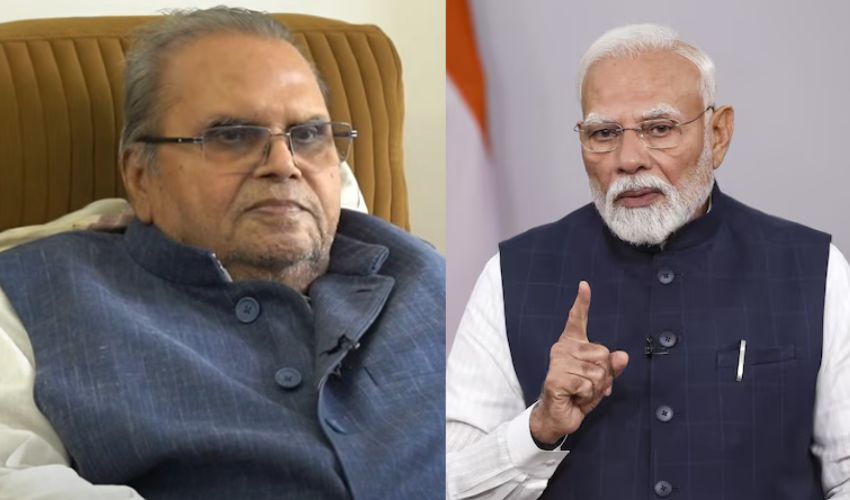
In a hard-hitting interview with The Wire’s Karan Thapar, former Governor of Occupied Jammu and Kashmir Satyapal Malik launched a blistering attack on the Modi government, calling its handling of the recent terrorist attack in Pahalgam "shameless," "incompetent," and riddled with "security lapses."
Speaking exactly two weeks after the attack, Malik said the government had prior intelligence about the threat but failed to take preventive action. "There was not a single soldier present in one of the most popular spots in Kashmir," he said, pointing to the presence of nearly 2,000 people in the area without security. Malik confirmed that intelligence inputs had specifically warned about a possible assault on a tourist location, but the administration took no substantial steps.
Malik directly blamed Prime Minister Narendra Modi and Home Minister Amit Shah for the lapses, stating: "The Prime Minister should have attended the all-party meeting. He should have apologized to the nation himself." He added that Amit Shah, despite being in Kashmir days before the attack, did not ensure adequate preparedness. “These meetings are just for gossip and lunch,” he said dismissively.
The former governor was also sharply critical of post-attack actions, including the demolition of nine houses on mere suspicion and the arrest of nearly 2,000 people without evidence. Calling it a violation of Supreme Court rulings, Malik said: "You can’t demolish homes or detain people on suspicion alone. It’s not justice; it’s cruelty."
When asked about growing hostility toward Kashmiris and Muslims elsewhere in the country following the attack, Malik said: “The government's rhetoric and media narrative are fuelling anti-Muslim sentiment. The silence of Delhi is criminal.” He condemned Hindu Sena leader Vishnu Gupta’s hate-filled statements calling for a boycott of Kashmiris, labeling it “communal and dangerous,” and demanded government action, which he said was unlikely given their political interests.
Malik also reiterated that security in Kashmir is controlled directly by Delhi and not the Lieutenant Governor, adding that real accountability lies in the capital. “The governor should have resigned,” he said, “but they won’t remove him because he’s their protective wall.”
Satyapal Malik’s interview comes at a time of rising political tension and widespread concern over the Centre’s handling of security in Jammu and Kashmir. His remarks, given his tenure during the 2019 Pulwama attack, have sparked fresh debate over intelligence failures, political priorities, and civil liberties.
Former governor of the Held Valley said BJP-led Modi government politics revolved around the attempt to deepen the Hindu-Muslim divide, with the interviewee stating that “the government was born out of the Hindu-Muslim divide and seeks to maintain and widen it.”
The speaker highlighted that, contrary to the national media’s narrative, the Kashmiri people showed remarkable unity and humanity during the crisis—opening mosques for stranded tourists and offering free transport to help them reach safety.
The interviewee criticized mainstream television channels and newspapers for failing to adequately report on this compassionate response by ordinary Kashmiris, suggesting a deliberate attempt to distort the narrative.
A significant part of the conversation centered on the Prime Minister's silence regarding the Kashmiri people’s generosity and bravery. “He didn’t have the heart to praise Kashmiri Muslims,” the Satya Pal Malik remarked, interpreting the silence as part of a broader strategy to marginalize Muslim contributions.
Referencing a 1947 letter by Jawaharlal Nehru, the Satya Pal Malik urged the government to adopt a civilized and inclusive approach toward minorities, rather than benefiting from fear-mongering and communal polarization.
Satya Pal Malik criticized the use of military posturing, siren drills, and blackout rehearsals to instill fear. “This is just psychological warfare to mobilize the Hindu vote bank,” he claimed.
In the latter part of the interview, Satya Pal Malik revealed personal allegations of harassment, including CBI raids and phone seizures, following his refusal to compromise on corruption-related cases. Despite this, he maintained that he had no fear and would continue to speak out.