




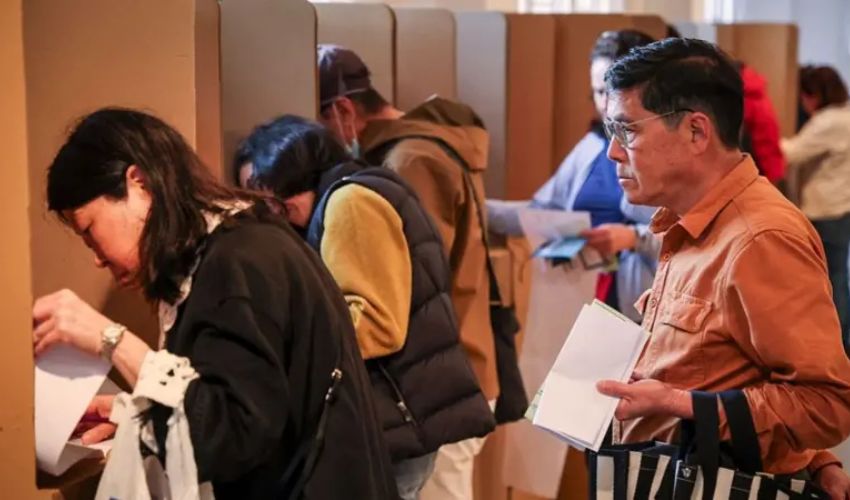
More than 18 million Australians are casting their votes today to determine who will lead the country as its next prime minister.
Incumbent Prime Minister Anthony Albanese of the center-left Australian Labor Party is seeking re-election, facing a strong challenge from Peter Dutton, leader of the conservative Liberal-National Coalition.
The cost of living has emerged as the defining issue of this election, with voters also expressing growing concern over the affordability of healthcare and housing.
Although official results may take days—or even weeks—to finalize, the Australian Electoral Commission will begin releasing preliminary results as soon as polls close. Historically, these early numbers provide a strong indication of which party will form the next government.
When Albanese called the election five weeks ago, many believed he faced an uphill battle. Some even asked whether he was under an “incumbency curse”—a global trend of voters ousting governments after a single term amid tough economic times. But political strategists now say that narrative has flipped. Rising international instability, they argue, has led many voters to favor continuity over change.
That shift has left the Liberal-National Coalition facing a more difficult path. Although opposition leader Peter Dutton appeared to be gaining momentum early in the campaign, a recent YouGov poll shows his party on track for its worst result since 1946. The Coalition has disputed those figures, saying its internal data shows stronger support, but current polling suggests Labor is now in a commanding position.
Who is Peter Dutton?
Peter Dutton has built his political career on a tough-on-crime and conservative platform, often drawing both praise and criticism. A former police officer, Dutton entered Parliament in 2002, pledging to represent the “forgotten people” of Australia. He vowed to push back against what he described as an “over-tolerant” society and a “boisterous minority.”
Now 54, Dutton has remained committed to those views throughout his political rise. His no-nonsense, often combative rhetoric has made him one of the most polarising figures in Australian politics. His campaign has focused heavily on law and order, immigration, and national security—issues central to his conservative base.
Election Day Atmosphere
Despite a chilly morning in Sydney, voters in the Harbour City are out early. Streets are lined with campaign posters, and volunteers in bright party-colored shirts are on hand near polling stations.
Many Australians are turning Election Day into a social outing. One voter, for instance, planned to cast his ballot at a local surf lifesaving club before meeting friends—and enjoying the tradition of a "democracy sausage" after voting.
Polls have just opened across Australia's eastern states. Stay tuned for updates throughout the day as Australians decide their nation's future.