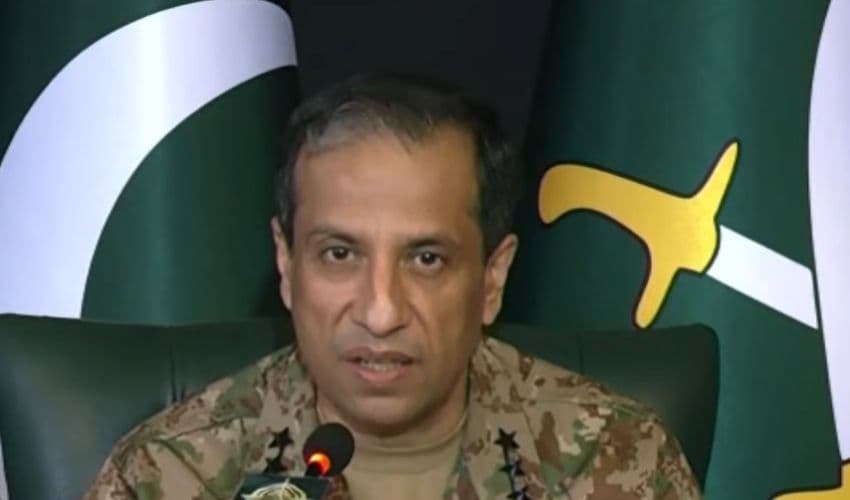
The Pakistan Army has killed 206 Afghan Taliban fighters and 112 militants belonging to the group Fitna al-Khawarij during the recent Pak-Afghan border conflict, according to the director general of Inter-Services Public Relations (ISPR).
In a detailed briefing to the media, Lt Gen Ahmed Sharif Chaudhry revealed extensive counter-terrorism operations and issued stern warnings to India over hostile designs in the region.
He claimed that Pakistan’s security forces eliminated 206 Afghan Taliban members and 112 militants linked to Fitna al-Khawarij during heightened border tensions between Pakistan and Afghanistan. Most of these operations were conducted in Balochistan, where militant activity had intensified.
He further revealed that 1,667 terrorists were killed in security operations across the country. Among them, 128 Afghan terrorists were neutralized inside Pakistan. During these operations, 584 soldiers and 356 civilians were martyred, he added.
In Khyber Pakhtunkhwa, 77 terrorists were killed, while 36 Army and Frontier Corps soldiers were martyred and 138 others injured in the province, he further revealed. Additionally, 12 civilians were martyred in Khyber Pakhtunkhwa during these operations, the DG said.
The spokesperson stated that Pakistan’s military acted swiftly in response to cross-border threats, emphasizing that the country’s borders are fully protected.
TTP a branch of Afghan Taliban, says DG ISPR
In a significant revelation, the ISPR chief claimed that the Tehreek-e-Taliban Pakistan (TTP) had pledged allegiance to the Afghan Taliban’s emir and functions as a branch of the Afghan Taliban. “TTP swore allegiance in the name of the Afghan Taliban’s leader,” the military spokesperson said, underscoring the intertwined nature of the two groups.
Highlighting the scale of counter-terrorism efforts, he reported that 62,113 operations were carried out across the country this year -- most of them in Balochistan. These operations, while successful, came at a heavy cost: 584 soldiers were martyred in the line of duty.
The spokesperson reaffirmed Pakistan’s resolve to defend its borders and eliminate all threats to national security.
'India preparing another false flag operation'
The military spokesperson also accused India of preparing another false flag operation in the deep sea, intended to malign Pakistan. “India can do whatever it wants on land, sea, and air,” he warned, adding that this time the response will be more severe than before.
He emphasized that Pakistan’s forces are fully prepared to respond decisively to any aggression from India.
The ISPR DG expressed concern that poppy growers enjoy political patronage in certain regions and that terrorists are collecting taxes in the name of Ushr to fund their activities. He called for joint national efforts to curb such practices that undermine internal stability.
"The number of madrassas was 38,000, which has now grown to over 100,000," he asserted.
Rapid response across Afghan border
Addressing operations near the Afghan frontier, the military spokesman said Pakistan’s response in Afghanistan has been swift and precise. "We tried to settle matters with Afghanistan. Pakistan has one-point agenda: Afghan soil should not be used against us," he declared.
He added, “If love for Afghanistan is awakening in your heart, then you can go there,” referring to those who sympathise with the Afghan Taliban despite their role in cross-border militancy.
"Pakistan did not allow the US to attack Afghanistan from its soil," Lt Gen Chaudhry said, rubbishing such reports as "Afghanistan's propaganda".
He said the conditions set by Afghanistan were meaningless, as ending terrorism was Pakistan’s top priority. He accused Afghan drug smugglers of interfering in Afghan politics and added that large-scale drug smuggling into Pakistan from Afghanistan continues.
He firmly stated that Pakistan will never hold talks with terrorists. The DG stressed that Pakistan’s response to the Afghan Taliban was swift and effective, producing the desired results.
Responding to questions about Pakistan’s potential participation in a Gaza peacekeeping force, the DG ISPR said the decision will be made by the government and parliament. He emphasized that Pakistan is fully independent in making its policies.
Army has no role in politics
The DG ISPR reiterated that the Pakistan Army does not want to be involved in politics and should be kept away from political affairs. He noted that political criminals and terrorist groups remain major obstacles to ending crime and smuggling in the country.
He clarified that the authority to decide on governor’s rule rests solely with the government.
He also said that intelligence-based operations in Tirah and Khyber Pakhtunkhwa are continuing successfully. However, he noted that some political forces begin raising objections whenever operations against terrorists and criminal elements take place.
He said that those political forces opposing actions against such elements are well known.
Comments on KP leadership
When asked about Chief Minister Sohail Afridi, the DG ISPR said, “Sohail Afridi is the elected chief minister of Khyber Pakhtunkhwa.” He emphasized that the Army has no personal preferences and that no individual or political party is above the state. “Elected politicians create the state, and institutions must work for the state,” he added.
The DG ISPR concluded, “I am a public servant and cannot accuse anyone. I will only say this — Sohail Afridi is the chief minister.”