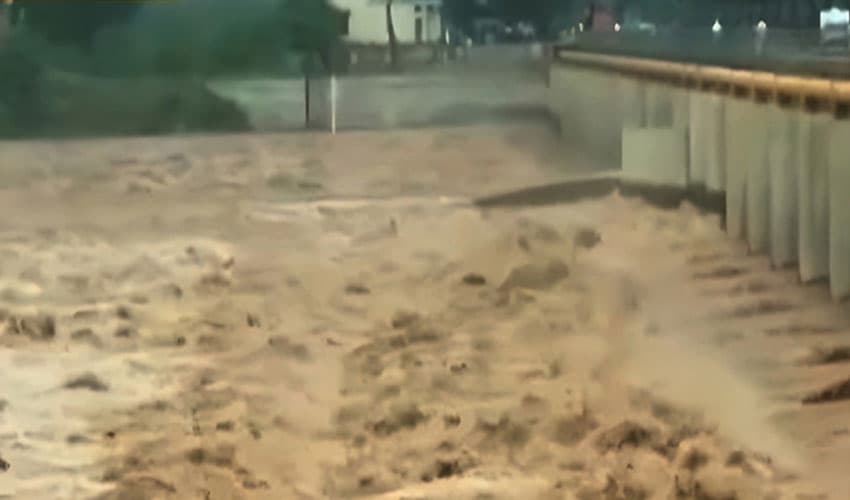
Rising water levels in the Ravi River have triggered large-scale evacuations in Lahore and surrounding districts, with officials warning of an extreme flood situation.
Announcements were made through mosques on Thursday morning, urging residents in low-lying areas to move to safer ground with their families and livestock. Section 144 has been imposed to restrict movement in the flood-hit zones.
At Shahdara, the Ravi’s water level surged to 151,000 cusecs and is expected to cross 200,000 cusecs within 12 hours, according to the Punjab Disaster Management Authority (PDMA). The river’s capacity is 250,000 cusecs, and preparations have been made to deal with further rise.
RELATED: At least 15 killed as flash flooding devastates Gujranwala division
Commissioner Lahore Asif Bilal Lodhi said evacuations from the riverbed have been completed and nearby villages are being cleared. “So far, around 500 families have been shifted to relief camps,” he confirmed.
At Jassar, the Ravi River is also in extreme flood condition with a flow of 166,000 cusecs. Downstream at Balloki, the flow stands at 82,000 cusecs and continues to rise.
Situation in Chenab and Sutlej rivers
While water pressure in the Chenab has started to ease at some points, the threat remains severe.
-
At Khanki Headworks, flow has reduced from 1.05 million cusecs to 905,000 cusecs.
-
At Qadirabad Headworks, water levels remain dangerously high at 1.05 million cusecs.
-
At Marala Headworks, flow has dropped to 246,970 cusecs but remains at high flood level.
The PDMA has warned of a possible breach at Qadirabad, which could devastate Hafizabad and Chiniot. Mines have been placed along protective embankments in Chiniot to relieve pressure if needed.
Meanwhile, the Sutlej River at Ganda Singh Wala has recorded 261,000 cusecs, putting Kasur and Okara districts on high alert. At Sulemanki, medium flood levels are being observed.
Casualties and damage so far
In Gujranwala division alone, at least 15 people have died due to flood-related incidents, including 5 in Sialkot, 4 in Gujrat, 3 in Narowal, 2 in Hafizabad, and 1 in Gujranwala. Three more remain missing.
Authorities report:
-
150,000+ people and 35,000 livestock evacuated from flood-hit areas.
-
600,000 people affected across Punjab.
-
769 villages submerged and millions of acres of farmland damaged.
According to the UN Office for the Coordination of Humanitarian Affairs (UNOCHA), deaths during this year’s monsoon are nearly three times higher than last year.
Kartarpur Gurdwara submerged
In Narowal, floodwaters entered the historic Gurdwara Darbar Sahib Kartarpur, submerging its grounds. More than 150 Sikh pilgrims and staff trapped inside were rescued by emergency teams under the supervision of Federal Minister Ahsan Iqbal and provincial minister Ramesh Singh Arora.
RELATED: Qadirabad Headworks on Chenab River at risk of collapse
The Narowal–Shakargarh road has also been cut off over several kilometers, leaving surrounding villages isolated.
Widespread displacement across Punjab
Floodwaters from Ravi, Sutlej, and Chenab have spread into multiple districts including Sheikhupura, Nankana Sahib, Okara, Faisalabad’s Tandlianwala tehsil, and parts of Sahiwal.
-
In Nankana Sahib, villages such as Hira, Nawan Kot, and Khizra Abad are submerged.
-
In Okara, the town of Jandran Kalan (population 30,000+) has been inundated.
-
In Faisalabad, officials warn more than 100 settlements in Tandlianwala tehsil may be hit.
Relief operations are underway with 263 relief camps and 161 medical camps established in the affected districts. Food, medical aid, and temporary shelters are being provided.
Govt response
Punjab Chief Minister Maryam Nawaz confirmed that Rs900 million has been released for emergency relief. She stressed that all departments remain on high alert and directed immediate evacuation of at-risk populations.
Rescue 1122 reported that nearly 40,000 people have been moved to safety from Sialkot, Sargodha, Chiniot, Gujranwala, Nankana Sahib, Lahore, Narowal, Kasur, Okara, Bahawalnagar, Bahawalpur, and Lodhran.

.jpg&w=640&q=75 "Holiday announced on July 22")


.jpg&w=256&q=75 "Holiday announced on July 22")