




In a landmark ruling, the Supreme Court has declared that denying dower and maintenance to women is unlawful under any circumstances, emphasizing that infertility cannot be used as a justification for withholding a woman’s legal rights.
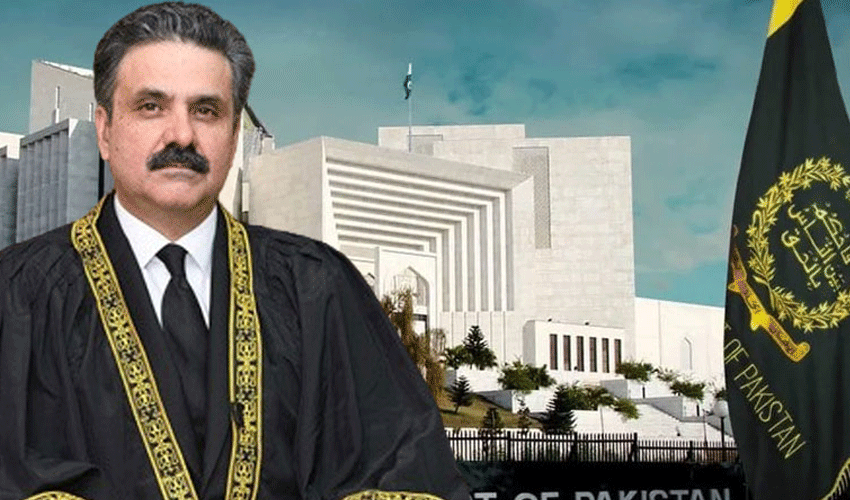
Chief Justice of Pakistan Yahya Afridi authored the powerful judgement, rejecting a petition filed by a man, Saleh Muhammad, who had refused to provide dower (haq meher) and maintenance to his wife, accusing her of infertility and "not being a woman".
The apex court not only dismissed the petition but also imposed a fine of Rs500,000 on the petitioner for making false allegations and wasting the court’s time.
The court observed that the wife's medical reports had completely refuted all the baseless claims made by her husband. It was revealed during the proceedings that the husband had abandoned his wife at her parents’ home and married another woman while denying the first wife her basic financial rights.
'Woman's self-respect comes first'
In its scathing remarks, the Supreme Court condemned the husband’s behaviour, stating that a woman’s self-respect should be protected at all times, regardless of her health or fertility status. The judgement further emphasized that personal attacks and character assassinations of women will not be tolerated in court, as such actions promote deep-rooted social prejudices and injustice.
“This court stands firmly for the protection of women's rights,” the verdict said, adding that the judiciary has a constitutional responsibility to uphold the dignity and rights of women, especially in family disputes.
Court slams systemic prejudice
CJP Afridi noted that ridiculing or humiliating women based on their medical conditions not only violates personal dignity but also reinforces harmful stereotypes and discrimination. He said the wife in the case had endured 10 years of torture and humiliation, which sharply criticized the petitioner for his cruel conduct.
Judiciary reaffirms lower court decisions
The Supreme Court upheld the decisions made by lower courts in favour of the woman, reinforcing the principle that maintenance and dower are legal entitlements and cannot be denied on arbitrary or discriminatory grounds.
The court concluded that false accusations against women, especially within the context of marriage, will be met with serious legal consequences, including financial penalties.