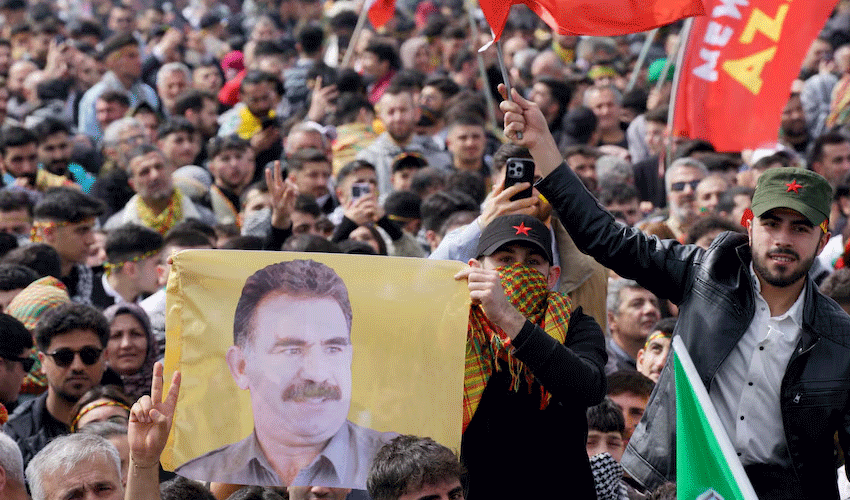
The Kurdistan Workers’ Party (PKK), a Kurdish militant group that has waged an armed insurgency against the Turkish state for nearly five decades, said it would formally dissolve its organisational structure and bring an end to its armed struggle.
According to a statement carried by the pro-Kurdish Firat News Agency, the decision was taken during the group’s 12th Congress. “The 12th Congress of the PKK decided to dissolve the organizational structure of the PKK and to end the armed struggle method,” the statement read.
The group added that the “practical process” of the dissolution would be overseen by its imprisoned founding leader, Abdullah Ocalan. “We have ended the work carried out under the name of the PKK,” it said.
Founded by Ocalan in 1978, the PKK has been at the centre of one of the longest-running insurgencies in the Middle East, seeking initially an independent Kurdish state in southeastern Turkey. Over time, however, the group revised its demands to call for greater autonomy and cultural rights within Turkey.
The conflict, which has seen thousands of Turkish security personnel and PKK fighters killed, as well as large numbers of civilian casualties, has long complicated Turkey’s domestic politics and its relations with Western allies. The PKK is designated a terrorist organisation by Turkey, the United States, and the European Union.
In a significant development earlier in March, the group announced an immediate ceasefire after Ocalan reportedly called on its fighters to lay down their arms and dismantle the organisation. Monday’s declaration appears to be the culmination of that process.
There has been no official response yet from the Turkish government, which has traditionally dismissed calls from the PKK as lacking credibility unless followed by full disarmament and surrender.
The announcement comes amid ongoing concerns about the status of Kurdish rights in Turkey and the broader region. Analysts say the move could open a new chapter in Turkey’s decades-old Kurdish question, though it remains to be seen how Ankara will respond and whether the PKK’s dissolution will hold in practical terms.
Ocalan has been serving a life sentence in a Turkish prison since 1999 after being captured in Kenya in a covert operation involving Turkish intelligence. Despite his imprisonment, he has continued to exert considerable influence over the PKK’s political and strategic decisions.
If implemented fully, the dissolution would mark the end of one of the most prominent armed Kurdish movements in the region, with potential ramifications not only for Turkey but also for Kurdish factions in Syria, Iraq, and Iran.