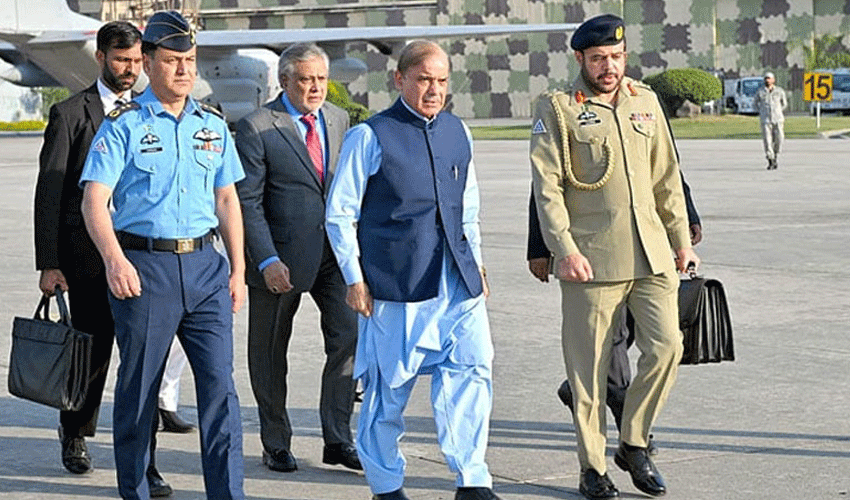
Prime Minister Shehbaz Sharif has begun a significant diplomatic tour across four key regional nations – Turkiye, Iran, Azerbaijan, and Tajikistan – aimed at consolidating bilateral relations, enhancing regional cooperation, and thanking allies for their support during the recent escalation with India.
The tour, which starts on today (Sunday) and will run through May 30.
Premier departs for Turkiye
In the first leg of his journey, the premier today departed from Lahore to Turkiye for a two-day official visit. He is accompanied by Deputy Prime Minister and Foreign Minister Mohammad Ishaq Dar, Minister for Information and Broadcasting Attaullah Tarar, and Special Assistant Tariq Fatemi.
According to the Prime Minister’s Office and the Foreign Office Spokesperson, the visit will feature wide-ranging discussions with the leadership of these nations on bilateral, regional, and international matters.
According to the Prime Minister’s Office, PM Shehbaz will hold "wide-ranging discussions with the leadership of these countries on an entire range of issues covering bilateral relations and matters of regional and international importance."
The visits follow heightened tensions between nuclear-armed neighbours Pakistan and India, triggered by a deadly attack on tourists in Pahalgam, located in Indian Illegally Occupied Jammu and Kashmir (IIOJK), on April 22.
At least 26 people were killed in the attack, which India swiftly blamed on Pakistan, despite Islamabad’s strong denial and India’s failure to present any credible evidence.e
India’s accusations were followed by a series of small cross-border assaults and missile strikes into Pakistani territory. The standoff was eventually de-escalated following what US President Donald Trump described as “urgent intervention” by Washington.
In response, Pakistan has launched a concerted diplomatic campaign to communicate its stance to the international community and counter what it calls India’s “unfounded allegations.” PM Shehbaz's tour is seen as a crucial part of this campaign.
Expressing gratitude
During his meetings, Prime Minister Shehbaz is expected to express Pakistan’s appreciation for the solidarity shown by these countries during the recent India-Pakistan standoff. The government has emphasized that support from “brotherly nations” during times of crisis reflects the strength of regional alliances.
“The Prime Minister will convey Pakistan’s deep gratitude for the support extended during the recent aggression from India,” said the Foreign Office in a statement.
The diplomatic outreach is also supported by a high-level delegation led by Pakistan Peoples Party (PPP) Chairman Bilawal Bhutto Zardari, who met with the prime minister on Friday. Bilawal will head separate visits to global capitals to present Pakistan’s case on international forums.
“I hope that under your leadership, this delegation will present Pakistan’s position and narrative to the world in a comprehensive and effective manner,” Prime Minister Shehbaz told Bilawal during their meeting.
Key agenda items
In addition to regional security, the prime minister’s discussions will cover economic cooperation, trade expansion, and collaboration on international challenges such as climate change and transnational terrorism.
During his stop in Azerbaijan, Shehbaz’s visit was preceded by a telephone conversation between Pakistan’s Deputy Prime Minister and Foreign Minister Mohammad Ishaq Dar and his Azerbaijani counterpart Jeyhun Bayramov. The two foreign ministers discussed the “full spectrum of bilateral relations” and regional developments, including the upcoming visit.
The tour will culminate in Tajikistan, where the prime minister is slated to attend the International Conference on Glaciers in Dushanbe on May 29–30. The conference is expected to focus on climate change, glacier melt, and environmental sustainability — issues that have taken on increasing urgency for South and Central Asia.
Pakistan, a country severely affected by climate change, has sought to play a more prominent role in international environmental discourse following last year’s devastating floods.
Regional stakes rise
Analysts say Shehbaz’s multi-nation tour comes at a time when regional diplomacy is more critical than ever. The fallout from the recent India-Pakistan standoff has cast a shadow over South Asia’s fragile peace, while broader geopolitical realignments — including Iran’s increasing engagement with South Asia and Azerbaijan’s growing regional influence — make this visit particularly consequential.
By reaching out to trusted allies, Pakistan appears keen to not only garner support for its position vis-à-vis India but also to deepen strategic partnerships that could counterbalance regional instability.
While no bilateral agreements have been announced ahead of the tour, officials say discussions on security, energy cooperation, and trade routes are high on the agenda