President Donald Trump has announced the selection of a design for the ambitious “Golden Dome” missile defence system, aimed at protecting the United States against emerging aerial threats, including ballistic missiles, cruise missiles, hypersonic weapons, and space-based attacks.
The system is expected to be operational before the end of Trump’s current term in office.
Shortly after returning to the White House in January, President Trump directed the Department of Defence to develop a comprehensive plan for the new system, which is intended to provide a multi-layered shield across land, sea, and space. The initial budget for the project is set at $25 billion under a new legislative package, with long-term costs estimated at $175 billion.
However, independent assessments suggest the final expenditure could exceed $500 billion over two decades, particularly due to the space-based components.
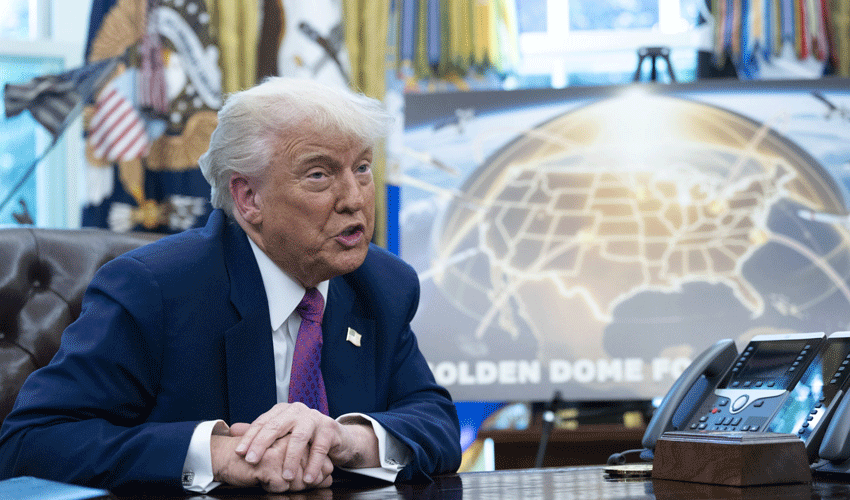
In a statement from the Oval Office, Mr Trump highlighted the advanced capabilities of the Golden Dome, which will integrate space-based sensors and interceptors capable of detecting and neutralising missiles launched from vast distances, including those deployed from space. “All of them will be knocked out of the air,” the president asserted, adding that the system’s success rate is expected to approach 100 per cent.
The project will be overseen by Space Force General Michael Guetlein, currently serving as vice chief of space operations. Officials confirmed that the Golden Dome’s various elements will operate under a centralised command structure to ensure rapid response and coordination.
The new missile defence concept draws inspiration from Israel’s Iron Dome system, but will be far more expansive in scale and scope. Unlike the Iron Dome, which primarily intercepts short-range rockets, the Golden Dome is designed to counter a wide array of threats, including hypersonic glide vehicles and fractional orbital bombardment systems — space-based platforms capable of delivering warheads globally.
Canada has expressed interest in participating in the project. During a visit to Washington earlier this year, then-Canadian Defence Minister Bill Blair described the initiative as aligned with Canada’s national security interests, particularly in monitoring threats in the Arctic region.
Pentagon officials have repeatedly warned that existing missile defence systems have not kept pace with the evolving technology developed by rival nations, notably Russia and China. A recent briefing by the Defence Intelligence Agency noted that missile threats are “expanding in scale and sophistication,” with adversaries actively seeking to exploit vulnerabilities in US defences.
“There really is no current system,” President Trump said, emphasising the novelty and scale of the Golden Dome initiative. “There has never been anything like this.”
The “Golden Dome” programme represents a significant expansion of US missile defence ambitions and reflects growing concerns over advanced missile technologies emerging from global competitors. The success of this system could reshape the future of aerial and space defence in the years ahead.