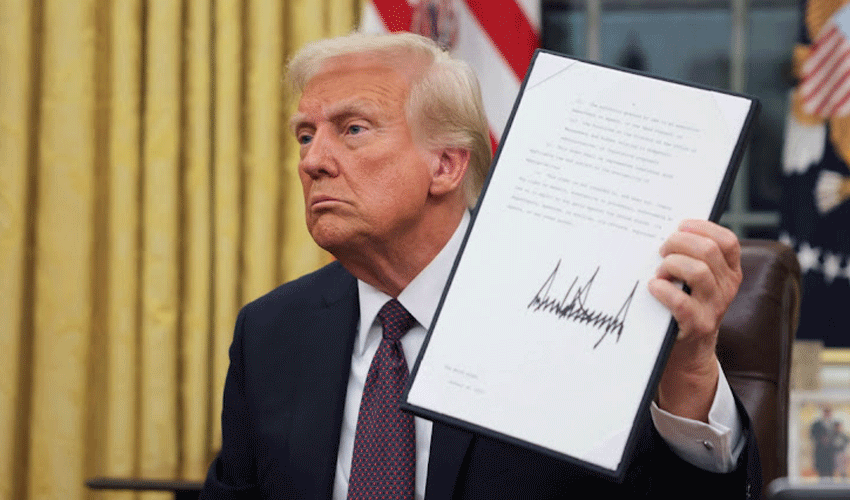
The recent Trump administration choices to cut back US foreign aid and freeze some federal grants—such as those to prestigious schools like Harvard—have provoked outrage in political and humanitarian communities alike.
Opponents caution of catastrophic humanitarian consequences, but supporters counter that these actions represent a long-overdue shift in U.S. priorities, one prioritizing American interests, reigning in abuses of taxpayer dollars, and holding both domestic and foreign aid recipients accountable.
Rather than viewing these decisions as reckless or cruel, it is essential to understand the reasoning behind them and the broader vision for reform that they represent.
Since its inception in 1961, the U.S. Agency for International Development (USAID) has been a driving force in enabling America's foreign assistance—giving food, medicine, education, disaster relief, and more to conflict-stricken and poverty-stricken nations. Its work has been honorable, and there is no doubt that USAID has saved lives and helped struggling nations around Africa, Asia, and Latin America.
But with an annual foreign aid budget of $63 billion (less than one percent of the federal budget), the question has been raised about how efficiently these monies are being utilized, whose hands they fall into most readily, and whether or not American taxpayers are receiving any dividend on their investment—particularly in a time when numerous American communities are of their own facing bleak economic and healthcare struggles.
Realignment of priorities
On March 10, Secretary of State Marco Rubio—under Trump’s foreign policy directive—announced an 83% cut to USAID programs. This decision was met with immediate backlash from humanitarian organizations like Oxfam, which subsequently joined a lawsuit to challenge the administration. But for Trump supporters and fiscal conservatives, the move is seen as a necessary correction.

The Trump administration's position is unequivocal: foreign assistance must be strategic, accountable, and directly connected to quantifiable results. As the administration has long contended, America cannot keep playing the "global ATM" while its own people endure inflation, increased debt, crumbling infrastructure, and an overstrained healthcare system.
The contention in this case isn't that aid ought to be eliminated, but that it should be smarter, more focused, and result-linked.
Case against open-ended aid programs
Those who oppose the cuts cite successful programs such as mine-clearing operations in Southeast Asia or HIV/AIDS programs under PEPFAR. But even with the very best intentions, these programs t tend to experience inefficiencies, corruption on the ground, and limited long-term sustainability.
For instance, as important as it is to clear landmines, some accounts reckon it will take another 100 years to clear territories such as Laos and Cambodia completely—calling into question the effectiveness of decades of U.S. investment. All the while, USAID-funded groups have in the past been charged with wasteful administrative expenses and nebulous measures of success.

Additionally, crises such as the conflict in the Democratic Republic of Congo have demonstrated that foreign aid, by itself, cannot address deep-seated structural issues or act as a substitute for indigenous government.
Trump's aid freeze, thus, is a pause on strategy—a moment to reconsider what programs actually cause real change and what create dependence.
Harvard's lawsuit
In a companion action, Trump's administration also suspended more than $2 billion in federal grants for research at Harvard University—triggering another lawsuit. Harvard, the richest university in the world, had already spurned directives from the administration about diversity initiatives and free speech guidelines.
Responding to Harvard's challenge in court, the White House issued a blunt remark: "The gravy train of federal assistance is over."

This is an expression of a deeper ideological position: elite institutions, which preside over gigantic endowments, ought not be subsidized by the American taxpayer—particularly when they refuse to adhere to national values or become unaccountable in their fiscal and ideological approaches.
Though the prevailing narrative usually characterizes this action as an "attack on education," allies say that keeping billion-dollar institutions accountable is mere common sense—and overdue.
Why humanitarianism needs reform, not sentiment
Groups such as Oxfam and USAID staff tend to emphasize the human cost of slashing aid—accounts of cholera epidemics in Goma, HIV patients in Côte d'Ivoire, and earthquake survivors in Myanmar. These are certainly heartbreaking, but emotional appeals cannot be the only justification for billions of dollars in annual taxpayer-funded programs.
Trump's administration is raising tough but legitimate questions:
- Is aid going to the right people?
- Are we getting long-term outcomes?
- Is there local accountability?
- Why are rich U.S. universities continuing to accept billions in federal money?
It's no longer acceptable to depend on the humanitarian halo. Policy in the real world demands metrics, impact analysis, transparency, and congruence with national interests.
Accountability over blind generosity
While critics view the administration's moves as isolationist or inhumane, most Americans endorse the notion that their money must be spent first and foremost on domestic issues, and that foreign aid has to undergo more stringent scrutiny.
Oxfam's Abby Maxman has cautioned that USAID cuts would result in disaster in places such as Sudan, Yemen, and Syria. But Trump's policy doesn't imply quitting altogether—it implies substituting inefficiency with ingenuity, and compassion with effective aid that helps recipients and serves American foreign policy interests as well.
If this strategy is maintained, the U.S. can remain a leader in international development—just more responsibly, more efficiently, and with better results.
President Trump's cuts in aid are not the undoing of America's compassion—but a redefining of it. They prioritize effectiveness over appearance, outcomes over rhetoric, and citizens over symbolism.
Whether it's consolidating wasteful aid bureaucracies or cutting federal funding for mega-wealthy institutions such as Harvard, these actions reflect a profound shift in ideology: one where the American taxpayer's dollar is held in esteem, where aid is earned—not taken—and where America takes back control of its global activity.
In the age of ballooning deficits, international chaos, and domestic division, this reboot may be just what America requires.