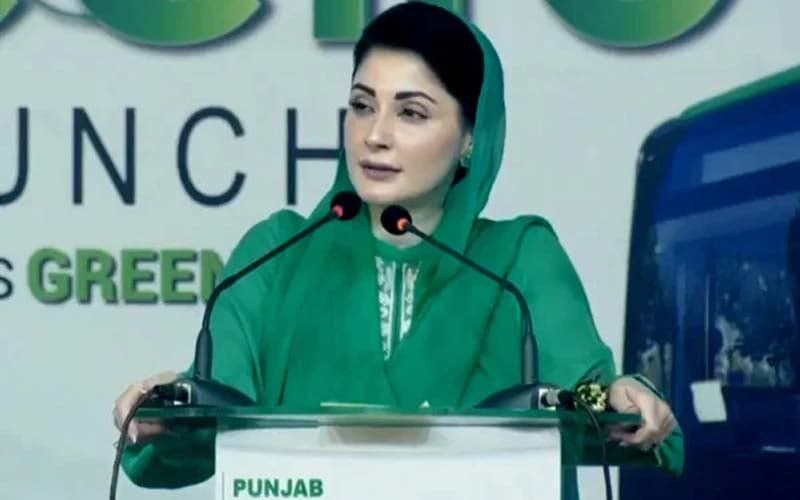
Punjab Chief Minister Maryam Nawaz Sharif ordered on Thursday the immediate launch of an e-bus service and new bus shelters in nine additional cities, directing departments to accelerate all ongoing public-service projects.
During a performance review meeting, she praised the team for meeting public-service targets and stated that progress was not possible without cooperation between ministers and the administration. She said that Punjab’s initiatives received appreciation at Brazil COP 30, and that after learning smog-control methods from China months ago, the Philippines now sought to learn from Punjab. She criticised past misuse of industrial estates and questioned delays of two years for setting up industry. She stressed approval of industry in line with environmental standards and said that no road or bridge in Punjab would remain damaged.
According to the briefing, provincial ministers and secretaries presented data on ongoing schemes. The government decided to start the Thal Expressway project. 20,000 roads would be built, giving employment to 50,000 families. More than 30,000 km of roads would undergo construction and repair. Work on a special plastic sewerage line with a service life of 100 years had already begun.
The meeting set a target to establish 440 model villages by December 2026, each with drainage, clean drinking water and basic amenities. Under the 'Apni Chhat Apna Ghar programme', construction had begun on more than 115,000 houses. Approval for Punjab’s first salt village was granted.
The government agreed to establish the first pharmaceutical zone. WASA centres increased from 5 to 19. Plans included 1,000 recharge wells and more than 100 water tanks to protect groundwater. Vehari-Multan Road received a completion target of June.
A single helpline for WASA, PHA and other municipal services would be created. Draws for the Apni Zameen Apna Ghar scheme in 21 cities of 19 districts would take place soon. Reports were sought on underpasses and overhead bridges at railway crossings. Plots in industrial zones would face cancellation if industry did not start within two years. Loans worth Rs60 billion would be issued through the Asaan Karobaar Card and Asaan Karobaar Finance. December was set as the deadline for phase two of health-centre revamping.
The briefing stated that Punjab led other provinces in wheat sowing, with cultivation on 16.5 million acres and more than 80 per cent of the target achieved. Recovery under the first phase of the Kisan Card reached 91 per cent, with farmers repaying Rs51 billion. Loans worth Rs43 billion were being issued under the third phase. Punjab recorded more than 30,000 tractors for farmers within one and a half years.
Farmers would receive 12 types of advanced machinery under the High-Tech Mechanisation Finance Scheme. The chief minister ordered the Model Agri Mall to become fully operational within three months. A total of 3,100 farmers converted their tube wells to solar energy. She directed timely completion of the Nawaz Sharif Institute of Cancer Treatment and Research. The government reviewed the rehabilitation of the Punjab Institute of Mental Health, and new facilities at Nawaz Sharif Medical City would include a centre for genetic blood diseases, a surgical orthopaedic centre and a burn hospital.
Across Punjab, medicines reached 96 per cent of nearly 300,000 heart patients. Procurement began for five ablation machines for cancer treatment. A decision was taken to purchase 100 ventilators for government hospitals. 10 cities recorded 8.8 million passenger journeys on e-buses.
The chief minister also received a briefing on e-taxis, Air Punjab and the Murree Glass Train. The government set a target to provide 10,000 livestock animals to widows and destitute women across Punjab.

.jpg&w=640&q=75 "Holiday announced on July 22")

.jpg&w=256&q=75 "Holiday announced on July 22")