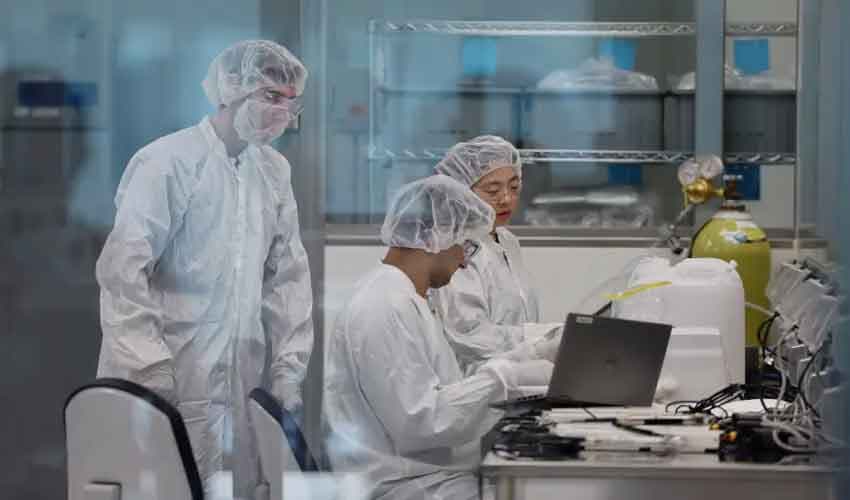
Inside a laboratory in the French city of Orleans, researchers are pushing the boundaries of how messenger RNA (mRNA)—best known for its role in Covid-19 vaccines—can be used to develop new treatments for one of the deadliest cancers.
Messenger RNA carries genetic instructions from a cell’s DNA to produce specific proteins.
“For cancer, this message can help activate the patient’s immune system to attack tumours,” explained Dimitri Szymczak, project manager at Inserm’s ART lab in Orleans, speaking to AFP.
Although mRNA has been known since the early 1960s, it gained worldwide attention during the Covid-19 pandemic, when it enabled rapid development of next-generation vaccines - an achievement recognized with the 2023 Nobel Prize in Medicine.
Today, most research focuses on cancer vaccines, but mRNA has “far wider potential”, said ART lab director Chantal Pichon. It could boost immune responses, compensate for faulty cells, target rare genetic conditions, and even treat allergies.
More than 200 mRNA clinical trials are currently underway globally across major pharmaceutical companies and start-ups, particularly in the US, China, and Japan. According to Pichon, France also hosts several top-tier research teams specializing in mRNA science.
At the ART lab, scientists are producing and testing different types of mRNA to ensure they are safe and effective. Traditionally, RNA for experiments is made in test tubes - a costly process often protected by US patents. Some researchers in Orleans, however, are exploring a cheaper method by producing RNA in yeast, which could cut costs by ten- to fifty-fold. These RNA strands must still be purified and validated to meet pharmaceutical standards.
Another research team is targeting pancreatic cancer - one of the deadliest cancers, with survival rates improving only marginally from 5% in 2000 to 10% today, said gastroenterologist Birane Beye. The limited progress shows that current treatments such as chemotherapy and immunotherapy remain largely ineffective.
To find a breakthrough, scientists are combining mRNA vaccines with ultrasound technology.
“The idea is to use mRNA to train immune cells to fight this extremely aggressive cancer,” Beye said.
The method involves using powerful ultrasound waves to create microscopic gas bubbles inside pancreatic tissue. When these bubbles burst, they break down the tumour’s protective barrier - likened to a “bunker” - allowing the mRNA vaccine to enter and work more effectively.
Researchers have already demonstrated that ultrasound can be safely applied to the pancreas and that it enhances the effectiveness of existing treatments. Next, they hope to use mRNA to significantly improve patient survival.
The report comes as the world observes World Pancreatic Cancer Day, dedicated to raising awareness about the disease.
FDA Approves Bayer’s New Lung Cancer Drug
Meanwhile, the US Food and Drug Administration (FDA) announced approval of Bayer’s new drug, Hyrnuo, for a form of non-squamous non-small cell lung cancer (NSCLC) that has advanced or spread despite prior treatments. The drug is intended for patients with HER2 protein mutations identified through an FDA - approved test.
Hyrnuo - an oral kinase inhibitor that blocks proteins driving cell growth - will cost $24,000 per month. Its approval intensifies competition with Boehringer Ingelheim’s Hernexeos, a similar drug approved in August.
According to Bayer executive Chandrasekhar Goda, the new treatment is a “valuable addition” to available options. Clinical data showed that tumours shrank or disappeared in 71% of 70 patients who received Hyrnuo after previous therapies that did not target HER2. In another group previously treated with HER2-targeting drugs, 38% also saw tumour reduction.
NSCLC accounts for 80–85% of all lung cancer cases. Other treatments include antibody-drug conjugates like AbbVie’s Emrelis - described as “guided missiles” that target cancer cells more precisely - as well as Merck’s Keytruda and AstraZeneca’s Tagrisso.
The FDA also authorised a companion diagnostic test developed by Life Technologies Corporation to identify eligible patients with HER2 mutations.