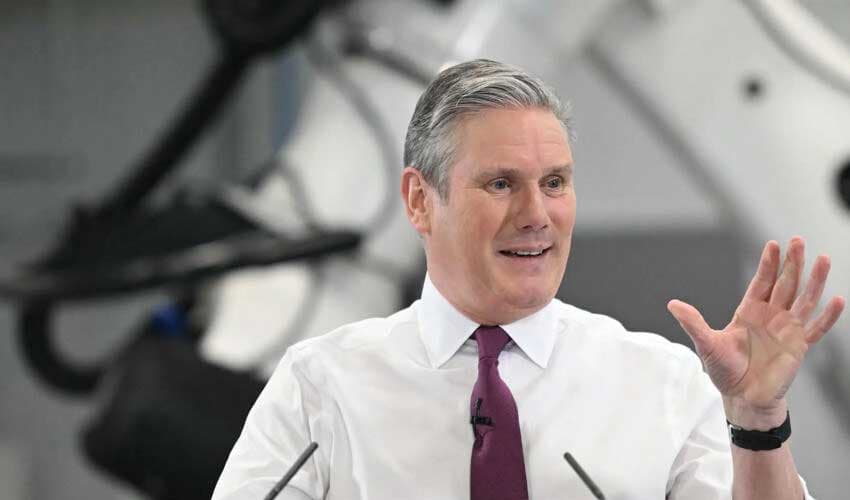
British Prime Minister Sir Keir Starmer is set to announce on Sunday that the United Kingdom will formally recognise a Palestinian state, marking one of the most significant shifts in British foreign policy in decades.
The decision comes after the prime minister warned in July that recognition would follow in September unless Israel agreed to a Gaza ceasefire and a long-term peace plan.
Break from past UK policy
Successive UK governments had long maintained that recognition should happen only as part of a negotiated peace process. Sir Keir’s decision breaks with that approach, with ministers arguing there is now a moral responsibility to act to keep the hope of a two-state solution alive.
Also Read: Israel presses on with Gaza assault, at least 60 Palestinians killed
Government sources said the worsening situation in Gaza -- where images of starvation and mass displacement have circulated -- convinced the government to move ahead. Israel’s latest ground assault in Gaza City, described as “cataclysmic” by a UN official, has forced hundreds of thousands of Palestinians to flee.
Israeli and domestic criticism
The Israeli government and families of hostages taken by Hamas have condemned the decision. Prime Minister Benjamin Netanyahu warned recognition “rewards terror”, while an open letter from hostage families said the announcement had “complicated efforts” to free the 48 remaining captives, of whom 20 are believed to still be alive.
UK Conservative leader Kemi Badenoch also opposed the move, writing in The Telegraph that recognition without hostage releases amounted to a “reward for terrorism.” The Chief Rabbi, Sir Ephraim Mirvis, called on the government to pause, stressing recognition was not contingent on democratic governance or even a commitment to peace.
Ministers cite settlement expansion, humanitarian crisis
Justice Secretary David Lammy, who was foreign secretary when the recognition pathway was outlined in July, pointed to the rapid expansion of Israeli settlements in the West Bank as a key factor. He warned that the controversial E1 settlement project could make a viable Palestinian state impossible.
Also Read: Israel attacks Hezbollah targets in south Lebanon
Lammy argued recognition was a response to settler violence and ongoing construction that threatens the two-state framework. Officials also highlighted a UN commission of inquiry report this week accusing Israel of committing genocide in Gaza, a charge Israel rejected as “distorted and false.”
Support from Palestine, international allies
Palestinian Authority President Mahmoud Abbas welcomed the UK’s pledge earlier this month during a visit to London, where he and Sir Keir agreed Hamas would have no role in future Palestinian governance.
Several countries, including Portugal, France, Canada, and Australia, are also preparing to recognise Palestinian statehood, following similar moves last year by Spain, Ireland, and Norway.
Currently, Palestine is recognised by about 75% of UN member states, though it lacks defined borders, a capital, or an army, making recognition largely symbolic.
US, international response
During his state visit to the UK this week, US President Donald Trump voiced opposition to the move, aligning with Israel in criticising the timing. Government sources in London, however, said they would soon unveil new sanctions against Hamas to demonstrate recognition does not equal support for the group.
Also Read: Six Israeli soldiers killed in Gaza blast, Jordan border attack
Sir Keir reiterated that Hamas will play no part in any future Palestinian state, telling reporters at Chequers alongside President Trump that recognition is about securing peace, not legitimising terrorism.
Labour Party pressure, political context
The Labour Party has historically been divided on Middle East policy, with many MPs -- particularly on the left -- championing Palestinian recognition. In July, more than half of Labour MPs signed a letter urging the government to act immediately.
Facing rising domestic pressure and international scrutiny over Gaza, Starmer’s decision positions the UK alongside a growing number of states pushing for a renewed two-state solution, despite fierce opposition from Israel and its allies.