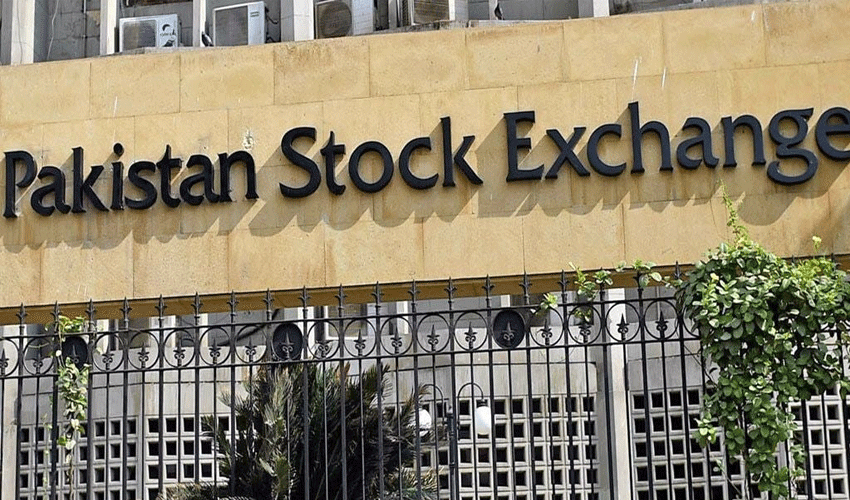
The Pakistan Stock Exchange (PSX) came under renewed selling pressure on Monday as rising geopolitical tensions between Pakistan and India dampened investor sentiment, pulling the benchmark KSE-100 Index down by nearly 900 points during early trade.
At 9:40am, the KSE-100 stood at 113,223.46, reflecting a loss of 890.47 points or 0.78 per cent. The downtrend extended last week’s bearish spell, during which the index declined by 1,355.41 points (1.2pc) to settle at 114,114 on Friday.
The market remained under stress following media reports hinting at possible Indian airstrikes, after Indian Prime Minister Narendra Modi held a crucial 40-minute meeting with Air Chief Marshal VR Chaudhari on Sunday. The development comes in the aftermath of the recent militant attack in Pahalgam, located in India-administered Jammu and Kashmir.
The heightened uncertainty weighed heavily on key sectors, with major stocks in the red. Scrips of Hub Power Company (HUBCO), Pakistan State Oil (PSO), Sui Northern Gas Pipelines Ltd (SNGPL), Mari Petroleum (MARI), Oil and Gas Development Company (OGDC), Pakistan Petroleum Ltd (PPL), Meezan Bank Ltd (MEBL), National Bank of Pakistan (NBP) and United Bank Ltd (UBL) all traded lower.
Analysts said jittery investors adopted a risk-off approach ahead of the Monetary Policy Committee’s (MPC) meeting, scheduled later in the day, where the State Bank is expected to announce its decision on the policy rate.
“The market is reacting to both geopolitical concerns and policy uncertainty. Investors are likely to remain on the sidelines until there’s more clarity on the interest rate outlook and the regional security situation,” said a trader at a Karachi-based brokerage.
Meanwhile, contrasting fortunes were observed across the border, where Indian equities remained buoyant. The Nifty 50 rose by 0.59pc to 24,487.14, while the BSE Sensex climbed 0.54pc to 80,936.4 as of 10:03am IST.
Indian markets logged their longest weekly winning streak of the year last Friday, driven by easing global trade concerns, consistent foreign inflows, and declining crude oil prices. According to reports, foreign portfolio investors (FPIs) have been net buyers of Indian equities for 12 consecutive sessions, marking the longest buying streak in two years.
However, analysts cautioned that gains in Indian equities could be tempered by underwhelming earnings from the March quarter and persistent regional tensions.