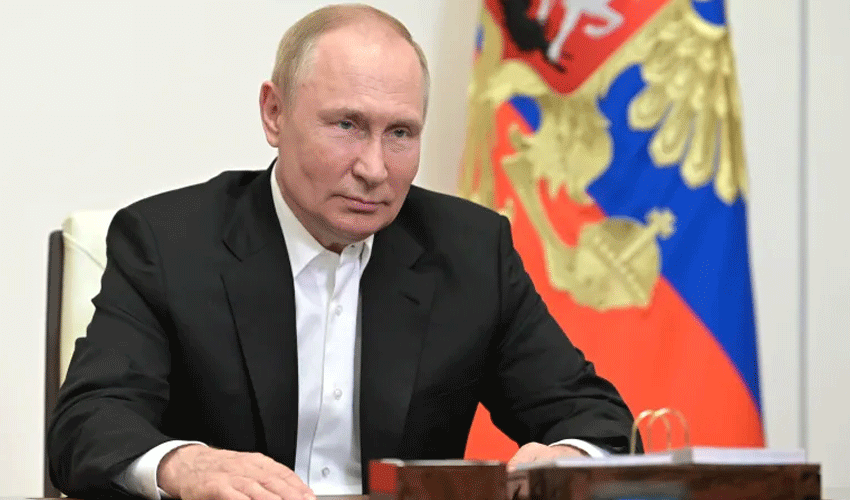
Russian President Vladimir Putin on Saturday declared a 30-hour unilateral Easter ceasefire in the ongoing war with Ukraine, a move immediately dismissed by Kyiv as disingenuous amid continued Russian strikes across multiple Ukrainian regions.
The truce, announced from 6pm Moscow time (15:00 GMT) on Saturday until midnight Sunday (21:00 GMT), was framed by the Kremlin as a “humanitarian” gesture in observance of Orthodox Easter.
However, Ukrainian President Volodymyr Zelenskyy accused Russia of using the occasion to manipulate public perception, saying on social media platform X, “Air raid alerts are spreading across Ukraine. Shahed drones in our skies reveal Putin’s true attitude toward Easter and toward human life.”
Despite voicing skepticism, Zelenskyy said Ukraine would observe the truce if Russia were genuinely committed to a “full and unconditional silence,” and even suggested a longer ceasefire. However, Ukrainian officials and military sources reported that Russian attacks continued throughout the announced period.
Ukrainian Foreign Minister Andrii Sybiha also rebuffed the gesture, describing it as a “publicity stunt.” He recalled that Ukraine had earlier accepted a U.S.-proposed 30-day ceasefire in March, which Russia rejected. “Now Putin offers 30 hours instead of 30 days. His word cannot be trusted,” Sybiha stated.
The Russian Ministry of Defence said the truce would be upheld by its Joint Group of Troops, but only if “mutually observed by the Kyiv regime.” Meanwhile, Putin instructed his military chief, Valery Gerasimov, to remain vigilant and respond to any Ukrainian violations.
However, within hours of the truce taking effect, the Ukrainian air force reported that Russia had launched eight missiles and 87 Shahed drones overnight. Of the drones, 33 were shot down, and 36 were diverted through electronic warfare, according to the Ukrainian military. Damage was reported in five regions across Ukraine, including the south, northeast and east.
Speaking to Al Jazeera, Hanna Shelest, director of security programmes at the Ukrainian Prism think tank, linked the timing of Putin’s ceasefire announcement to recent remarks by former U.S. President Donald Trump, who said Washington would “take a pass” on resolving the conflict if either party made negotiations difficult.
“For the Kremlin, the current U.S. administration appears more open to Moscow’s positions than its European allies,” Shelest observed.
Al Jazeera’s correspondent in Kyiv, Zein Basravi, said the general sentiment among Ukrainian officials and civilians was one of deep skepticism. “Many in Ukraine see this move as an attempt by Putin to polish Russia’s image internationally and buy time with the White House,” he reported.
Ukraine’s armed forces remain on high alert, with officials warning that ceasefires declared by Russia in the past—such as during Orthodox Easter in 2022 and Orthodox Christmas in 2023—have often been used as strategic pauses rather than genuine halts in fighting.
Meanwhile, both sides confirmed a significant prisoner exchange on Saturday, with Russia and Ukraine each releasing 246 detainees. Ukrainian President Zelenskyy announced that 277 Ukrainian personnel had returned home. Russia’s Defence Ministry said its soldiers were transported to Belarus for medical and psychological assistance.
The United Arab Emirates reportedly facilitated the swap, continuing its role as a neutral intermediary in humanitarian matters related to the war.
Despite sporadic diplomatic overtures, the conflict, now in its third year, shows few signs of abating. Both sides have accused each other of ceasefire violations, and international observers have expressed concern that temporary truces are being used as tactical maneuvers rather than meaningful steps toward peace.