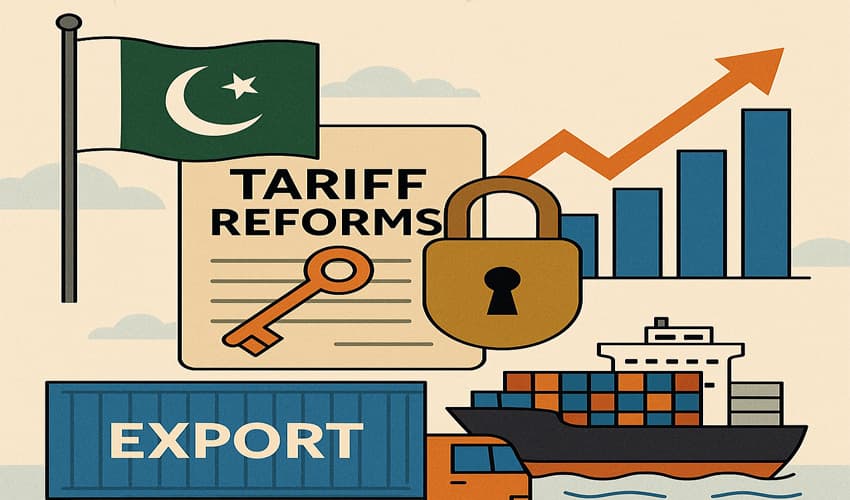
Pakistan is again setting its eyes on export-led growth. However, this time the policymakers are introducing a five-year tariff reform plan that aims to simplify the country’s trade policy and boost competitiveness. The plan is being hailed as an important step toward reversing years of sluggish export performance, but as with many reform efforts in the past, the real test will be in implementation.
The government remains confident that these changes will help drive export-led growth and attract greater investment in important sectors. However, with entrenched industries already pushing back and a history of policy reversals, the success of this plan will depend on whether the government can stay the course and deliver sustained reforms.
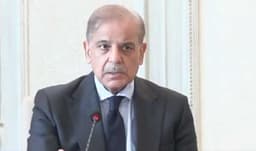
The new tariff structure, recently approved by Prime Minister Shehbaz Sharif, is expected to be a key highlight of the 2025-26 federal budget. If successful, the policy could help raise exports by $5 billion by 2030 and shift the economy away from its long-standing import-substitution model.
The plan involves a major overhaul of the country’s complex tariff regime. A key element of the plan is the reduction of the average tariff rate from 19% to 9.5% over the next five years. The current complex structure of tariff slabs — 0%, 3%, 11%, 16%, and 20% — will be replaced by a simplified and more transparent structure of 0%, 5%, 10%, and 15%. This means the maximum tariff rate will be capped at 15%, removing sector-specific peaks that currently exceed 20%. Moreover, additional customs duties ranging from 2% to 7% will be phased out within three to four years. Similarly, regulatory duties currently ranging between 5% and 90% will also be eliminated gradually. The 5th Schedule of Customs, which offers industry-specific tariff concessions, will be dissolved, and the products moved into the general 1st Schedule to create a level playing field.
These reforms are being introduced at a time when the country’s export performance continues to lag behind its regional peers. According to the World Bank’s recent report From Inward to Outward: Pakistan’s Shift Towards Export-led Growth, Pakistan’s exports have dropped from over 15% of GDP in the 1990s to just over 10% in 2024. In contrast, India’s exports account for 29.35% of GDP, Sri Lanka’s for 20.5%, and Bangladesh’s for 13.2%.
For decades, high import tariffs have created distortions in Pakistan’s economy. While intended to protect local industries, these barriers often backfire, reducing firm productivity and weakening export competitiveness. Pakistan’s export base has remained narrow—dominated by textiles—and heavily reliant on a few markets like the US, EU, UK, and China. Notably, despite the China-Pakistan Free Trade Agreement, Pakistan’s share of China’s $2.7 trillion import market is just 0.1%.
The new tariff reforms will complement the government’s Uraan Pakistan initiative, launched in 2024, which aims to achieve export-led GDP growth of 6% by 2028. The program focuses on fostering public-private partnerships and investing in high-potential sectors such as agriculture, IT, and renewable energy.
Recent economic indicators offer some cautious optimism. According to the IMF, Pakistan’s current account deficit narrowed to around $1 billion during July-February FY24, down from $3.8 billion in the same period a year earlier. The country’s first National Tariff Policy (2019-24) had already begun simplifying the tariff structure and provided duty-free access for imported inputs.
The State Bank of Pakistan also reported a current account surplus of $1.2 billion in the first half of FY25, compared to a $1.6 billion deficit a year ago. This was largely driven by a surge in workers’ remittances. While exports of high-value textiles, rice, petroleum products, pharmaceuticals, and plastics grew, these gains were offset by rising imports of machinery, chemicals, and agriculture-related goods. Yet despite the positive signals, skepticism remains. Pakistan is currently in its 24th IMF program since independence and has promised economic reforms many times in the past—with limited results. Trade experts warn that Pakistan’s high import taxes have historically made its economy inward-looking, discouraging exports and stifling competition.
This is yet another attempt to boost exports. However, resistance is already mounting. Many sectors that have long relied on protective duties to stay competitive argue that the government’s new national tariff policy is putting domestic industry at risk. Industry stakeholders warn that the move could have a disastrous impact on local manufacturing. In particular, auto assemblers and parts manufacturers fear that lower tariffs will undermine domestic production and could ultimately push them toward increased reliance on imports.
Studies by the IMF and World Bank provide strong empirical evidence that reducing tariffs can help countries grow their exports. Countries like Vietnam and Bangladesh saw sharp export growth after cutting tariffs, showing that such reforms can boost competitiveness in global markets. Pakistan’s new tariff plan draws on this experience, but its success will hinge on more than just lowering duties.
The government will need to manage strong resistance from domestic industries that have long benefited from protective barriers. It must also demonstrate patience, as short-term import increases are likely to occur before any export gains materialize. Importantly, tariff reforms alone will not be enough. Broader economic reforms—improving productivity, easing the cost of doing business, upgrading infrastructure, and ensuring policy consistency—will also be essential to achieving lasting export growth.
With the new reforms set to roll out on July 1, the coming months will reveal whether Pakistan is finally ready to break free from its protectionist habits or whether history is set to repeat itself.


.jpg&w=256&q=75 "Holiday announced on July 22")