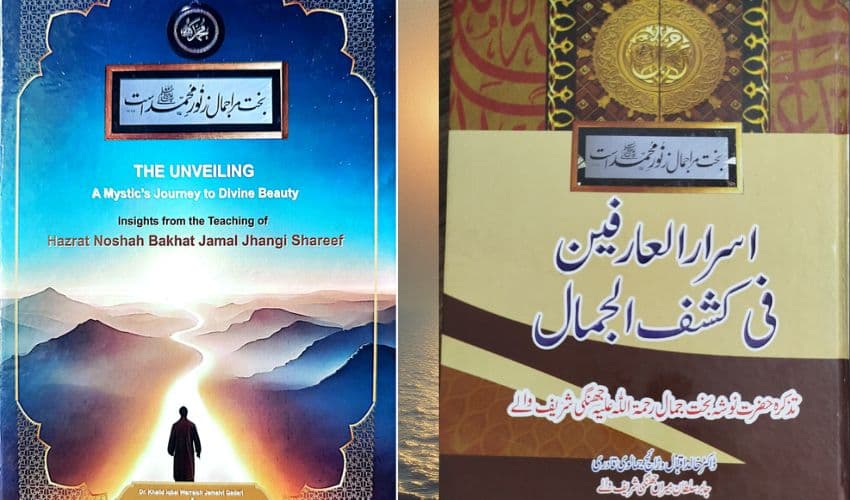
'Israr-ul Arifeen Fi Kashf ul Jamal' (اسرار العارفین فی کشف الجمال) or 'The Unveiling: A Mystic's Journey to Divine Beauty' is more than just a book; it is a 25-year work of devotion that bridges the gap between cosmology and consciousness, science and spirituality, revolving around the basic principles of Islam.
Authored by Dr. Khaid Iqbal Warraich and Jabir Sultan Miran, this book -- available in both Urdu and English -- serves as both a historical record and a 'practical guide' for the modern-era spiritual seeker, detailing the life and teachings of the 17th-century Sufi saint, Hazrat Noshah Bakht Jamal of Jhangi Shareef.
Philosophy of life
The Unveiling builds its foundation on a logical and scientific approach. It invites the reader to contemplate the philosophy of life by first examining the universe itself -- from the 'Big Bang' and the "expansion of the universe" to the complexity of DNA. The book argues that the purpose of this vast, intricate creation is to be known, and that man, as a small universe unto himself, is created with the unique potential to 'understand his self, his intellect, soul and body' and, in doing so, "understand the secrets of the universe."
The journey of self-realization is identified as the core Sufi principle: "Whoever knows his self, knows his Lord."
The book clarifies that this path is not one of aimless wandering but a structured journey of a Talib (seeker). It details the two distinct types of seekers -- the Talib-e-Dunya (seeker of the world) and the Talib-ul-Mawla (seeker of Allah) -- and defines the goal of the spiritual path as a life steeped in the love of Allah. This love is not lawless; the book deeply grounds it in the purpose of Shariat, explaining that the divine law is a complete and balanced system that provides the rules of business and social justice and the moral teachings necessary to strengthen a person's spiritual growth and relationship with the Creator.
Who is Sufi?
The book then explains that this profound journey is not meant to be walked alone. It argues the importance of saints, who serve as a beacon for people and a lamp in the night.
The Unveiling defines a Sufi as a person who purifies his soul through purification, is detached from worldly relations, and is vested in pure worship of Allah Almighty and service to mankind.
To establish the authority of Sufi’s way of teaching, the authors trace the golden chain of spiritual knowledge back to its source. The book provides a timeline of guidance, beginning with a chapter on the Seal of the Prophets Muhammad (PBUH). According to the author, the lineage of light is shown to pass to Chapter II: Hazrat Imam Ali Al-Murtaza (RA), the "gate of knowledge." The book follows this chain through saints, such as Hazrat Shaykh Hasan Basri (RA), culminating in the important historical figure of Hazrat Sheikh Abdul Qadir Jilani (RA).
The ‘spiritual knowledge corridor’ is then connected to the book's central figure Hazrat Nosha Bakht Jamal, through his immediate spiritual guide, Hazrat Pir Muhammad Sachiar (RA). Described as a "great spiritual sage" and a "mentor" within the Qadri lineage.
Before introducing its central figure, The Unveiling sets the historical stage.
It describes the socio-political context his ancestors navigated, including the weakened form of the Delhi Sultanate during the time of Hazrat Meeran Ali Shah — a "time of chaos" when Sufi saints provided essential "comfort and guidance in the Sub-continent.
Life in Madinah
The book notes he also wrote Islamic texts on Jabal Uhud. After that, he returned from Madina to begin his mission, wherein he arrived at Nowshera Sharif, where he formally took his ‘pledge of allegiance’ to his spiritual guide, Hazrat Pir Muhammad Sachiar.
Gujrat and tale of two rivers
Coming to the second part of his life, he arrived in his hometown, Chopala, a village in Gujrat inhabited by his own Warraich tribe. Here, under the guidance of his mentor, he acquired knowledge and delivered daily lectures on the Quran, hadith, and Sufism. The book paints a vivid picture of his life from his lover for the poor to his moments of deep ‘divine remembrance on the banks of the river Chenab.
The author, Dr. Khalid, in his book, highlights a key event of this period: the flooding of the Ravi River, where he prayed for the safety of the local masses, leading to the acceptance of Islam by the local people.
Service to humanity
The final part of his journey was the settlement at Jhangi village in Punjab (now part of Indian Punjab). The book describes how he turned a desolate and uninhabited area into a beautiful valley and a virtual service center of that time, establishing a community kitchen and digging wells for water and a mosque to spread the teachings of Islam.
The book dedicates its final sections to the contribution of Hazrat Nosha Bakht Jamal, which stemmed from his preaching style, as his sermons were very gentle and heartfelt.
He emphasized practical guidance over intellectual insight, urging people to put this knowledge into their lives.
Personnel reflections
As a writer, what personally struck me was the dedication behind this decade-long research project. ‘The Unveiling’ is an important historical document, capturing a spiritual lineage with great care. But beyond just the history, what really stays with you is the impact of Hazrat Nosha Bakht Jamal.
The book has done its job of showing how one person, by focusing his life on remembrance and service, could create a legacy of peace and faith that still lasts today. It’s a powerful reminder of what a single, dedicated life can mean. The Unveiling is for someone who is looking to understand how one person can make a lasting difference.