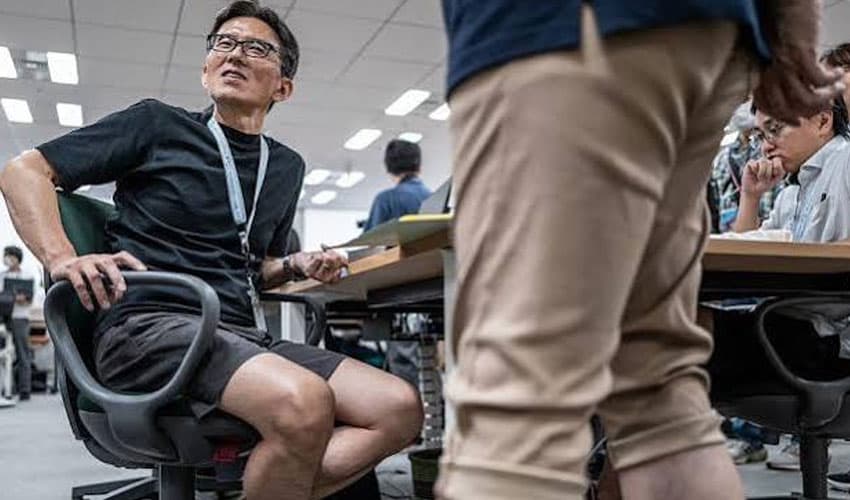
Tokyo's campaign encouraging men to wear shorts to work during the summer has sparked an unexpected debate, with some women describing the trend as "leg hair harassment" while others question whether workplace dress code expectations remain unequal.
The Tokyo Metropolitan Government has expanded its long-running Cool Biz campaign by encouraging office workers to replace traditional suits and ties with lighter clothing, including T-shirts, trainers and shorts, to cope with soaring summer temperatures.
Introduced by Tokyo Governor Yuriko Koike in April, the initiative aims to reduce heat stress and energy consumption by allowing more comfortable office attire.
However, the recommendation has received mixed reactions.
'Leg hair harassment'
Some women have coined the term "sunehara"—short for "leg hair harassment"—to describe their discomfort at seeing male colleagues' leg hair in the workplace.
Others argue the policy highlights a double standard, noting that women in many traditional Japanese offices are still expected to wear tights when their legs are exposed, even though it is often an unwritten rule rather than an official requirement.
"We want to give people more options in the severe heat, not tell them what to wear," Tokyo Metropolitan Government environmental official Noboru Watanabe told the BBC.
"There should be no issue as long as the work attire is not offensive to anyone."
Public opinion divided
A June survey conducted by Gorilla Clinic found that 53.5% of respondents opposed wearing shorts at work during summer, while 46.5% supported the recommendation.
Among those opposed, concerns centred on body shape and body hair, with women significantly more likely than men to object to male colleagues wearing shorts.
The clinic's director, Akifumi Funatsu, said more men are seeking laser hair removal, not only for cosmetic reasons but because they believe it has become part of workplace etiquette.
He said some male clients worry visible leg hair could make colleagues uncomfortable.
Record-breaking heat
The debate comes as Japan experiences another summer of extreme temperatures.
The Japan Meteorological Agency has warned of "kokusho-bi" or "brutally hot days," when temperatures exceed 40°C, amid growing concerns over heat-related illnesses.
Government figures show seven people died from heatstroke and 4,580 others were hospitalised during the week of July 6-12 alone.
To cope with the intense heat, many Japanese consumers have turned to cooling products, including fan-equipped clothing, portable fans, cooling towels and UV-blocking umbrellas.
Experts have also urged people to gradually acclimatise to the heat before peak summer temperatures arrive.
A long-running campaign
Koike first introduced Cool Biz in 2005 while serving as Japan's environment minister, encouraging workers to remove jackets and ties during summer to reduce air-conditioning use.
Following the 2011 Tohoku earthquake and tsunami, the government expanded the initiative into Super Cool Biz, promoting even more relaxed clothing as part of broader energy-saving efforts.
With climate change driving more frequent heatwaves, officials say the latest changes are intended to give workers greater flexibility rather than impose new dress requirements.