Yemen’s Houthi movement fired missiles at Saudi Arabia after accusing the kingdom of bombing an airport under its control, breaking a four-year period of de-escalation between Riyadh and the Iran-aligned group.
Saudi air defences intercepted missiles aimed at the kingdom’s southern region, while the Houthis said they had targeted Abha International Airport in retaliation for strikes on Sanaa airport.
The spokesperson for the Saudi-led military coalition in Yemen said missiles launched by the “terrorist Houthi militia” towards southern Saudi Arabia had been intercepted.
Houthi military spokesperson Yahya Saree said the group had targeted the international airport in Abha, the capital of a mountainous southern region bordering Yemen.
Abha is a popular summer destination for Saudis seeking cooler temperatures.
The Saudi government’s communication office did not immediately respond to a request for comment.
First claimed Houthi attack since 2022 truce
The missile launch was the first attack claimed by the Houthis against Saudi Arabia since an informal truce took effect in March 2022. The agreement followed a series of Houthi attacks on Saudi energy infrastructure and largely halted direct cross-border hostilities.
Monday’s violence raised the prospect of renewed conflict along Saudi Arabia’s southern frontier. It came after Iranian missile and drone attacks targeting Riyadh and Saudi Arabia’s eastern regions subsided following an April truce in the wider Iran conflict.
Wider conflict could threaten Saudi oil routes
Saudi Arabia’s large territory allowed it to fare better than several smaller Gulf states during the regional war.
The kingdom continued exporting oil through a pipeline running from its eastern oil-producing region to the Red Sea coast, allowing shipments to bypass the Strait of Hormuz.
However, a renewed conflict with the Houthis could threaten that alternative route.
The Yemeni movement has previously attacked commercial shipping in the Red Sea, raising concerns over the security of global trade and energy supplies.
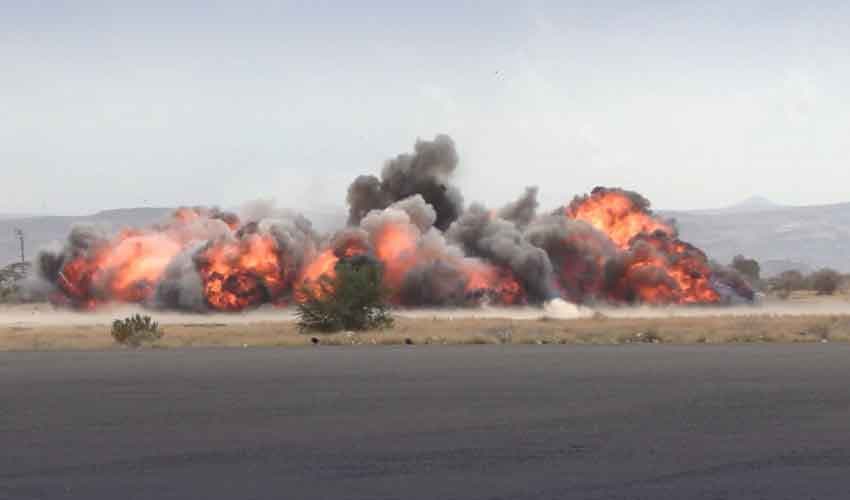
Earlier on Monday, the Houthis accused Saudi Arabia of launching airstrikes on Sanaa International Airport, which is under their control. The group described the attacks as “blatant aggression” and said they had ended the period of de-escalation.
The Houthis vowed to retaliate and warned airlines against using Saudi airspace until what they called the “siege” on Sanaa airport was lifted.
The movement controls Yemen’s capital and most of the country’s northern regions.
Yemeni govt claims airport strike
The strikes on Sanaa airport were claimed by Yemen’s internationally recognised government, which is strongly supported by Saudi Arabia. Many members of the Yemeni government are based in Riyadh.
Yemen’s defence ministry said the runway at Sanaa International Airport had been targeted to prevent an Iranian aircraft from landing in violation of the country’s sovereignty.
The ministry said government forces would respond to any hostile aircraft violating Yemeni airspace “by all available means”.
It also held Iran responsible for the incident.
Iranian plane lands at Hodeidah airport
A spokesperson for the Yemeni armed forces later said the Iranian aircraft had landed at Hodeidah airport, which is also controlled by the Houthis.
Hodeidah is located on Yemen’s Red Sea coast, approximately 150 kilometres, or 93 miles, southwest of Sanaa. It was not clear whether government forces had attempted to prevent the aircraft from landing in Hodeidah.
A Yemeni government minister also accused the Houthis of detaining another aircraft at Sanaa airport. The plane belonged to the International Committee of the Red Cross.
Hachem Osseiran, the ICRC spokesperson for the Middle East, said all staff members and the aircraft’s crew were safe and accounted for.
He declined to provide further details.
Prisoner exchange deal collapses
The escalation followed the collapse of an ICRC-mediated prisoner exchange agreement between the Houthis and Yemen’s internationally recognised government.
Both sides blamed each other for the failure of the deal.
The breakdown was seen as another indication of growing tensions after several years of relative calm between the Houthis and Saudi Arabia.
Yemen has faced civil war and regional proxy conflict for more than a decade. The Houthis seized Sanaa and forced the internationally recognised government to relocate to southern Yemen.
A Saudi-led coalition intervened against the Houthis in 2015. The conflict triggered one of the world’s worst humanitarian crises, leaving millions of people dependent on humanitarian assistance.
Southern separatist advances deepen divisions
Violence intensified again late last year after a separatist movement backed by the United Arab Emirates captured territory in southern Yemen.
The advances further fractured the Saudi-led coalition originally formed to fight the Houthis.
Despite those tensions, the 2022 truce between Saudi Arabia and the Houthis had largely held.
The ceasefire survived broader regional escalation linked to the Israel-Gaza war, during which the Houthis attacked numerous vessels in the Red Sea, as well as the wider conflict involving Iran.
GCC condemns attack on Saudi Arabia
The Gulf Cooperation Council strongly condemned the Houthi ballistic missile attack on Saudi Arabia’s southern region.
GCC Secretary-General Jassim Mohammed Al-Badawi described the attack as a clear violation of international law and international humanitarian law. He said the assault reflected continued attempts by the Houthis to undermine regional peace and stability and target civilians and vital facilities.
Al-Badawi called on the international community to adopt a strong, effective and decisive position against repeated Houthi violations of the ceasefire and international law. He also urged the international community to end what he called the group’s aggressive actions and bring those responsible to justice.
The GCC secretary-general said Saudi Arabia’s security and stability were inseparable from the collective security of all Gulf Cooperation Council member states. He affirmed the council’s full support for all measures taken by Saudi Arabia to protect its security, stability, citizens and residents.
The renewed hostilities now threaten to unravel years of cautious diplomacy and could open another front in an already volatile region.
Pakistan condemns attacks against Saudi Arabia
Pakistan’s Deputy Permanent Representative to the United Nations, Usman Jadoon, strongly condemned the ballistic missile attacks launched by Yemen’s Houthi movement against Saudi Arabia.
Addressing an emergency meeting of the UN Security Council on the situation in the Middle East, Jadoon reaffirmed Pakistan’s full support for Saudi Arabia’s security, sovereignty and territorial integrity.
He called for dialogue to de-escalate growing regional tensions, stressing that diplomacy and restraint should remain the preferred course of action.