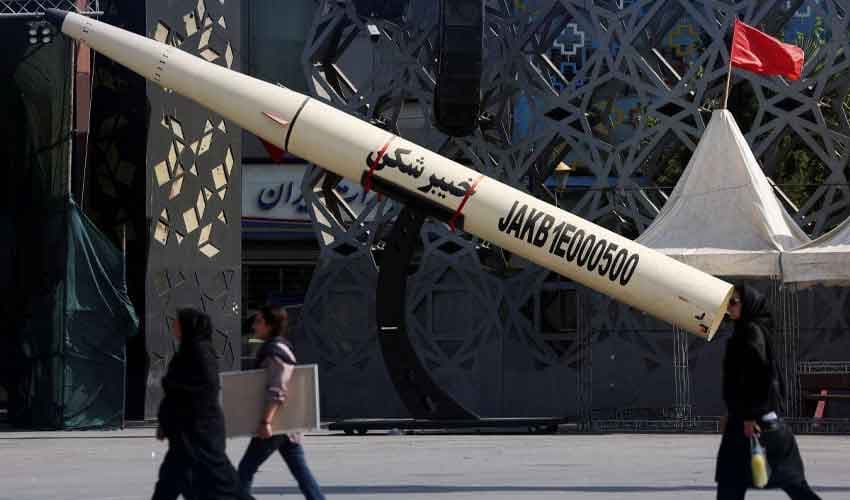
The United States and Iran have exchanged a new wave of missile, drone and air strikes across the Gulf, with Tehran claiming attacks on US-linked military facilities in Bahrain, Kuwait and Jordan while again declaring the Strait of Hormuz closed.
The renewed fighting followed the failure of indirect, Omani-mediated negotiations in Muscat and has cast fresh doubt over an interim US-Iran agreement intended to reopen the vital waterway and end the war after 60 days of further negotiations.
Iran’s Islamic Revolutionary Guard Corps said its retaliatory operation continued into Monday after US forces carried out fresh strikes against Iranian military installations.
The Revolutionary Guards claimed they targeted Sheikh Isa Air Base in Bahrain, Ali Al Salem Air Base and Ahmad Al Jaber Air Base in Kuwait, and Prince Hassan Air Base in Jordan.
According to the IRGC, the attacks were carried out in response to what it described as renewed US aggression against Iranian coastal military bases.
Iran said fuel storage tanks and ammunition depots were set ablaze at Prince Hassan Air Base, which has previously been used by the US military.
Later, the Revolutionary Guards issued another statement saying its naval forces targeted and destroyed US military facilities in Jafirah, Bahrain, and radar systems in Oman as part of reciprocal actions.
They also said an air defense unit destroyed a Low-Cost Uncrewed Combat Attack System (LUCAS) drone belonging to the US military near the Iranian port city of Bandar Abbas on Monday, Mehr News reported.
The Revolutionary Guards also claimed that a command-and-control centre and drone hangars were destroyed in Jordan. It later said a US radar facility had also been targeted.
Jordan’s military rejected parts of the Iranian account, saying it had intercepted and destroyed four Iranian missiles that entered its airspace.
Jordan’s state news agency reported that the attempted attack caused no injuries or material damage.
Bahrain sounds emergency sirens
Emergency sirens sounded in Bahrain early on Monday as authorities urged residents to remain calm and move to the nearest safe location.
Bahrain’s Ministry of Interior issued the public safety advice as Iran claimed it had struck Sheikh Isa Air Base during the second phase of its retaliatory operation.
The headquarters of the US Navy’s Fifth Fleet is located in Bahrain, although it is not based at Sheikh Isa. The Bahraini installation has, however, hosted US military aircraft and operations.
Bahrain said it had intercepted several Iranian aerial attacks during the wider regional escalation.
Iran claims strikes on US systems in Kuwait
Iran’s Revolutionary Guards said Ali Al Salem and Ahmad Al Jaber air bases in Kuwait were also attacked. Both facilities belong to Kuwait but host US military personnel and operations.
In a separate statement, the IRGC claimed that drones and missiles struck US High Mobility Artillery Rocket System, or HIMARS, launchers inside Kuwait.
It alleged that two HIMARS launchers, missile storage facilities and a US ground-to-ground missile base were destroyed.
Kuwait’s military said its armed forces were engaging hostile aerial targets inside Kuwaiti airspace.
It said explosions heard by residents were caused by air-defence systems intercepting incoming attacks and urged the public to follow official safety instructions.
Kuwaiti authorities initially reported no casualties or damage. However, the army later said strikes had caused damage and that an attack on an oil drilling platform injured one worker.
Qatar, Oman and UAE also report attacks
The latest Iranian barrage expanded beyond countries that had recently faced attacks and reached Qatar, which has been involved in efforts to mediate between Washington and Tehran.
Qatar had not been targeted since April. Authorities said three people, including a child, were injured by falling shrapnel. Doha said Iran was fully responsible under international law for the attack.
Iran’s Revolutionary Guards claimed they destroyed a jet maintenance centre and command facility in Qatar.
Qatar has previously said it would not continue acting as a mediator while it remained under attack.
The United Arab Emirates, which had not reported being targeted since early May, said its air defences detected and engaged missile threats outside its borders.
Oman said two of its regions were targeted by drones and later summoned the Iranian ambassador to lodge a formal protest.
The US Embassy in Oman instructed American nationals in Duqm and Musandam to shelter in place.
Iran also claimed it had attacked aircraft-carrier support and refuelling platforms used by US forces in Oman.
In total, six Middle Eastern countries reported being targeted on Sunday: Qatar, Oman, the United Arab Emirates, Jordan, Bahrain and Kuwait.
US launches further strikes on Iran
US Central Command said American forces began another round of strikes against Iran at 5pm Washington time on Sunday, or 2100 GMT.
CENTCOM said the operation was aimed at further reducing Iran’s ability to attack civilian sailors and commercial vessels travelling through the Strait of Hormuz.
The US military said it struck dozens of targets, including Iranian air-defence systems, coastal radar installations, missile and drone capabilities and small military boats.
US fighter aircraft, naval vessels, one-way attack drones and unmanned sea-based attack systems were used in the operation.
CENTCOM spokesperson Tim Hawkins told CNN that US aircraft also shot down an Iranian cruise missile and a one-way attack drone.
President Donald Trump briefly commented on the strikes during a telephone interview with Reuters, saying US forces were heavily attacking Iranian positions.
CENTCOM said American forces had completed another wave of strikes on Sunday after attacking 140 Iranian military targets on Saturday.
The command said more than 300 targets had been struck over three nights in an effort to weaken Iran’s ability to threaten commercial ships and civilian mariners.
Iranian cities report explosions
Iranian media reported explosions in several southern, western and northern parts of the country during the US strikes.
Blasts were reported around the port cities of Sirik and Bandar Abbas, which is home to major Iranian military facilities near the Strait of Hormuz.
Multiple explosions were also reported near Bandar Abbas airport and in other parts of the city. Iranian reports said blasts were heard on Qeshm Island as well as in the southern province of Sistan and Baluchestan.
Iran’s air-defence system was activated in Kermanshah, while explosions were also reported in the northern city of Ahvaz.
An Iranian official said a US strike hit an agricultural water-pumping station in Mahshahr, in the southwestern province of Khuzestan. Khuzestan Deputy Governor Waly Allah Hayati told the official IRNA news agency that one person was killed and four others were injured.
Separately, Iranian media reported that a maintenance worker was killed in a US attack in Hormozgan province.
Two other workers were injured, although Iranian authorities did not immediately provide further details about the nature or location of that strike.
Iran again declares Strait of Hormuz closed
The latest escalation followed another series of attacks on commercial vessels in the Strait of Hormuz, the narrow waterway between Iran and Oman.
Around 20% of the world’s oil normally passed through the strait before the war. The route also carried roughly one-fifth of global oil and liquefied natural gas shipments.
The Revolutionary Guards declared the waterway closed again and said two vessels had been stopped for violating Iranian rules.
Iran alleged that the US military had encouraged the vessels to make illegal movements through the strait.
Tehran said late on Saturday that it closed the route after firing a warning shot that struck a vessel travelling along what it called an unauthorised route.
On Sunday, Iranian authorities said they had disabled a second vessel.
Iran warned that any military response to the incident would be met with a severe reaction.
The recently established Persian Gulf Strait Authority said passage through the waterway was not currently possible because of what it called illegal movements by US military forces in the region. It said transit permits would be issued once stability and calm had been restored.
Iran has sought to establish a permanent system for authorising shipping and collecting transit charges in the strait. It has repeatedly warned ships not to enter without approval.
US rejects Iranian claim of control
US Central Command rejected Iran’s declaration, saying the strait remained an international waterway open to lawful traffic.
“Iran does not control the strait. Traffic is flowing,” CENTCOM said.
Trump also said during an interview with NBC’s Meet the Press that the Strait of Hormuz remained open to commercial shipping.
The US Navy-led Joint Maritime Information Center said the security threat remained severe but advised that an expanded southern route near Oman was available for two-way traffic.
Washington said US forces were positioned to defend freedom of navigation against what it described as Iranian aggression, harassment, threats and arbitrary declarations.
The United States revoked a licence authorising sales of Iranian crude on Tuesday following earlier attacks on international shipping.
Container ship attacked near Oman
The US military said its Saturday strikes followed an attack by Islamic Revolutionary Guard Corps forces on the Cyprus-flagged container ship GFS Galaxy while it was transiting the strait.
India said one of its citizens was missing after the vessel was attacked off the coast of Oman.
Omani authorities said 23 crew members were rescued.
Qatar advised all vessels to suspend maritime activities, including commercial ships, leisure boats, fishing vessels and jet skis.
The attacks on shipping have added to international concerns about the security of one of the world’s most important energy routes.
Failed Oman talks precede escalation
The latest attacks and counterattacks came after a new attempt at indirect talks in Oman failed to produce an agreement on Saturday.
Iranian Foreign Minister Abbas Araqchi and his Omani counterpart discussed possible arrangements for the safe passage of vessels through the Strait of Hormuz.
Washington had been seeking a public Iranian commitment guaranteeing free and secure transit through the waterway.
Iran’s Foreign Ministry said negotiations in Muscat focused on the management of the strait and designated transit routes. The ministry said no result was achieved because of what it described as overt and covert US pressure on Oman.
The failed discussions further weakened prospects for restoring an interim agreement signed in June.
That arrangement was intended to reopen the Strait of Hormuz and create conditions for ending the war after a further 60 days of negotiations.
Trump has left the door open to additional talks but said during the past week that he considers the ceasefire linked to the June memorandum of understanding to be over.
Iran’s top negotiator, Mohammad Baqer Qalibaf, said the period of one-sided agreements had ended and warned Washington to honour its commitments or face consequences.
Iran says attacks were self-defence
Iranian Foreign Ministry spokesperson Esmail Baghai said the attacks on US military bases were carried out under Iran’s right to self-defence.
He said it was wrong to hold Iran responsible for defending itself and argued that countries allowing the United States to use military bases on their territory must also answer for US actions.
Baghai accused the United Nations of repeatedly ignoring Iran’s position. He called for those responsible for violating international law to be held accountable.
The spokesperson also urged the United Nations to use what Iran considers the correct name for the Persian Gulf. Baghai said the latest US strikes had rendered months of diplomatic efforts ineffective.
Iran’s Foreign Ministry separately condemned the weekend US attacks as aggressive.
War places interim agreement in doubt
The renewed violence has raised further questions about the future of the interim US-Iran arrangement and the possibility of resuming ceasefire negotiations.
The conflict began on February 28 when the United States and Israel launched attacks against Iran.
Since then, Tehran has targeted countries hosting US military bases, destabilising the Gulf and placing major energy routes at risk.
Iran’s effective blockade and restrictions in the Strait of Hormuz have pushed energy prices higher and contributed to global inflation.
Rising fuel costs, particularly gasoline prices, are politically sensitive for Trump ahead of the US congressional elections in November.
With diplomatic efforts stalled and attacks spreading across the Gulf, there is no immediate indication that either Washington or Tehran is preparing to halt military operations.