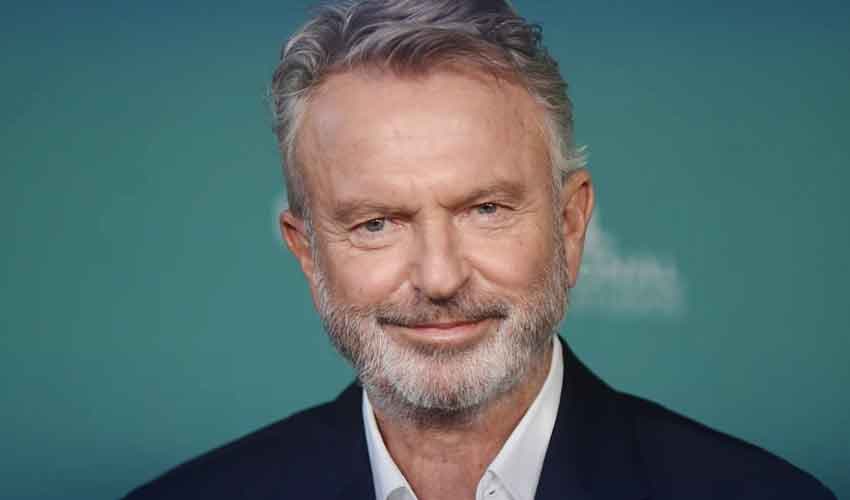
Sam Neill, the versatile New Zealand actor who won worldwide recognition as palaeontologist Dr Alan Grant in the Jurassic Park films, died suddenly on Monday at the age of 78.
His family announced that he died in Sydney on July 13 surrounded by loved ones. No cause of death was disclosed, but the family said his passing was “sudden and unexpected” and noted that he had remained cancer-free.
A statement shared through Neill’s official Instagram account said the actor passed away with the dignity that had characterised his life.
His family thanked the medical team at St Vincent’s Private Hospital in Sydney for the care provided to him and requested privacy while dealing with the loss.
View this post on Instagram
The statement said further information would be released later.
Neill had announced in April that scans showed no remaining signs of cancer after he underwent treatment for stage-three angioimmunoblastic T-cell lymphoma, a rare form of blood cancer.
Anthony Albanese pays tribute
Australian Prime Minister Anthony Albanese paid tribute to Neill, recalling his contribution to some of Australia’s most beloved film and television stories.
Albanese said Neill had earned a “special place in Australian hearts” through his dry humour, thoughtful personality and understated style.
He said the actor confronted illness with the same dignity, humour and determination that defined his performances, adding that he would be deeply mourned and remembered for years to come.
Neill was born Nigel John Dermot Neill in Omagh, Northern Ireland, in 1947. His mother was English, while his New Zealand-born father was serving in the British Army at the time of his birth. The family moved to New Zealand in 1954.
He began calling himself Sam at the age of 12 because there were several boys named Nigel at his school. Neill later joked that Sam allowed him to move through life more easily, while Nigel felt like an awkward name for a film actor.
He attended school and university in Christchurch but did not initially plan to become an actor. After what he described as a disastrous year studying law, Neill began appearing in Canterbury University theatre productions and discovered his interest in acting.
He eventually moved to Wellington and joined the Downstage Theatre as a professional performer.
Neill recalled receiving around $35 a week, along with any food left in the theatre kitchen after meals had been served to audience members.
Breakthrough in New Zealand cinema
After taking several small roles on local television, Neill secured his breakthrough performance in the 1977 political thriller Sleeping Dogs.
The film became one of the first New Zealand productions to secure a theatrical release in the United States and helped place Neill on the international film industry’s radar. He followed it with a leading role opposite Judy Davis in the acclaimed Australian period drama My Brilliant Career in 1979.
Neill subsequently portrayed Damien Thorn, the son of the devil, in Omen III: The Final Conflict in 1981. That year, he also appeared in Polish filmmaker Andrzej Żuławski’s surreal psychological horror film Possession, which later developed a strong cult following.
His growing list of major roles included the 1982 adaptation of Ivanhoe. The production made him particularly popular in Sweden, where it became a television tradition shown around New Year for decades.
Neill appeared alongside Nicole Kidman and Billy Zane in Phillip Noyce’s psychological thriller Dead Calm in 1989. He also played Michael Chamberlain opposite Meryl Streep’s Lindy Chamberlain in the 1988 biographical drama Evil Angels, released in some markets as A Cry in the Dark.
In 1990, Neill appeared as Russian naval officer Captain Vasily Borodin in John McTiernan’s submarine thriller The Hunt for Red October.
These performances established him as an actor capable of moving comfortably between independent productions, historical dramas, thrillers and major Hollywood films.
‘Jurassic Park’ brings worldwide fame
Neill reached a new level of international fame in 1993 when Steven Spielberg cast him as the intelligent but reluctant palaeontologist Dr Alan Grant in Jurassic Park.
The role was reportedly first offered to Harrison Ford before Neill was selected to lead the blockbuster.
His portrayal of Grant — a scientist forced to protect two children while surviving an island overrun by dinosaurs — became the most widely recognised performance of his career.
Neill returned to the character in Jurassic Park III in 2001 and reunited with original co-stars Laura Dern and Jeff Goldblum for Jurassic World Dominion in 2022.
Months before his death, Neill again worked with Dern and Goldblum for a commercial directed by Taika Waititi.
Acclaimed performance in ‘The Piano’
The same year that Jurassic Park was released, Neill appeared in Jane Campion’s Oscar-winning drama The Piano. He played Alisdair Stewart, a stern and emotionally distant New Zealand settler who enters an arranged marriage with a mute pianist portrayed by Holly Hunter.
The contrasting performances in Jurassic Park and The Piano demonstrated Neill’s ability to move between large-scale commercial cinema and complex art-house storytelling.
Throughout his career, he frequently played romantic leads, complicated authority figures, charismatic villains and morally ambiguous men.
Neill once explained that he tried to reveal the contradictions and hidden qualities within his characters because he believed real people were rarely entirely heroic or villainous.
More than 150 film and television credits
Neill accumulated more than 150 screen credits during a career spanning five decades. His notable film roles included The Jungle Book, In the Mouth of Madness, Event Horizon, The Horse Whisperer, Bicentennial Man, The Dish and Peter Rabbit.
In John Carpenter’s 1994 horror film In the Mouth of Madness, Neill played insurance investigator John Trent, whose investigation into a missing author leads him into a terrifying and increasingly unstable reality.
He portrayed the captain of a doomed spacecraft in Paul W.S. Anderson’s 1997 science-fiction horror film Event Horizon.
In The Horse Whisperer in 1998, he played the father of Scarlett Johansson’s character, while in Bicentennial Man in 1999, he appeared as the head of a family whose domestic robot, played by Robin Williams, gradually develops human qualities.
Neill was also considered one of the leading candidates to succeed Roger Moore as James Bond.
He completed a screen test for the role in 1986, but Timothy Dalton was eventually selected as the next actor to play the British secret agent.
In 2016, Neill starred in Taika Waititi’s hit New Zealand comedy-drama Hunt for the Wilderpeople. He played Hector, a reclusive farmer who becomes the subject of a nationwide manhunt alongside his foster child.
The film’s success introduced Neill to a new generation of viewers and led to brief appearances in Waititi’s Marvel films Thor: Ragnarok and Thor: Love and Thunder.
Memorable television performances
Neill also enjoyed an extensive television career and earned Golden Globe and Primetime Emmy nominations for his work. He portrayed real-life British spy Sidney Reilly in the 1983 miniseries Reilly, Ace of Spies, earning a Golden Globe nomination.
He later played the legendary magician Merlin in television miniseries broadcast in 1998 and 2006.
Neill appeared as Cardinal Thomas Wolsey in The Tudors and as corrupt police officer Major Chester Campbell in the acclaimed crime drama Peaky Blinders. His other television work included The Twelve, Apples Never Fall and voice appearances in The Simpsons and Rick and Morty.
In the 2024 series Apples Never Fall, he played a husband whose wife mysteriously disappears.
Sam Neill’s cancer diagnosis
Neill disclosed in his 2023 memoir, Did I Ever Tell You This?, that he had been diagnosed with stage-three angioimmunoblastic T-cell lymphoma in 2022. He first noticed swollen glands while promoting Jurassic World Dominion and subsequently began chemotherapy.
By the time his memoir was published, the disease was in remission, but Neill said he continued to receive monthly treatment.
At one stage, he described an arrangement under which the cost of an ongoing medication would be covered after he survived the initial months of treatment.
When conventional chemotherapy eventually stopped working, Neill participated in an Australian clinical trial involving CAR T-cell therapy. The treatment modifies a patient’s immune cells so they can identify and destroy cancer cells more effectively.
Neill announced in April 2026 that a scan had shown no cancer remaining in his body, describing the result as extraordinary and expressing support for wider access to the treatment in Australia and New Zealand.
His family stressed in announcing his death that he remained cancer-free.
Neill said he did not fear death
While discussing his illness in 2023, Neill said he was not frightened of dying, although he admitted that dying would frustrate him because he still had much he wanted to experience. He wanted more time to watch the olive trees, cypress trees and terraces on his property mature.
Above all, he wanted to see his grandchildren grow older.
Neill also said he dreaded the possibility of retirement and remained eager to continue acting. He described the opportunity to work internationally as deeply appealing for someone who had grown up in a small and geographically isolated country.
Away from film sets, Neill lived on a farm and operated a winery called Two Paddocks in New Zealand’s Central Otago wine region. He jokingly described winemaking as an extremely time-consuming and expensive business that remained worthwhile because it was satisfying and enjoyable.
Neill frequently shared humorous videos and photographs from the farm on social media. He named several of his animals after actors and colleagues, including a chicken named Laura Dern, a duck named Kylie Minogue and a cow named Helena Bonham Carter.
His life as a winemaker became an important part of his public personality, with fans enjoying his understated humour and affection for his animals.
Honours for services to acting
Neill was appointed an Officer of the Order of the British Empire in 1991 for his contribution to acting. In 2007, he was appointed a Distinguished Companion of the New Zealand Order of Merit.
After changes to New Zealand’s honours system allowed recipients to convert the distinction into a knighthood, Neill accepted the title of Knight Companion of the New Zealand Order of Merit in 2022.
The honour formally gave him the title Sir Sam Neill.
Neill sometimes described his family life as somewhat haphazard because of the demands of his international acting career. He is survived by four children: Andrew, Tim, Elena and Maiko.
Andrew was placed for adoption when Neill was in his early twenties. Father and son were reunited in 1994. Tim was Neill’s son with actor Lisa Harrow, while Elena was his daughter with makeup artist Noriko Watanabe.
Neill adopted Maiko, Watanabe’s daughter from a previous marriage. He is also survived by six grandchildren.
Neill’s career was marked by a rare ability to move between Hollywood blockbusters, intimate independent films, television dramas, horror movies and New Zealand comedies.
Whether facing dinosaurs as Alan Grant, portraying a troubled husband in The Piano, investigating supernatural terror in In the Mouth of Madness or playing a corrupt policeman in Peaky Blinders, he brought intelligence, restraint and dry humour to his performances.
His death brings to an end one of the most varied screen careers to emerge from New Zealand, leaving behind a body of work that crossed genres, generations and national borders.