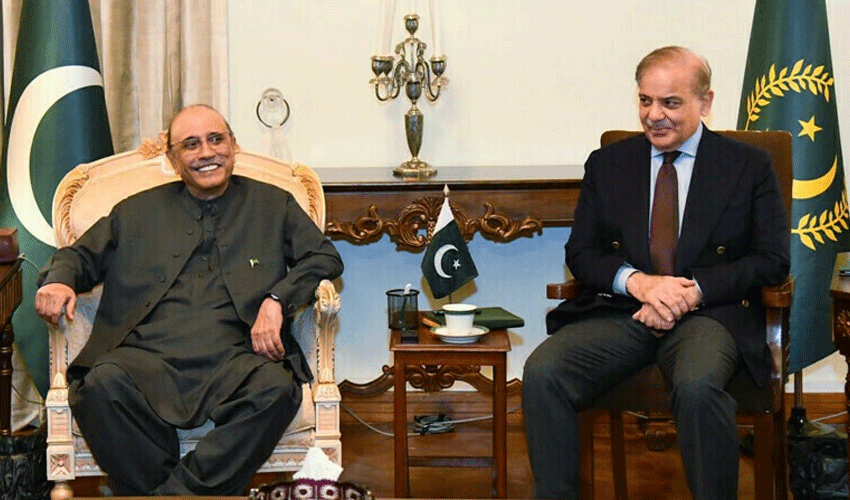
President Asif Ali Zardari on Sunday warned that while Pakistan does not seek conflict with India, any future aggression would be met with “more and bigger surprises than before,” as he lauded the country’s armed forces for their performance during recent hostilities.
The president made these remarks during a high-level meeting with Prime Minister Shehbaz Sharif at Aiwan-e-Sadr, where the two leaders discussed the evolving regional situation following the recent ceasefire between India and Pakistan. Also present during the meeting were Punjab Governor Saleem Haider and National Assembly Speaker Ayaz Sadiq.
According to sources familiar with the development, PM Shehbaz briefed the president on the current security situation, his recent foreign visits, and the government’s diplomatic efforts to counter what he described as “India’s false narrative.”
The meeting comes amid continued tension between the two nuclear-armed neighbours following the April 22 Pahalgam incident, which India has blamed on Pakistan. In the aftermath, diplomatic relations between Islamabad and New Delhi deteriorated sharply, leading to tit-for-tat measures including suspension of the Indus Waters Treaty by India and a complete diplomatic and trade freeze by Pakistan.
President Zardari, while commending the armed forces, said, “Pakistan has written a new chapter in this century’s military history. We are a peaceful nation but will not remain silent if war is imposed. The response will be stronger than ever before.”
PM, echoing the President’s sentiments, said Pakistan’s defensive operations had earned global recognition and sympathy. “The world has seen Pakistan’s commitment to peace and its capability in warfare. The global response in our favour is itself a strategic victory,” he said.
Mr Sharif also highlighted the importance of regional alliances, terming the country’s ties with China, Türkiye and Azerbaijan as a “new chapter in strategic diplomacy.” He directed the diplomatic corps to actively counter Indian propaganda at international forums.
The April 22 attack in Indian-administered Kashmir’s Pahalgam was a flashpoint that quickly escalated tensions. India retaliated by suspending the Indus Waters Treaty, restricting Pakistani diplomatic presence, and expelling Pakistani patients and visitors.
Pakistan, in turn, called the suspension of the treaty a “declaration of war,” reduced Indian diplomatic staff, revoked Indian visas except for Sikh pilgrims, and closed its airspace to Indian flights.
Tensions peaked on the night of February 6 and 7 when India launched coordinated missile strikes on six Pakistani locations, including Kotli, Bahawalpur, Muridke, Bagh and Muzaffarabad, resulting in 26 civilian deaths and 46 injuries.
Pakistan responded by downing five Indian warplanes, three of which were Rafale jets, in a swift counteraction.
On February 10, India targeted Pakistani airbases using drones and missiles. Pakistan's subsequent response—code-named Operation Banyan Marsus—struck strategic sites across India, including Udhampur, Pathankot and Adampur airbases, as well as BrahMos missile storage facilities and elements of the S-400 missile defence system.
The two sides later agreed to an uneasy ceasefire, brokered behind the scenes by international actors including China and the United Arab Emirates. However, threats of renewed escalation continue to loom large, with Islamabad accusing New Delhi of maintaining an aggressive posture.
Despite the fragile calm, both civilian and military leadership in Pakistan appear to be bracing for the possibility of future flare-ups.