




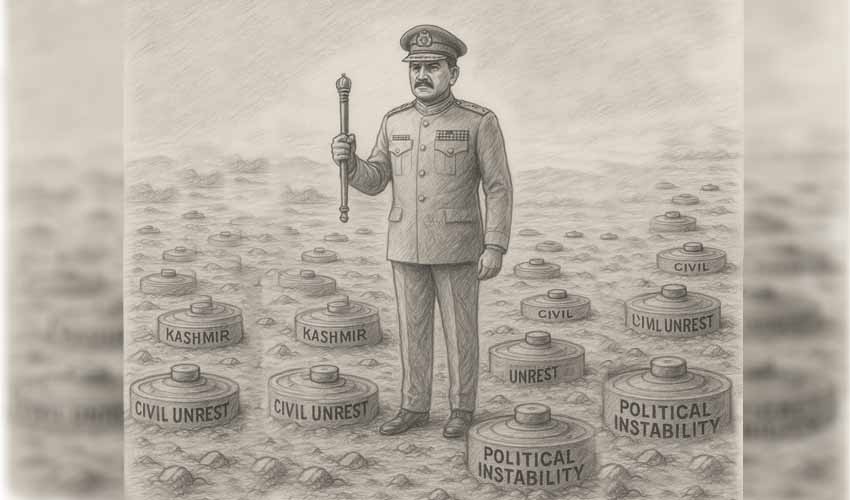
What looks like an honor is in truth a burden, and a heavy one. The conferment of the field marshal’s baton upon Chief of Army Staff General Asim Munir marks an important moment in Pakistan’s history. This is only the second time the nation has witnessed this elevation – and that too after 66 years – reminding us of the armed forces’ important role in protecting the country's sovereignty. However, if this honorary elevation is to mean more, it must serve as a turning point, not just in how the country projects its strength but in how it pursues stability.
The recent tragic attack on a school bus in Khuzdar, Balochistan, which left at least eight people dead and dozens injured – with several still fighting for their lives in hospitals – serves as a warning that even in moments of institutional pride, the threat is far from over. The Corps Commanders’ Conference rightly identified the evolving contours of external threats, especially the use of proxies and hybrid tactics by hostile actors. It is clear now that enemies of Pakistan prefer covert destabilization to conventional warfare. These threats demand a calibrated and multi-institutional response that goes beyond strategic victories to long-term prevention.
While counter-terrorism efforts against foreign-backed militants can buy some breathing space in Balochistan, the state must match them with a deeper commitment to local engagement, infrastructure, and education
Policymakers must understand that external threats do not operate in a vacuum. They exploit vulnerabilities, some of which are internal. Therefore, in order for the military's success to take root, there must be equal focus on governance, development, and inclusion. While counter-terrorism efforts against foreign-backed militants can buy some breathing space in Balochistan, the state must match them with a deeper commitment to local engagement, infrastructure, and education. In other words, as the military secures the land, civilian leadership must strive to win the hearts and minds of the people.
It is heartening to see the corps commanders vowing to pursue all facilitators and proxies of terrorism “with unrelenting resolve”. This commitment reflects strong institutional clarity that the nation badly needs. However, this clarity must also be mirrored in policy that is clear in intent, consistent in action, and humane in impact.
Meanwhile, Field Marshal General Asim Munir’s elevation also reaffirms to the nation that civil-military cooperation must remain grounded in constitutional order and shared purpose. Then there is, of course, cause for pride. The successful conclusion of Operation Bunyan-um-Marsoos, especially the containment of provocations during Marka-i-Haq, shows that Pakistan is not passive in the face of aggression.
The corps commanders’ emphasis on regional stability, particularly regarding Indian Illegally Occupied Jammu and Kashmir, is also timely. With tensions rising and diplomacy under strain, Pakistan must continue to raise its voice for justice for the oppressed Kashmiris through a consistent foreign policy, global engagements, and advocacy drives.
Moreover, as the country celebrates its successes, it must not lose sight of the longer game. National strength lies not in ranks and medals alone but in security that reaches every region and community. Pakistan is not at the end of a war. It is in the middle of a struggle that requires stamina, patience, and unity. For now, the baton conferred signals not just honor bestowed but responsibility embraced.