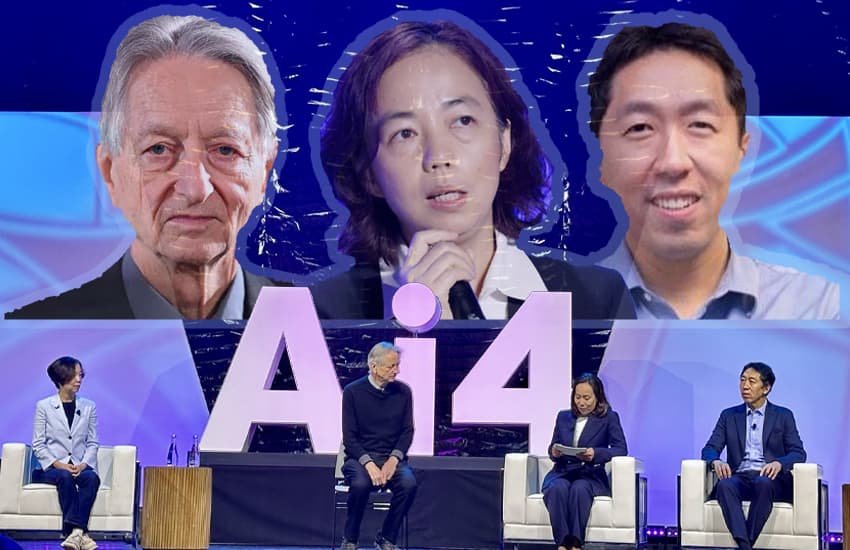
Four of artificial intelligence’s most prominent researchers said on Thursday that within five to six years, AI could help the world announce the eradication of illiteracy, as they used the second-day keynote of the AI4 2026 conference to argue that fear, not automation, is the biggest threat AI poses to jobs today.
The panel, comprising Nobel laureate Geoffrey Hinton, ImageNet creator Fei-Fei Li, DeepLearning.AI founder Andrew Ng and moderated by Washington Post Intelligence Deputy Editor Yun-Hee Kim, was asked what single AI-related headline the world might wake up to in the next five to six years.
“I think that we have a chance... in five years to create a headline that, with AI as a tool, the world announces the eradication of illiteracy,” said Li, who is also chief executive of World Labs and a founding co-director of Stanford’s Human-Centered AI Institute.
Hinton, who won the 2024 Nobel Prize in Physics for his work on the foundations of modern AI systems, said the technology is already changing the nature of jobs rather than eliminating them. He cited a health service caseworker who used to spend about half an hour drafting a written response to each complaint she handled. With an AI system producing the first draft, he said, the task now takes minutes, leaving her to review and correct the letter rather than write it from scratch.
Feeding Fears
The panelists said only about 1.5% of jobs have been adversely affected by AI so far, compared with widely circulated claims that as much as half the workforce has already been reshaped by the technology. They said no such disruption has taken place, and argued that jobs have in fact become more secure, more accessible and greater in number since generative AI tools became widely available.
“Companies developing AI have a huge vested interest in telling you two things,” Hinton said. “One, there’s no chance it will go well. And two, it won’t cause much unemployment.”
Hinton said software engineering, a profession widely predicted two years ago to be hit hardest by generative AI, has instead seen demand for engineers grow as AI tools take over routine code generation and engineers move into building and supervising AI agents. He said the same fear had been raised years earlier about other technical professions and had proven wrong each time, and that the pattern with coding was repeating itself.
He said a similar shift is playing out in contact centers. Reaching a human agent has become less difficult, not more, Hinton said, because AI is absorbing the repetitive cost of processing routine calls and emails, freeing staff to do more valuable work. He said the underlying task of a contact center employee is increasingly about motivating and assisting customers rather than processing volume, and that AI has made that shift possible rather than blocking it.
Public Trends & Legislation
Hinton also said fear of AI is affecting young people directly, beyond the labor market. He recounted a conversation with a high school student who told him she felt discouraged from writing because she could not match the fluency of an AI chatbot’s prose. He said the wider public narrative around job losses has made it harder, not easier, for governments to legislate on AI, since a frightened public tends to produce reactive policy rather than considered policy.
Pay The Authors
On compensation, Hinton said authors and other creators whose work has trained large language models should be paid for that data, and dismissed the argument made by major AI companies that negotiating individually with millions of authors is impractical.
“We have things called AI engines, and AI engines are very good at doing things like that,” he said. He argued that AI systems could themselves handle the negotiation process on behalf of companies, contacting rights holders, securing consent and agreeing a price, whether a flat licensing fee or an ongoing royalty. “I don’t see any reason why we can’t have a system like that,” he said, adding that legislation should be built around that principle.
Open & Closed Sources
Li used part of her remarks to challenge the framing of AI development as a binary contest between open source and closed, proprietary models, calling it a false debate. She compared the situation to nuclear physics, where basic scientific research is conducted openly even though the most sensitive downstream applications, such as uranium enrichment, remain tightly controlled. She said AI development would likely settle into a similar spectrum of openness rather than resolve into a single model.
She cited the mapping of the human genome in the 1990s as a precedent. A private company and a publicly funded academic consortium of universities were racing to complete the genome sequence first, she said. Had the private effort won outright and patented the results, she said, the technology could have been kept out of reach of the wider scientific and pharmaceutical community. Instead, both efforts were announced jointly by the Clinton administration, and the resulting public data set became the foundation for years of subsequent drug discovery research that benefited both the private and public sectors.
“This debate, especially at the sweeping level of we can only tolerate one, is a false debate,” Li said. She said journalists covering AI have a responsibility to move past that framing. “We need to get to the level of nuance... we need to look at what is the nuance and when and where and how to use these different kinds of openness or closed models,” she said.
Ng, founder of DeepLearning.AI and a former head of Google Brain, joined Hinton and Li on the panel, which was framed throughout around the argument that Silicon Valley has failed to invest adequately in communicating AI’s effects to the public, and that this failure, more than the technology’s actual impact, is driving the current wave of public anxiety over jobs.
Kim, moderating the session, pressed the panelists on how quickly new categories of jobs tied to AI could emerge. Hinton said he did not have a complete picture of how fast new roles would appear, but said the more urgent problem was correcting the public narrative around job losses so that legislation and education policy could be based on accurate information rather than fear.
All four speakers agreed AI has created jobs and will keep creating them, and that today's fear outpaces today's damage. None of them disputed the longer-term claim that AI systems will eventually outperform humans at most tasks as training data and compute continue to scale. What they disputed was the timeline being sold to the public, not the destination itself. That distinction, left largely unexamined on stage, is likely to outlast the conference.
The keynote was one of the marquee sessions of the AI4 2026 conference, which has drawn technology executives, policymakers and researchers to discuss the direction of AI development over the next five to 10 years.