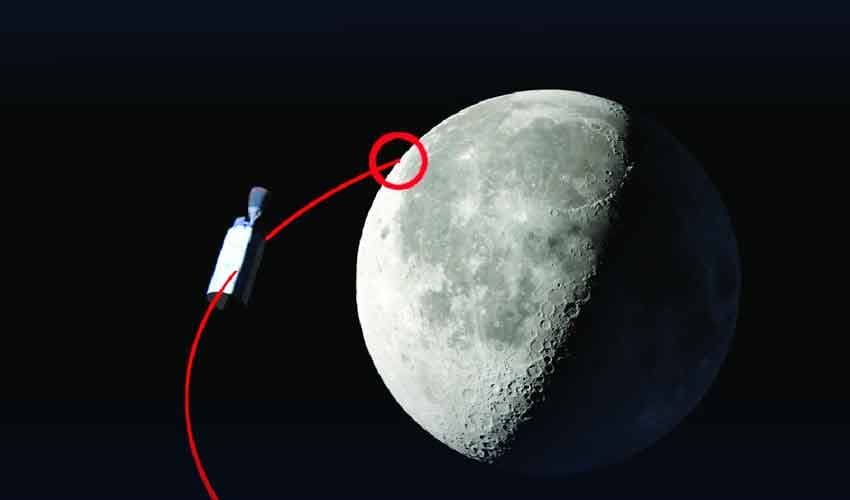
A discarded SpaceX Falcon 9 rocket stage was expected to slam into the Moon at high speed early Wednesday in an unplanned impact that could offer scientists valuable data.
The development came as SpaceX CEO Elon Musk outlined ambitious goals for the company's next Starship test flight.
The school bus-sized object was the second stage of a SpaceX Falcon 9 rocket that launched a lunar lander from Firefly Aerospace toward the Moon in January 2025.
Weighing around 4 metric tons (4,000 kilograms), the rocket body was expected to impact the Moon at approximately 2:35am ET (0635 GMT) while travelling at nearly 5,400 mph (8,690 kph).
Scientists said the impact was unlikely to be confirmed immediately because none of the spacecraft orbiting the Moon were positioned to observe it live. Confirmation was expected several hours later through telescope imagery from observatories in the Americas, according to the BBC.
Impact expected near Einstein Crater
The rocket stage was expected to strike Einstein Crater, located on the Moon's western limb, a region that is often difficult to observe from Earth.
The collision was expected to create a plume of lunar dust illuminated by sunlight. However, experts said the dust cloud would likely be too faint to be visible with the naked eye from Earth.
SpaceX stressed that the impact was unintentional.
How the rocket ended up on collision course
Normally, Falcon 9 second stages re-enter Earth's atmosphere after completing their mission, burning up or falling into the ocean after delivering payloads into orbit.
However, the January 2025 lunar mission required extra thrust, leaving the rocket's second stage stranded in space after it exhausted its fuel. It joined thousands of pieces of orbital debris that active satellites must avoid.
Earlier this year, astronomers determined that the uncontrolled rocket body had entered an orbital path that would eventually intersect with the Moon.
SpaceX Director of NASA Science and Dragon Programs Julianna Scheiman said the unusual trajectory resulted from a combination of solar activity and gravitational forces.
"What has happened is essentially a mixture of solar activity and gravity forces have put it on a path toward the moon," Scheiman told reporters.
Astronomer Bill Gray, creator of widely used astronomy software, said the impact may provide a modest scientific opportunity.
Gray said researchers could learn from the collision while noting that it also highlights shortcomings in how space agencies dispose of orbital hardware.
He emphasized that the impact posed no danger to people, although it underscored the growing challenge of managing space debris.
Rare lunar impacts by space hardware
Space junk striking the Moon remains uncommon.
A Chinese rocket stage crashed into the lunar surface in March 2022 after completing a test mission.
In 2009, NASA intentionally crashed a rocket stage into the Moon to study the cloud of material produced by the impact.
Several lunar landing missions have also ended in crashes. Russia's Luna-25 mission lost control and crashed in 2023, leaving behind what experts believe is a harmless plutonium-238 power source.
India's Chandrayaan-2 lander and Israel's Beresheet spacecraft both crashed in 2019. The Israeli lander was carrying microscopic tardigrades, extremely resilient organisms that may still remain on the lunar surface.
NASA also deliberately crashed stages from its Saturn V Moon rockets during the 1970s to study lunar seismic activity.
NASA, SpaceX working to prevent future impacts
Scheiman said NASA and SpaceX are discussing measures to avoid similar accidental lunar impacts in the future.
The issue is becoming increasingly important as NASA prepares to establish a lunar base and conduct routine astronaut missions under its multibillion-dollar Artemis program later this decade. Uncontrolled space debris could threaten future infrastructure on the Moon.
SpaceX eyes next Starship test later this month
Alongside the lunar impact news, Elon Musk announced that SpaceX is targeting its 14th Starship flight test later this month, pending regulatory approval.
The upcoming mission aims to place the first batch of upgraded V3 Starlink satellites into orbit before attempting something never achieved before—returning Starship's upper stage to land at the launch site.
Musk said the idea of recovering the upper stage had been under consideration throughout the year, depending on the success of previous test flights.
First attempt to catch Starship upper stage
If approved, SpaceX will attempt to catch the upper stage using giant mechanical arms attached to the launch tower in Texas.
The company has already successfully recovered the Super Heavy booster using the tower's arms on three occasions, most recently in March 2025.
For the next test, Super Heavy would still splash down in the Gulf of Mexico, but Musk said SpaceX ultimately wants the tower to recover both stages during the same mission.
The plan involves catching the booster first, moving it aside, and then catching the returning upper stage roughly 90 minutes later after it completes one orbit around Earth.
Starlink expansion remains key objective
The 14th Starship mission will also deploy the first V3 Starlink satellites, which Musk said are expected to provide 10 times more broadband capacity and data density than previous generations.
SpaceX eventually plans to launch 60 V3 Starlink satellites per Starship mission, significantly increasing the capacity of its rapidly expanding satellite internet network.
The company said Starlink launches now make up an increasing share of its missions as satellite internet revenue continues to outpace its other business operations.
Musk said the timing of the next Starship flight depends on regulatory approval but expressed confidence that launch frequency will increase dramatically.
"Assuming we receive regulatory approval to do so, we'll attempt to catch the ship with the tower on the next flight," Musk said, adding that the launch is tentatively planned for the end of the month.
Looking further ahead, Musk predicted that SpaceX could eventually conduct at least one Starship launch every day, possibly even more, within about a year.