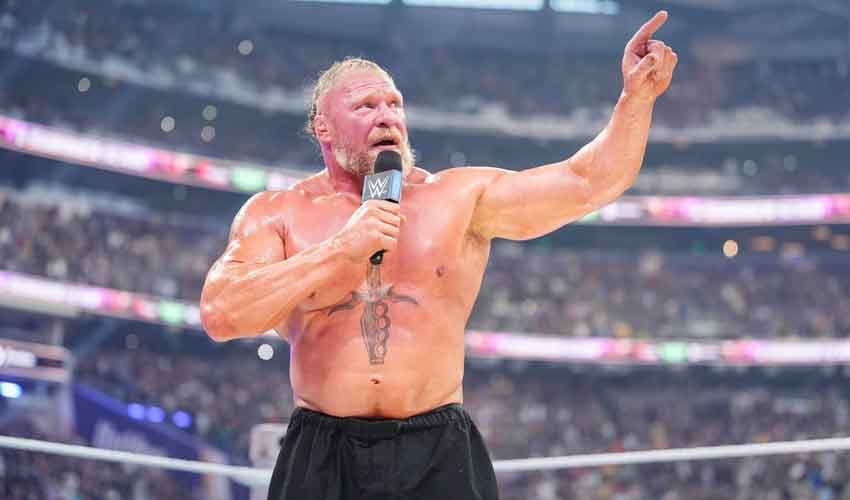
Brock Lesnar has officially announced his retirement from professional wrestling and mixed martial arts, bringing an end to one of the most successful crossover careers in combat sports history.
The former UFC heavyweight champion and WWE icon confirmed the decision during an appearance on The Pat McAfee Show, just days after what turned out to be his final WWE appearance at SummerSlam.
Lesnar ended months of speculation about his future by announcing that he is officially retiring from in-ring competition.
"I'm here today to do this interview to let the world and everybody know that I am retired and I wanted to say a big thank you to everybody," Lesnar said.
The 49-year-old explained that SummerSlam convinced him it was finally time to walk away from both professional wrestling and mixed martial arts.
Emotional decision after SummerSlam
Lesnar revealed that he had first considered retirement after being slammed by Oba Femi at WrestleMania but initially believed he still had more to accomplish.
"Saturday was a very emotional day for me. It's kind of weird because when Oba Femi slammed me at WrestleMania, I was like, 'I can't do this again.' I thought I still had fuel in the tank, but Saturday, that's it for Brock Lesnar. That's it for me in the squared circle and for everything else, too," he said.
His comments confirmed that SummerSlam ultimately became the defining moment in his decision to end his combat sports career.
From WWE rookie to global superstar
Lesnar's professional wrestling journey began in 2000 when he joined Ohio Valley Wrestling (OVW), WWE's developmental territory.
He made his WWE main roster debut in 2002 and was immediately promoted as "The Next Big Thing," rapidly becoming one of the company's biggest attractions.
However, Lesnar left WWE in 2004 after growing frustrated with the demanding travel schedule associated with full-time wrestling.
Following his departure, Lesnar recovered from injuries sustained in a motorcycle accident and attempted to pursue a career in American football. He participated in training camp and preseason games with the NFL's Minnesota Vikings.
Although he later received an opportunity to join the club's European affiliate, Lesnar declined the offer and chose to remain in the United States with his family.
Lesnar then transitioned into mixed martial arts, where he quickly established himself among the sport's elite competitors. He won the UFC heavyweight championship and secured notable victories over Frank Mir, Randy Couture and Shane Carwin.
His final UFC appearance came in 2016 against Mark Hunt. Although Lesnar originally won the fight, the result was later changed to a no contest after he failed a drug test, which also resulted in legal action from Hunt.
Return to WWE as 'The Beast Incarnate'
After returning to WWE, Lesnar reinvented himself as "The Beast Incarnate" and became one of the promotion's most dominant and marketable superstars.
During this phase of his career, he captured multiple world championships and remained one of WWE's biggest attractions for more than a decade.
Retirement focused on family
Now living in Canada, Lesnar said retirement will allow him to spend more time with his family and support his children's ambitions.
"I've got some hunting lined up and I've got two boys in hockey, I'm going to support their dreams as long as that's feasible," he said.
"My daughter has her eye on the 2028 Olympics. I'm just going to spend more time with the kids, enjoy the outdoors and enjoy life."
Lesnar retires as one of the most accomplished athletes in professional wrestling and combat sports.
His WWE achievements include seven WWE Championships, three Universal Championships, the 2002 King of the Ring tournament victory, and Royal Rumble wins in 2003 and 2022.
Outside WWE, he also captured the NCAA Division I heavyweight wrestling championship and the UFC heavyweight championship, making him one of the rare athletes to achieve elite success across amateur wrestling, professional wrestling and mixed martial arts.
With championships spanning multiple sports and a career that transformed him into a global icon, Brock Lesnar leaves behind a legacy that ranks among the greatest crossover athletes of all time.