US President Donald Trump has announced what he described as a "historic" agreement for the complete disarmament of Hamas and other armed groups in Gaza, marking what he called a major milestone in his Gaza peace initiative.
While Hamas has acknowledged progress and agreed to a roadmap in principle, Israeli officials have expressed reservations, saying the proposal does not fully meet Israel's security demands.
President Donald Trump announced on Thursday that talks in Cairo between mediators and Hamas leaders had resulted in an agreement for the complete disarmament of Hamas and all other armed groups in Gaza.
In a post on Truth Social, Trump described the deal as a "historic" and "monumental step toward lasting peace and security," saying the disarmament would take place in carefully structured phases under his broader 20-point Gaza peace plan.
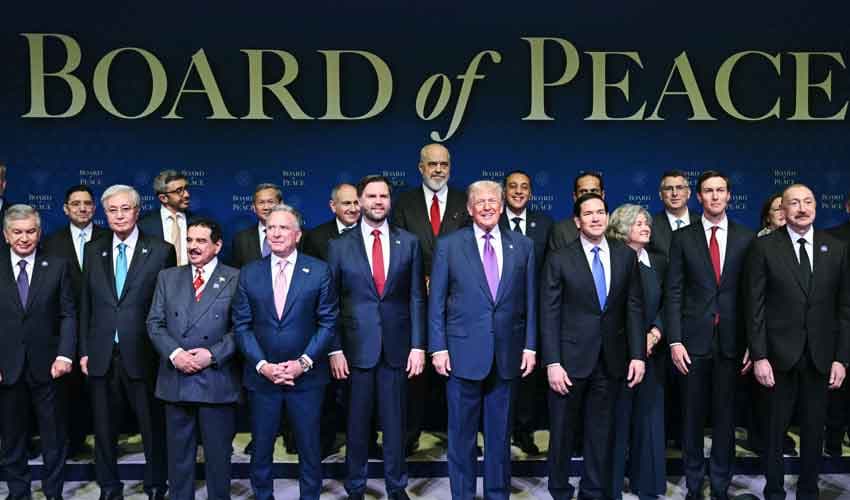
Trump said the agreement would pave the way for Gaza to be governed by a new Palestinian administration working closely with the Board of Peace, the multinational body he established to oversee governance, humanitarian relief, reconstruction and economic recovery in the enclave.
He added that once disarmament is completed, Israeli forces would withdraw from Gaza and an International Stabilization Force, working alongside a new Palestinian police force, would help maintain security.
Hamas confirms roadmap but sets conditions
A senior Hamas official told the BBC that the group had agreed to the Board of Peace's plan for complete disarmament and that an official statement would be issued soon.
Hamas negotiator Ghazi Hamad told Al Jazeera that negotiations had been difficult but productive, adding that the movement sought the best achievable outcome.
However, Hamad stressed that Hamas would not implement any part of the agreement unless Israel fulfilled its commitments. He said disarmament depends on Israel's withdrawal from Gaza and meaningful progress in rebuilding the territory.
"We will not take any action regarding disarmament prior to Israel's withdrawal from the Strip," Hamad said.
What the roadmap includes
According to copies of the roadmap obtained by media outlets, the agreement requires a detailed disarmament plan to be prepared within 14 days, with extensions possible only through approval by an international verification body and agreement among all parties.
The process would begin with the deployment of a National Committee and an International Stabilization Force into Gaza.
The National Committee would oversee the inventory, collection and storage of weapons while an international verification committee monitors compliance. Palestinian factions would participate in the process, but weapons would remain under the control of the National Committee and would not be transferred to Israel or any non-Palestinian authority.
The roadmap also links Hamas's disarmament directly to a gradual Israeli military withdrawal from Gaza and the establishment of a new Palestinian transitional administration.
Phased disarmament explained
US and Board of Peace officials outlined a multi-stage implementation process.
The first phase would see Hamas's police force surrender its weapons to the transitional Palestinian authorities.
The second phase would involve dismantling heavy military infrastructure, including tunnels, weapons depots and production facilities, while heavy weapons would be decommissioned and safely stored.
The final phase would address personal and light weapons under Palestinian law. Militias, clans and other armed groups operating in Gaza would also be required to surrender their weapons.
Officials acknowledged that dismantling Hamas's military infrastructure would be a lengthy and technically complex process because of the group's extensive tunnel network and weapons facilities.
Israel remains skeptical
Despite Trump's announcement, Israel has not officially endorsed the agreement.
A US official acknowledged that Israel remains "very skeptical" Hamas will actually disarm but said Washington is confident both sides will implement the commitments.
"If they don't, obviously President Trump would be very, very disappointed," the official said.
Earlier on Thursday, an Israeli official said Israel had rejected an earlier version of the proposal because it did not satisfy its demand for the complete removal of Hamas's weapons and the full demilitarization of Gaza as a precondition for any political process.
The Israeli embassy in Washington did not immediately comment following Trump's announcement.
Israeli media later reported that Israel remained opposed to the proposed terms, while the Times of Israel, citing unnamed sources, reported that Hamas negotiators, the Board of Peace and mediating countries had signed the agreement.
Mediators play central role
The negotiations took place in Cairo with mediation from Egypt, Qatar and Türkiye. Trump thanked all three countries for their role in advancing the agreement.
Egyptian state-linked media reported that Cairo will soon host another round of talks involving Egypt, the United States, Qatar and Türkiye to secure commitments from all parties for implementing the second phase of the ceasefire roadmap.
An informed Egyptian source said Hamas and other Palestinian factions had officially approved the proposal, which includes international forces and the launch of the National Committee's work.
Board of Peace hails breakthrough
The Board of Peace described the roadmap as the result of months of intensive negotiations conducted in good faith.
In a statement, the board said the agreement marks the first time Hamas has officially committed to an actionable plan to relinquish all of its weapons.
It said the roadmap promises governance reforms, humanitarian relief, reconstruction and economic recovery while delivering significant benefits to Gaza's residents.
Nickolay Mladenov, the Board of Peace's director-general and high representative for Gaza, said the negotiations had been extremely difficult.
"There were several points when I did not believe we would make it," Mladenov wrote on X.
He stressed that implementation would determine the agreement's success, saying verification must be credible and Israeli withdrawal must proceed in parallel with the decommissioning of weapons.
Mladenov added that the ultimate goal is "a Gaza rebuilt, governed by Palestinians and at peace with Israel," creating a political pathway toward resolving the Israeli-Palestinian conflict.
The broader peace plan includes a major increase in humanitarian assistance, civilian governance by a new Palestinian administration, reconstruction of Gaza and the deployment of an International Stabilization Force.
Once implementation is complete, the new Palestinian authority would become the sole entity authorised to possess weapons in Gaza.
Officials said the roadmap is built on a "zero-trust" model, meaning each phase will only proceed after an independent verification committee confirms that both Hamas and Israel have fulfilled their obligations.
Questions remain over implementation
Despite the breakthrough, major challenges remain.
It is still unclear how long the disarmament process will take. While one Board of Peace official estimated between 200 and 320 days, US officials downplayed that timeline and said progress would depend on conditions on the ground.
Questions also remain over how personal weapons will be handled, whether Israel will ultimately approve the roadmap, how many international troops will participate in the stabilization mission, and whether Israeli forces will fully withdraw from Gaza.
Violence continues despite diplomatic progress
Even as negotiations advanced, fighting continued on the ground.
Health officials in Gaza said separate Israeli airstrikes killed at least six Palestinians on Thursday, including two children, a woman and three men. The Israeli military said it targeted Hamas militants.
Since the ceasefire began in October, Gaza health authorities say more than 1,200 Palestinians, most of them civilians, have been killed in Israeli attacks, while Israeli authorities say four Israeli soldiers have been killed by militants.
Israeli Prime Minister Benjamin Netanyahu has also stated that Israel intends to expand the area under its military control to 70 percent of Gaza, highlighting the significant challenges that remain before the agreement can be fully implemented.