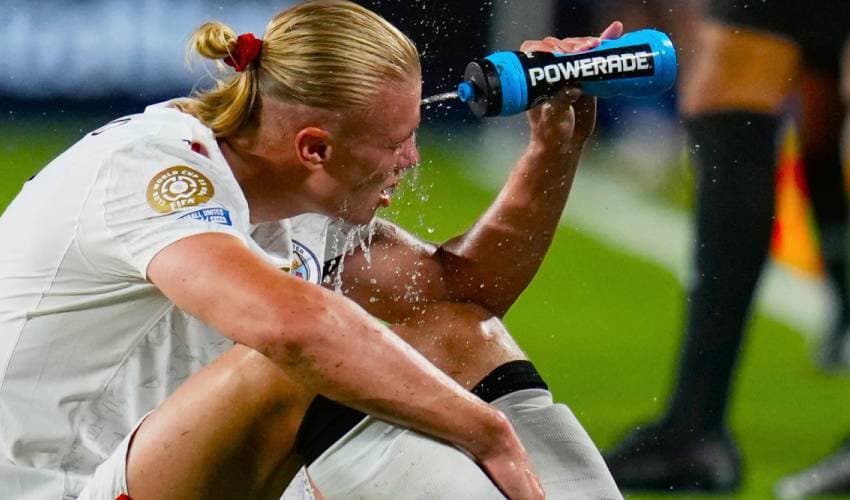
FIFA will review whether mandatory hydration breaks should continue after the 2026 World Cup following criticism from fans and questions over their effect on the game, FIFA's Chief of Global Football Development Arsene Wenger said on Saturday.
Speaking a day before the World Cup final between Argentina and Spain, Wenger acknowledged that the three-minute hydration breaks introduced midway through each half had divided opinion.
"Sometimes people didn't like it, and we have to analyse after the World Cup what is the impact," Wenger told reporters at the New York New Jersey Stadium.
"It didn't look to me that it changed the results of competition. But we are here to serve people who watch football, and we'll come to conclusions after the competition."
When asked whether FIFA had data showing the mandatory breaks improved player performance or match quality, Wenger replied simply: "No."
Mixed reaction from fans
The mandatory breaks, introduced for the first time at a World Cup, were intended to protect players from extreme heat.
However, supporters questioned the need for lengthy stoppages during matches played in cooler weather or inside covered stadiums.
Many also argued that the pauses disrupted the rhythm of games and allowed struggling teams to regroup tactically.
Throughout the tournament, some fans speculated the breaks primarily benefited broadcasters by creating additional opportunities for television advertisements.
Medical rule praised
While Wenger expressed uncertainty over the future of hydration breaks, he strongly defended another rule introduced at the tournament.
Players receiving on-field medical treatment are now required to leave the pitch for one minute before returning.
According to FIFA, that regulation reduced medical interventions from 2.3 per match at the 2022 World Cup to 1.6 per match during the current tournament.
"There is an element in this impact of the rule that is not measurable—that is the frustration you feel when somebody is lying on the field and is not injured," Wenger said.
"I asked so many people what they think of the impact, and everybody was so positive about it."
Decision after tournament
Before the 2026 World Cup, referees could decide whether to allow hydration or cooling breaks depending on weather conditions, with stoppages usually lasting around 90 seconds.
This tournament made the breaks mandatory for every match, extending them to three minutes regardless of temperature or stadium conditions.
Wenger said FIFA's medical and technical experts would analyse the tournament before deciding whether the rule should remain.
"We have not come to a conclusion yet, but I promise you, we will get one," he said.