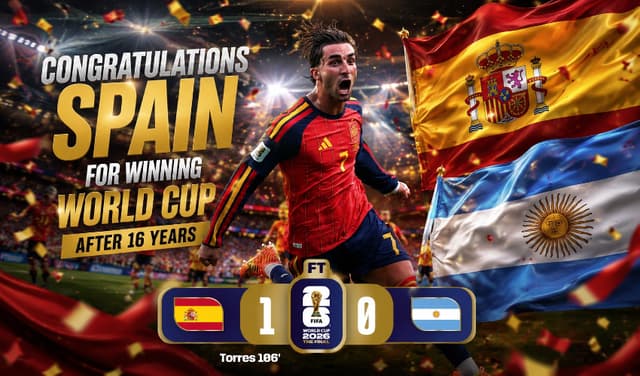
Spain celebrated a historic FIFA World Cup 2026 triumph after defeating defending champions Argentina 1-0 in extra time, but the night belonged to midfield leader Rodri, whose remarkable comeback from a serious knee injury culminated in him being named the tournament’s best player.
The victory at New York New Jersey Stadium completed one of football’s greatest individual and team achievements, with Spain collecting multiple FIFA awards after lifting their second World Cup title.
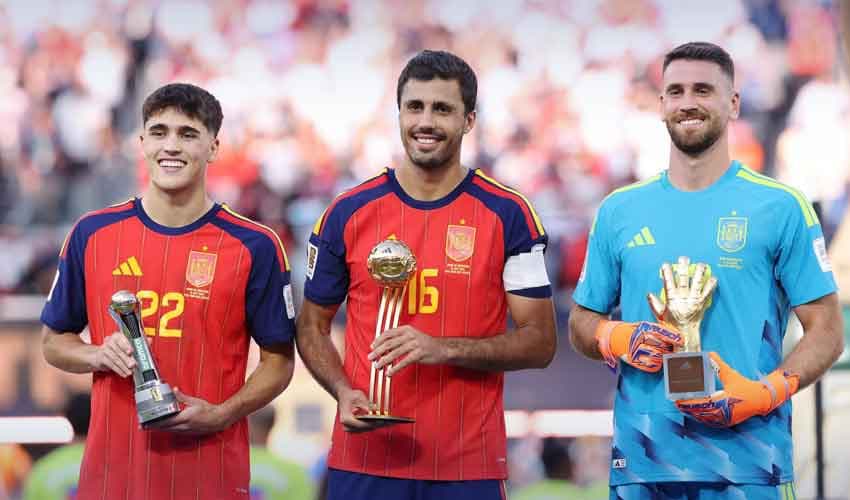
Rodri was awarded the FIFA Golden Ball as the best player of the FIFA World Cup 2026 following Spain’s dramatic victory over Argentina.
The 30-year-old midfielder completed an extraordinary football collection, joining Franz Beckenbauer, Gerd Müller and Zinedine Zidane as only the fourth player to win the FIFA World Cup, UEFA European Championship, UEFA Champions League and the Ballon d’Or.
The honour carried extra significance given Rodri’s journey over the past two years. After suffering a ruptured ACL that threatened his career, the Manchester City star returned to lead Spain to world glory and reclaim the dominant form that had earned him the 2024 Ballon d’Or following Spain’s European Championship triumph and City’s record 74-match unbeaten run with him in the side.
Receiving the Golden Ball, Rodri described the moment as the perfect ending to an emotional journey.
“It feels like the perfect script. I certainly didn’t expect this,” Rodri said.
He said he hoped younger players would take inspiration from his comeback story.
“I’d love for the younger generations to see that a player who touches the heavens, then descends into hell, can come back. It’s a lesson in overcoming adversity.”
Rodri later reiterated that Spain’s World Cup victory meant more than any individual award.
“This group is incredible. We are two-time world champions. It’s the hardest achievement in football, and we won it against a team like Argentina.”
Spain’s success built on teamwork
Although Rodri has been Spain’s most influential player throughout the tournament, he insisted La Roja’s success was built on collective effort. He praised his teammates for remaining patient against a resilient Argentina side before substitute Ferran Torres scored the decisive goal in the second period of extra time.
“That’s the secret of the national team. We’re always going to fight for each other. In the end, God rewards you. We’ve been brave.”
Rodri acknowledged Argentina’s defensive discipline but believed Spain fully deserved to become world champions.
“Argentina are world champions and they’re difficult to break down, but Spain are simply very good. In the end, the result was fair.”
Spain’s success extended well beyond lifting the World Cup trophy as Luis de la Fuente’s side dominated FIFA’s individual honours.
Rodri received the Golden Ball ahead of Argentina captain Lionel Messi, who collected the Silver Ball, while France star Kylian Mbappé finished third with the Bronze Ball.
Also Read: Spain win FIFA World Cup 2026 after extra-time victory over Argentina
Messi had been aiming to become the first player in history to win three World Cup Golden Ball awards after guiding Argentina to a second consecutive World Cup final, but narrowly missed out.
Mbappé, however, secured the tournament’s Golden Boot after finishing as the competition’s top scorer with 10 goals despite France ending the tournament in fourth place.
Cubarsí makes history with Best Young Player award
Spain defender Pau Cubarsí was named FIFA Best Young Player after producing one of the finest defensive performances by a teenager in World Cup history.
The 19-year-old Barcelona centre-back started all eight matches as Spain captured their second world title, helping his side beat Argentina 1-0 after extra time in the final at New York New Jersey Stadium.
Cubarsí partnered Aymeric Laporte at the heart of Spain’s defence as La Roja kept seven clean sheets and conceded only one goal throughout the tournament, which came during the 2-1 quarter-final victory over Belgium.
The teenager also became the first defender ever to receive the Best Young Player Award and only the fifth teenager in history to win the FIFA World Cup.

His growing list of achievements continues to expand. Cubarsí previously helped Spain’s Under-23 team win Olympic gold at the 2024 Summer Games and has already earned 20 senior international caps.
At club level, the La Masia graduate has established himself as one of Barcelona’s brightest stars, helping the Catalan giants win consecutive La Liga titles while making 128 senior appearances.
Cubarsí now joins an elite list of previous winners that includes Lukas Podolski (2006), Thomas Müller (2010), Paul Pogba (2014), Kylian Mbappé (2018) and Enzo Fernández (2022). The award itself traces its origins back to Brazilian legend Pelé’s recognition at the 1958 World Cup.
Simón produces one of the greatest goalkeeping tournaments ever
Spain goalkeeper Unai Simón was awarded the FIFA Golden Glove after delivering one of the greatest goalkeeping performances in World Cup history.
The Athletic Bilbao goalkeeper finished the tournament with seven clean sheets, setting a new World Cup record for the most clean sheets in a single edition.
Spain also produced one of the strongest defensive campaigns ever by a World Cup winner, conceding only one goal across eight matches -- the fewest ever by a team that lifted the trophy.
Before the final, Simón had already broken the long-standing record of five clean sheets jointly held by Fabien Barthez (1998), Oliver Kahn (2002), Gianluigi Buffon (2006) and Spanish legend Iker Casillas (2010).
His shutout streak reached an astonishing 649 minutes before Belgium ended it in Spain’s quarter-final victory.
Although Simón did not need to make a save during the final against Argentina, his consistency throughout the tournament earned widespread praise.
He also held off competition from Premier League Golden Glove winner David Raya and La Liga Golden Glove winner Joan García, who served as Spain’s backup goalkeepers.

Simón’s calm distribution, command of the penalty area and excellent shot-stopping proved crucial to Spain’s success and further strengthened his reputation after previously helping Spain win UEFA Euro 2024 and the 2023 UEFA Nations League.
Many observers now regard his 2026 World Cup campaign as the finest individual tournament ever produced by a Spanish goalkeeper, even surpassing legendary captain Iker Casillas.
The Golden Glove—formerly known as the Lev Yashin Award—is selected by FIFA’s Technical Study Group based on clean sheets, save quality, command of the area, distribution and overall influence on a team's progress.
Martínez also sets final record despite defeat
While Spain celebrated victory, Argentina goalkeeper Emiliano Martínez also entered the record books during the final.
Martínez produced 11 saves against relentless Spanish pressure, setting a World Cup final record despite Argentina’s 1-0 defeat.
His performance included a spectacular stoppage-time save to deny Lamine Yamal from the penalty spot after Argentina had been reduced to 10 men following Enzo Fernández’s red card.
Despite Martínez’s heroics, Ferran Torres eventually broke the deadlock in extra time to hand Spain the world title.
The FIFA World Cup 2026 concluded with Spain defeating Argentina after extra time to become two-time world champions.
Led by Rodri’s inspirational leadership, backed by Pau Cubarsí’s defensive maturity and Unai Simón’s record-breaking goalkeeping, Spain dominated both on the pitch and in FIFA’s post-tournament awards.
For Rodri, however, the greatest prize was not the Golden Ball but proving that perseverance and resilience can take a player from career-threatening injury back to the summit of world football.

.jpg&w=256&q=75 "Holiday announced on July 22")