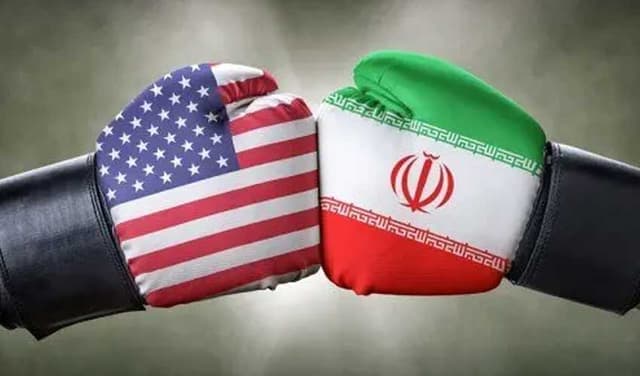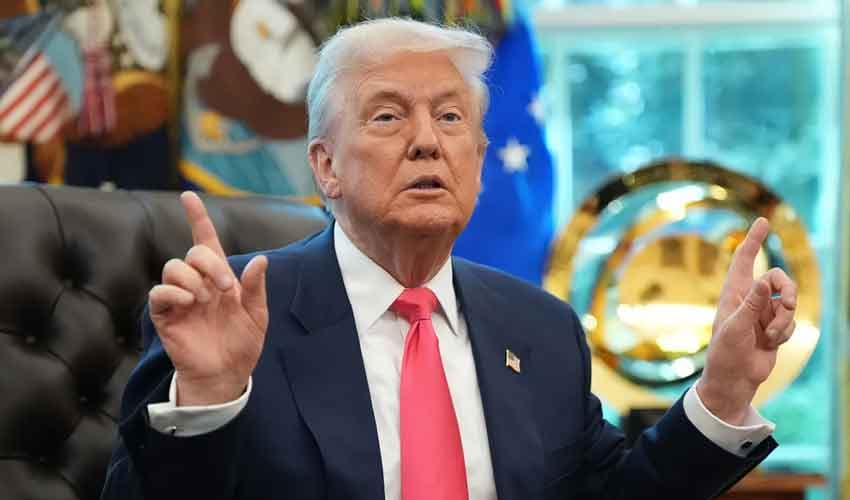
US President Donald Trump said Iran is seeking to negotiate an agreement with the United States as Washington escalated its military operations against Tehran with a second wave of strikes on Wednesday.
Speaking in Pennsylvania, Trump warned that the US could continue its military campaign if Iran does not agree to a deal, while insisting Tehran's leadership is under increasing pressure.
Speaking at the Defense and Innovation Summit in Pennsylvania, President Donald Trump claimed Iran is eager to reach an agreement with the United States despite the ongoing conflict.
"We're doing really well with Iran. The Islamic Republic of Iran is not happy right now," Trump said.
He asserted that Iranian leaders are actively seeking negotiations to end the confrontation.
"They want to settle so badly. They don't like what we're doing, and they do want to settle. We'll find out whether or not we settle with them, or we just finish it off," he said.
In a separate interview with Fox Business, Trump revealed that his administration had received what he described as a request from Iran to meet.
Also Read: US launches second wave of Iran strikes; Tehran retaliates across Gulf
"We received a call just as I was coming here that they want to meet," Trump said.
"They always want to meet," he added, claiming that Iran's military capabilities have been significantly weakened. "They're nasty people, but they want to make a deal."
Later, speaking to Fox News, Trump repeated his claim that Tehran wants an agreement. "I can tell you they want to make a deal," he said.
Trump warns Iran to 'behave'
Upon arriving in Pennsylvania before addressing the summit, Trump issued another warning to Tehran. While declining to set a deadline for negotiations, he suggested Iranian leaders clearly understood Washington's position.
"I don't like giving deadlines, but they pretty much know—they know the story. They better behave," Trump said.
The remarks marked another escalation in Trump's rhetoric as tensions between Washington and Tehran continue to rise.
US launches second wave of strikes on Iran
Trump's comments came as the US military's Central Command (CENTCOM) confirmed it had launched a second wave of military strikes against Iranian targets on Wednesday. The latest operations followed renewed hostilities between the two countries after a fragile ceasefire collapsed.
"We'll have Iran defeated soon. They'll be defeated very soon," Trump said while commenting on the military campaign.
The renewed escalation comes despite a Pakistan-mediated Memorandum of Understanding (MOU) that was intended to end the conflict after the war began with US-Israeli attacks on Iran in February.
In recent days, however, both Washington and Tehran have exchanged fresh attacks, further undermining hopes for a lasting ceasefire.
Although Trump repeatedly insisted Iran is ready to negotiate, Tehran has continued to publicly project a combat-ready posture.
Defense analysts quoted by CNBC said they see no clear path toward a negotiated settlement, despite the US president's optimism about potential talks.
The contrasting positions underscore the uncertainty surrounding the future of US-Iran relations as military operations continue.
Trump calls for faster US defense production
During his address at the Defense and Innovation Summit, Trump also focused on strengthening America's military industrial base.
He said the United States already produces the world's highest-quality defense equipment but needs to increase manufacturing speed.
"We have the best quality in the world, but we need a little more speed," Trump said.
Trump announced nearly $10 billion in new investments in Pennsylvania's defense industrial sector. According to the president, the funding will generate more than 4,000 jobs across the state.
Also Read: Iran says US MoU has no value without implementation
"Pennsylvania workers will build the ships, submarines, trucks, weapons and industries that will ensure America remains the strongest and most powerful nation in the history of the world," Trump said.
The investment is expected to expand defense manufacturing capabilities while supporting employment and military production.
Conflict continues despite diplomatic efforts
The latest exchange of military strikes highlights the continuing volatility in the Middle East despite diplomatic efforts to reduce tensions.
The Pakistan-brokered Memorandum of Understanding was intended to halt hostilities following the outbreak of war earlier this year, but renewed attacks by both sides have reignited fears of a broader regional conflict.
While Trump maintains that Iran is seeking negotiations, Tehran has not publicly indicated any change in its military posture, leaving the prospects for a diplomatic breakthrough uncertain.