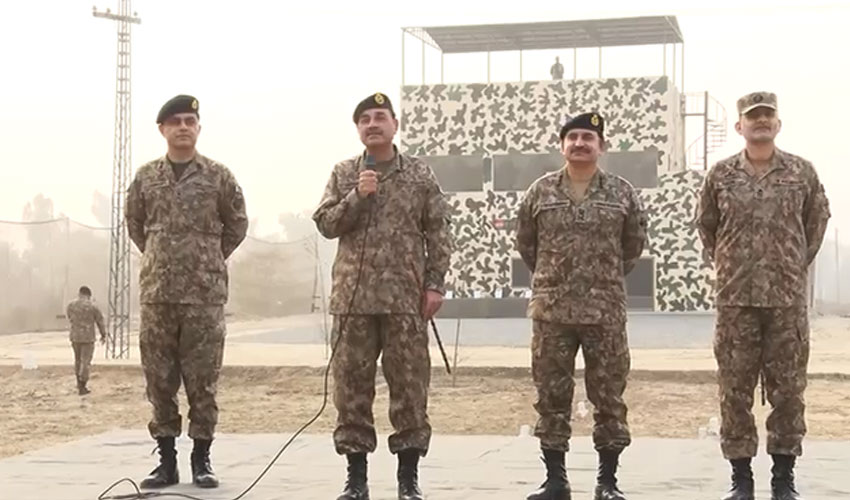






Director General Inter-Services Public Relations (ISPR) Lieutenant General Ahmed Sharif Chaudhry on Tuesday made it clear that Khyber Pakhtunkhwa will not be allowed to fall into the hands of terrorists, stressing that counter-terrorism operations are a constitutional and national responsibility of the state.
Addressing an important press conference, Lt Gen Ahmed Sharif Chaudhry said Khyber Pakhtunkhwa remains the worst-affected province by terrorism, accounting for nearly 71% of terrorist incidents nationwide.
He attributed the surge in violence to a political-criminal-terror nexus and a politically conducive environment that has emboldened militant groups.
“Should the state pledge allegiance to terrorists if operations are not carried out?” he asked, warning that any resistance to counter-terrorism efforts directly benefits extremist elements.
The DG ISPR categorically stated that the Pakistan Army will not allow Khyber Pakhtunkhwa to be handed over to terrorists under any circumstances.
“It is the duty of the Pakistan Army to protect Pakistan’s security,” he said, adding that terrorism is not a provincial issue but a national threat.
He questioned why certain groups had never been attacked by Fitna al-Khawarij, noting that all political parties have faced terrorist attacks, except those attempting to present themselves as the “approved voice” of extremists.
Counter-terrorism operations in 2025
Lt Gen Chaudhry described 2025 as a historic and productive year in Pakistan’s war against terrorism, marked by an unprecedented number of intelligence-based operations (IBOs).
Key statistics from 2025
-
Total counter-terrorism operations: 75,175
-
Khyber Pakhtunkhwa: 14,658 operations, 16 suicide bombings
-
Balochistan: 58,778 operations
-
Other regions: 1,739 operations
-
Total terrorist incidents nationwide: 5,397
-
Total suicide bombings: 27
-
Martyrs: 1,235
He said the scale of these operations reflects the state’s clear and uncompromising resolve to dismantle terrorist networks.
National unity
The DG ISPR emphasized that the war against terrorism is the war of the entire nation.
“All political parties are agreed on the National Action Plan,” he said, adding that terrorists are Khawarij and have no connection with Islam.
He noted that Pakistan’s counter-terrorism efforts have received international recognition and appreciation.
Illegal mining
Lt Gen Chaudhry raised concerns over illegal mining in Khyber Pakhtunkhwa, questioning who issued more than 5,000 mineral licenses in the province.
He said false statements are often made from the floor of the assembly, while claims of dollar inflows are misleading.
“Development in Khyber Pakhtunkhwa is only possible after peace,” he stressed.
Afghanistan turning into terrorist safe haven
Lt Gen Chaudhry said political changes in Afghanistan in 2021 proved to be a major turning point in the resurgence of terrorism across the region.
He said the security situation deteriorated after the Doha Agreement, with direct consequences for Pakistan’s internal security.
The ISPR chief noted that the Afghan Taliban had made three commitments after assuming power:
-
Not allowing Afghan soil to be used for terrorism
-
Ensuring women’s rights
-
Establishing an inclusive and representative government
“Unfortunately, no practical progress has been seen on any of these fronts,” he said.
According to the DG ISPR, the absence of an inclusive government in Afghanistan has encouraged terrorism, turning the country into a safe haven for militants.
He said global terrorist outfits, including Al-Qaeda and ISIS, are operating there, while leadership and training centres of the Tehreek-e-Taliban Pakistan (TTP) and Balochistan Liberation Army (BLA) are also based on Afghan soil.
He added that groups such as the East Turkestan Islamic Movement (ETIM) targeting China and the Islamic Movement of Uzbekistan (IMU) targeting Central Asia are also active in Afghanistan. Militants from multiple ethnicities and regions are present, with foreign terrorists shifting to the region following recent developments in Syria.
Terror financing and external support
Lt Gen Chaudhry revealed that several terrorist groups are operating at a regional level and are receiving financial and logistical support through different proxies. He disclosed that around $7.2 million has been provided to terrorists, along with bulletproof jackets and other protective equipment.
The DG ISPR said that internal political factionalism and weak governance in Afghanistan have further strengthened terrorist networks. He added that the Afghan Taliban played a calculated “graded game” at various levels, which allowed militant organizations to regroup and expand their influence.
Lt Gen Chaudhry said that after 2021, the Afghan Taliban began reorganizing the Tehreek-e-Taliban Pakistan as a central or “mother” organization. He added that the TTP was given an Afghan Taliban-style organizational structure, including training systems, command direction, and strategic guidance, significantly enhancing its operational capacity.
“When the [supply of] that money stopped, to continue running the war economy, they [Afghan Taliban] spread the war in the form of terrorism across the entire region. They find new patrons and financial sponsors, with the biggest patron for terrorism in Pakistan being India,” he said.
The DG ISPR added that India was using the Afghan Taliban as proxies and providing them with financial and other assistance.
“So the base of operations is being provided in Afghanistan by the Afghan Taliban and India’s money and patronage [is available].”
Ex-DG ISI was used for political purposes by PTI founder
Director General Inter-Services Public Relations (DG ISPR) Lt Gen Ahmed Sharif Chaudhry said on Tuesday that former ISI chief Lt Gen (retd) Faiz Hameed was used by the founder of Pakistan Tehreek-e-Insaf (PTI) for political objectives, stressing that such actions were driven by personalities rather than institutions.
Addressing a press conference, the DG ISPR said that at the time, the then prime minister ran both his party and government in a highly centralized manner.
Without naming Imran Khan directly, Lt Gen Ahmed Sharif Chaudhry remarked that the entire political structure revolved around a single individual, describing it as a “dictatorial style of politics.”
“This was not an institutional matter; it was a game of personalities,” he said, adding that state institutions should not be blamed for decisions taken to serve personal political interests.
Raising a pointed question, the DG ISPR asked: “Where is the DG ISI from that time who was used for political purposes?”
He rejected the narrative that the former prime minister lacked authority, saying the individual in question was “extremely powerful” during his tenure.
‘Unprecedented authority’
Lt Gen Ahmed Sharif Chaudhry said the former premier had exercised authority unseen since Pakistan’s independence.
“He was so powerful that he declared the then Army Chief as the ‘father of the nation’. No prime minister since 1947 has ever exercised such authority,” he said.
He emphasized that Pakistan has only one founding father — Quaid-e-Azam Muhammad Ali Jinnah — and one national poet, Allama Muhammad Iqbal, dismissing what he termed attempts to redefine national symbols for political convenience.
The DG ISPR reiterated that terrorism remains the most serious threat facing the country, noting that counter-terrorism operations in 2025 saw unprecedented intensity.
He also criticised repeated calls by the Khyber Pakhtunkhwa government for negotiations with terrorists, questioning the intent behind such demands.
“They have already pushed their own province into this fire and now want to drag the entire country into it,” he said, adding that such approaches have worsened the security situation rather than improving it.