Pakistan has strongly rejected India's comments on the Azad Jammu and Kashmir (AJK) Legislative Assembly elections, saying New Delhi lacks both the legal and moral standing to question the democratic process in the region.
The Foreign Office also reiterated Islamabad's commitment to regional peace, counter-terrorism cooperation and diplomatic engagement with neighboring countries.
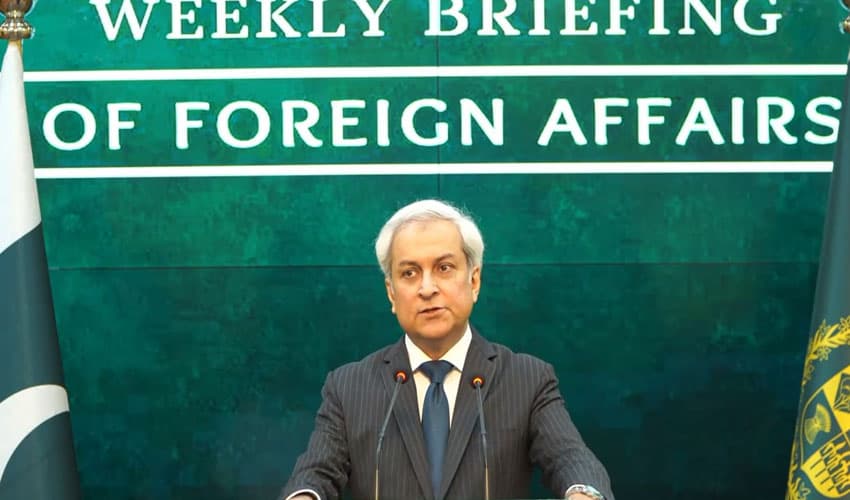
During the Foreign Office's weekly media briefing, spokesperson Tahir Hussain Andrabi categorically rejected what he described as the Indian Ministry of External Affairs' "misleading political statements" regarding the Azad Kashmir Assembly elections.
He said India was attempting to divert international attention from alleged human rights violations in India-Occupied Kashmir.
"India has neither the legal justification nor the moral authority to comment on the democratic process in Azad Jammu and Kashmir while it continues to deny the people of Indian Illegally Occupied Jammu and Kashmir their fundamental political rights and democratic freedoms," Andrabi said.
The spokesperson reiterated that the people of held-Kashmir should be granted their right to self-determination in accordance with relevant United Nations resolutions.
He added that the United Nations continues to discuss the international status of Jammu and Kashmir, and said the recent statement by the UN spokesperson was consistent with Pakistan's legal position on the dispute.
Pakistan also reiterated its condemnation of India's actions of August 5, 2019, describing them as illegal.
Pakistan focused on easing Gulf tensions
The Foreign Office said Pakistan remains committed to diplomatic efforts aimed at reducing tensions in the Gulf. According to Andrabi, Pakistan is working closely with brotherly countries to help resolve the Strait of Hormuz issue through dialogue.
He said the upcoming visit of Prime Minister Shehbaz Sharif and the field marshal to Saudi Arabia is part of those diplomatic efforts and is expected to strengthen Pakistan-Saudi Arabia relations and strategic cooperation.
The spokesperson also praised Oman's role in helping reduce tensions in the Strait of Hormuz, calling Muscat's efforts positive, sincere and commendable. He added that several friendly countries jointly played a facilitating role during the Strait of Hormuz crisis.
The spokesperson said Pakistan has played an important role in facilitating understanding between Iran and the United States. He emphasized that Islamabad will continue diplomatic coordination with friendly countries to promote peace and stability in the region.
No comment on Bangladesh's internal affairs
Responding to questions regarding recent developments in Bangladesh, the Foreign Office declined to comment.
Andrabi said Pakistan does not interfere in the internal affairs of other countries and considers the matter between India and Bangladesh to be a bilateral issue. He stressed that the people of Bangladesh are fully capable of resolving their own issues independently.
"Pakistan respects the sovereignty of Bangladesh and the free decisions of its people," he said.
The spokesperson added that Islamabad remains committed to expanding cooperation with Bangladesh in development, prosperity and bilateral relations.
Afghanistan and terrorism
The Foreign Office said Pakistan does not seek conflict with Afghanistan. "We are not at war with Afghanistan. Our brothers and sisters live there," Andrabi said.
He urged international donors supporting Afghanistan to ensure that financial assistance is not diverted toward terrorism.
The spokesperson said the Afghan Taliban would have to decide whether they wanted stronger relations with Pakistan or continued support for terrorist groups. He also referred to reports of clashes between the Afghan Taliban and opposition groups in several areas, including Badakhshan.
According to the Foreign Office, terrorist organizations operating from Afghanistan remain a regional concern.
Andrabi alleged that terrorist networks in Afghanistan receive financial support from India, and further claimed that India also provides financial backing to the banned Balochistan Liberation Army (BLA).
Pakistan-US counter-terrorism cooperation
The spokesperson said Pakistan and the United States maintain satisfactory intelligence cooperation. He confirmed that the fourth round of Pakistan-US counter-terrorism talks was recently held in Washington.
Both countries reaffirmed their commitment to strengthening cooperation against terrorism, including coordinated efforts against ISIS-Khorasan, Al-Qaeda, the banned Tehreek-e-Taliban Pakistan (TTP), and the BLA.
Speaking about Pakistan's defence industry, Andrabi said defence exports are an important component of the country's overall exports.
He noted that when private companies manufacture and export defence-related products, taxes and other revenues contribute to the national treasury.
Pakistan and Australia expand cooperation
The spokesperson also highlighted recent Pakistan-Australia talks and a meeting of the Joint Trade Committee in Canberra.
He said both countries agreed to enhance cooperation in political, trade, economic and security sectors while reaffirming their commitment to strengthening bilateral relations.
R4 foreign ministers back Palestinian state
Andrabi said the foreign ministers of Pakistan, Saudi Arabia, Egypt and Turkey participated in the R4 meeting.
According to the spokesperson, the participating countries reiterated their support for the rights of the Palestinian people and an independent Palestinian state.
The ministers also stressed closer coordination to promote peace and reduce tensions across the region.
The Foreign Office expressed regret over the continued captivity of Pakistani hostages in Somalia. The spokesperson said Pakistan was deeply saddened that their release had not yet been secured.
He assured that the matter remains under active consideration and that efforts are continuing for the safe and early release of the Pakistani hostages.