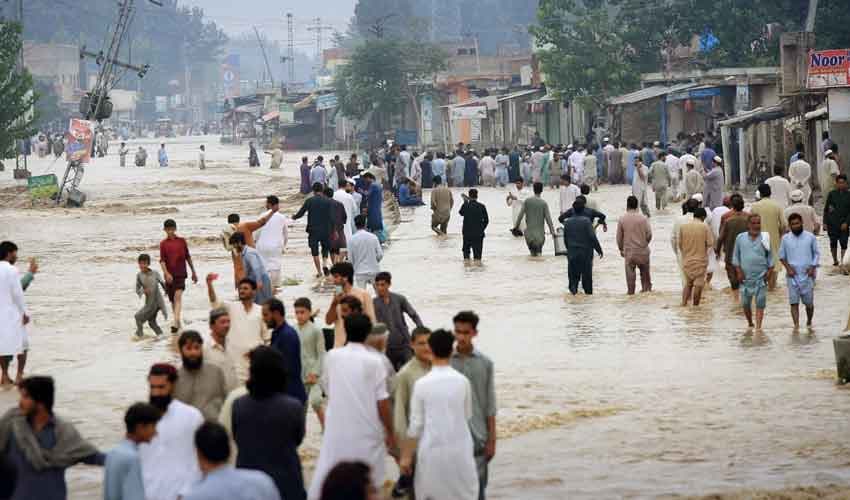
Heavy monsoon rains continue to batter large parts of Pakistan, leaving at least 12 people dead and 14 injured in Khyber Pakhtunkhwa, while widespread urban flooding, infrastructure damage and rising river levels have prompted high alerts across Punjab.
The Provincial Disaster Management Authority (PDMA) Khyber Pakhtunkhwa said 12 people lost their lives and 14 others were injured during the past two days due to heavy rainfall and flash floods across the province.
According to the PDMA, the deceased include six men, five children and one woman, while the injured comprise eight men, two women and five children.
The rains also damaged 14 houses, with one completely destroyed and 13 partially damaged. The affected districts include Peshawar, Khyber, Mardan, Buner, Bajaur, Lower Chitral, Abbottabad, Mansehra, Torghar and Kurram.
Lahore hit by rain, sinkhole reappears
Heavy rain lashed Lahore once again, inundating several commercial and residential areas, including Hussain Chowk, where severe waterlogging left vehicles stranded inside parking areas.
Residents were forced to remain indoors as floodwater accumulated across posh neighbourhoods. Rescue officials also confirmed that one person died from electrocution in the Bhattian area during the evening.
Meanwhile, Khayaban-e-Firdowsi, one of Lahore's busiest roads, developed another sinkhole after heavy rainfall. A section of the first lane and the adjacent green belt caved in, disrupting traffic.
WASA teams and heavy machinery rushed to the site to carry out restoration work. Officials said the green belt was badly affected by the rain, causing the road to sink again despite the earlier replacement of the sewage line.
Authorities noted that similar sinkholes have appeared on Khayaban-e-Firdowsi several times in the past, with the deteriorating sewerage system repeatedly blamed for the problem.
Gujranwala records highest rainfall in decade
Gujranwala witnessed one of its heaviest rainfalls in ten years, leaving large parts of the city submerged.
Several feet of water accumulated outside Jinnah Stadium and on major roads, forcing motorists to push stalled motorcycles and vehicles through flooded streets.
The rain turned many roads into waterlogged channels, severely disrupting daily life.
Tragedy also struck in different parts of the district. A 25-year-old man, identified as Hanan, died after being electrocuted by an electric pole while walking through rainwater in Bakhtewala Mohalla.
In another incident near Awan Chowk, the roof of a mud house collapsed, injuring a mother and her son, who were shifted to hospital.
In Nowshera Virkan's Tatle Ali area, the roof of a rice mill collapsed after heavy rain weakened the structure. One worker died after being buried under the debris, while two others sustained serious injuries and were shifted to DHQ Gujranwala.
Gujrat submerged after torrential rainfall
Gujrat city received around 150mm of rainfall, with intermittent showers continuing throughout the day. Several roads remained submerged, forcing markets to close and bringing commercial activities to a standstill.
Rainwater entered homes and shops in many neighbourhoods, with residents blaming poor drainage and administrative shortcomings for the widespread flooding.
Several feet of water accumulated on Garibpura Court Road, Jail Chowk, Rehman Shaheed Road and Bhambar Road, while Shadman, Shalimar Town, Model Town and Jinnah Road were also badly affected.
The Deputy Commissioner visited various disposal sites along with WASA officials to review drainage operations.
GEPCO confirmed that electricity supply remained uninterrupted across the city despite the severe weather.
Mandi Bahauddin reports multiple injuries
Heavy rain triggered three separate accidents in Mandi Bahauddin, leaving six people injured, including four women.
Near Duffer, the roof of a house collapsed, seriously injuring three women.
A woman was critically injured after a wall collapsed near Kakwal, while two more people sustained serious injuries when a wooden shed collapsed near Kadhar Pul. Rescue teams shifted all injured individuals to hospital.
Nowshera rescue teams save residents
Heavy rainfall since Monday night caused flooding in rivers, canals and rainwater drains across Nowshera. Several feet of water entered houses, markets, mosques and streets, causing widespread disruption.
Vehicles and livestock were submerged in many areas, while residential neighbourhoods in different tehsils were flooded.
Rescue teams safely evacuated 12 people trapped in floodwaters in Sahibzada Town, Akora Khattak, and rescued another five to six people stranded near Adamzai.
In Bargain near Jahangira Stop, 14 vehicles became trapped in flash floods but were later moved to safer locations through recovery operations. Rescue officials confirmed no casualties during both operations.
Jhang, Shakargarh remain on flood alert
Authorities issued a high alert in Jhang after rising water levels in the Chenab River increased fears of flooding. River erosion has already submerged several acres of agricultural land, raising concerns among farmers living along the riverbanks.
Officials warned that floodwaters are expected to pass through Trimmu within the next 48 hours.
Continuous rainfall has also submerged major roads and low-lying areas of Jhang, including Yousaf Shah Road near the DC House, severely affecting traffic.
WASA teams are working to remove standing water from roads.
In Shakargarh, rising water levels in Nullah Bein and Nullah Ojh prompted emergency rescue operations.
Ten farmers who had crossed the river from Chak Qazian village to plant paddy crops became stranded after water levels surged.
Rescue teams launched an operation to move them to safer locations.
Following the PDMA alert, the Narowal district administration placed all relevant departments on high alert, while rescue field posts were established in Kartarpur and Shakargarh.
Officials advised citizens to avoid rivers, streams and agricultural fields until July 24 due to the risk of flash floods.
River levels rise as Punjab issues flood warnings
According to the Flood Forecasting Division, low-level flooding has been recorded at several key locations.
Water inflow at Tarbela reached 302,000 cusecs, while Kalabagh recorded 283,000 cusecs. Mangla Dam registered an inflow of 102,000 cusecs.
Low-level flooding was also recorded at Head Marala with 103,000 cusecs, Khanki with 104,000 cusecs and Qadirabad with 109,000 cusecs.
Flood forecasting authorities said low-lying areas at six locations across three major rivers remain on alert due to increasing water inflows, while river levels are being monitored continuously.
Separately, the Punjab Disaster Management Authority (PDMA) said water flow remains normal at most rivers across the province despite isolated low-level flooding.
According to the PDMA spokesperson, Kalabagh on the Indus River recorded an inflow of 269,000 cusecs and an outflow of 262,000 cusecs.
Khanki on the Chenab River recorded an inflow of 113,000 cusecs and an outflow of 106,000 cusecs.
Water flow remains normal at Marala, Trimmu, Panjnad and Qadirabad on the Chenab River, Jassar, Shahdara, Head Sadhnai and Balloki on the Ravi River, Ganda Singh Wala, Sulemanki and Head Islam on the Sutlej River, as well as Tarbela, Chashma and Taunsa on the Indus River.
Authorities warn of more rain, urban flooding
The PDMA warned that river levels across Punjab could rise further by July 24 as the second spell of the monsoon continues.
Flood warnings have also been issued for the drains adjacent to the Ravi and Chenab rivers, including Bayan, Basantar, Dek, Ek, Palkho, Halsi and Dora.
Flash flood alerts remain in place for hill torrents in Dera Ghazi Khan.
Urban flooding is expected in Lahore, Gujranwala, Sialkot, Sargodha, Okara, Sahiwal, Bahawalnagar and Rawalpindi divisions.
Relief camps established
PDMA Director General Umar Abbas Baloch said flood relief camps have been established in vulnerable areas where basic facilities and medicines will be available for affected residents.
He urged people living near riverbeds to immediately move to safer locations if required and advised citizens to avoid unnecessary travel near rivers, canals and streams.
Authorities also appealed to parents to keep children away from rivers and floodwaters and not allow them to bathe in flowing streams during the ongoing monsoon spell.

.jpg&w=640&q=75 "Holiday announced on July 22")


.jpg&w=256&q=75 "Holiday announced on July 22")