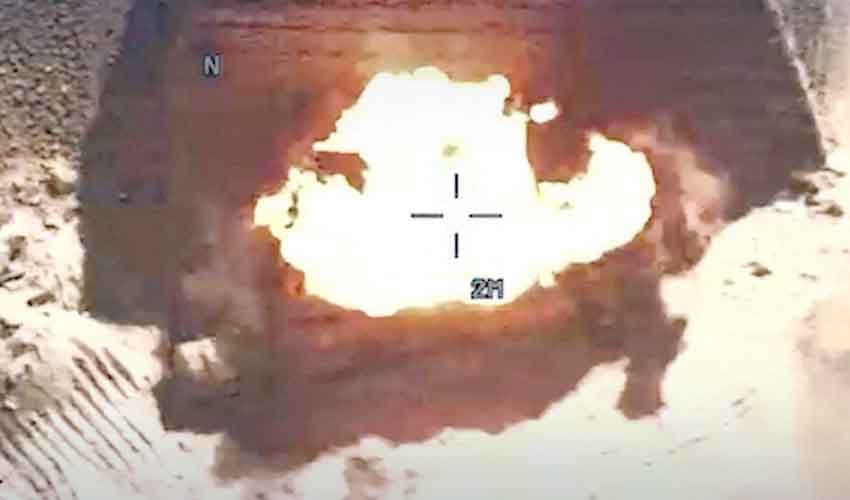
The Middle East conflict entered a dangerous new phase on the tenth consecutive day of US military operations against Iran, with fresh American airstrikes hitting several Iranian cities and Tehran responding with missile attacks on US military installations across the Gulf.
The escalating hostilities have also disrupted maritime security in the Strait of Hormuz, a critical global oil shipping route.
According to the US Central Command (CENTCOM), American warplanes carried out another round of attacks targeting strategic locations across Iran.
Explosions were reported in Qeshm Island, Bandar Abbas, Bushehr, Chabahar, Konarak, and Shiraz, as US forces struck Iranian military command centers, missile launch sites, drone launch facilities, and air defense installations.
CENTCOM said the latest operations were aimed at weakening Iran's military capabilities while maintaining maritime security in the region.
The command also stated that since May, US-led operations have provided safe passage to nearly 900 commercial ships through the Strait of Hormuz and facilitated the transport of approximately 450 million barrels of oil.
Iran attacks US military bases
Iran responded by launching another wave of surface-to-surface missile attacks against American military facilities in the Gulf region, according to the Islamic Revolutionary Guard Corps (IRGC).
The IRGC claimed it targeted Ahmed Al-Jaber (Arifjan) Air Base in Kuwait, where it said an American missile system was destroyed.
It also claimed responsibility for an attack on the MQ-9 drone hangar at Ali Al-Salem Air Base in Kuwait.
In Bahrain, Iranian forces reportedly targeted the US Patriot air defense system and attacked American radar and air defense installations in Muharraq, with the Revolutionary Guards claiming the systems were damaged or destroyed.
Strait of Hormuz security concerns grow
The latest escalation has also heightened concerns over maritime security in the Strait of Hormuz, one of the world's busiest oil shipping corridors.
According to the Revolutionary Guards, two oil tankers passing through the strategic waterway caught fire following explosions.
Iranian military authorities instructed ships operating in the area to exercise extreme caution because of potential threats.
Separately, maritime monitoring reports indicated a projectile attack on an oil tanker near Lima, forcing the crew to abandon the vessel and move to lifeboats, according to UKMTO.
Qatar urges UN action against Iran
As tensions escalated further, Qatar appealed to the United Nations and the UN Security Council, urging international action against Iran.
Qatar said Iran bears full responsibility for the attacks and the resulting losses, describing the strikes as a direct threat to regional and global peace.
The Gulf nation called on international organizations to take appropriate action to prevent further escalation in the region.
The tenth consecutive day of fighting underscores the rapidly expanding scope of the US-Iran conflict, with attacks now stretching across Iranian territory, American military installations in Gulf states, and key maritime routes used for global energy supplies.
The continued exchange of strikes has increased concerns over regional stability, commercial shipping security, and the potential for further escalation involving additional countries in the Middle East.

.jpg&w=256&q=75 "Holiday announced on July 22")