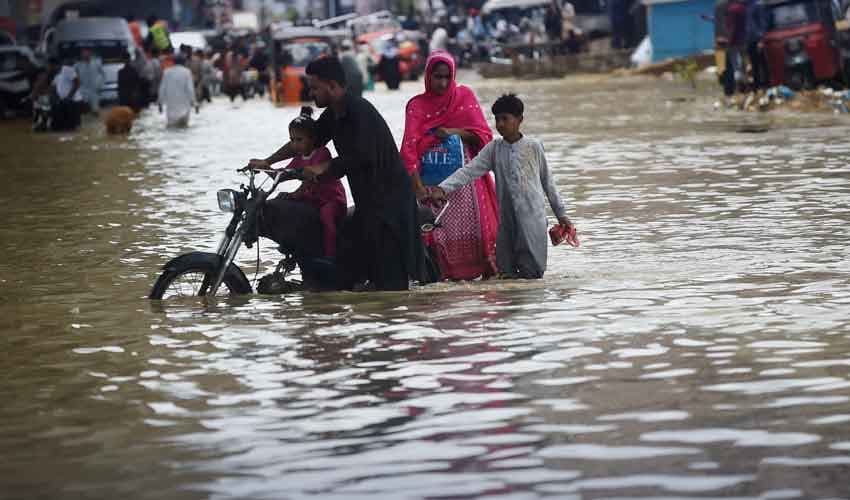
Monsoon rains have once again intensified flood threats across Pakistan, prompting authorities to issue flood alerts for several rivers, streams and urban centres.
Rising river levels, coupled with India's release of water from key dams, have heightened concerns of medium to high flooding in eastern rivers, while Lahore witnessed widespread disruption after torrential rainfall.
Pakistan's Flood Forecasting Division (FFD) has warned that the next 24 hours will be critical as monsoon rains continue to raise water levels in rivers across the country.
According to the FFD, the combination of heavy rainfall and increased upstream water inflows has significantly elevated flood risks in several areas, prompting authorities to closely monitor the situation.
India releases water from Baglihar, Salal dams
The flood threat has increased following India's release of water from the Baglihar and Salal dams on the Chenab River.
The Flood Forecasting Division warned of medium to high flood levels at Head Marala, Khanki and Qadirabad along the Chenab River.
Authorities are also closely monitoring water levels at Mangla Dam on the Jhelum River and Tarbela, Kalabagh and Chashma on the Indus River as inflows continue to rise.
Flash flood warning for KP, Balochistan, DG Khan
The FFD has issued flash flood warnings for parts of Khyber Pakhtunkhwa, northern Balochistan, and the Dera Ghazi Khan divisions, where heavy rainfall could trigger sudden flooding in rivers, streams and hill torrents.
Officials have advised district administrations to remain on high alert and continue monitoring vulnerable areas.
Alongside river flooding, authorities have warned of urban flooding in 12 cities, including Lahore, Sialkot and Gujrat, due to continued heavy rainfall.
Also Read: Monsoon rains trigger floods across Pakistan, 3 missing in Khyber
The administration has urged residents living near rivers, nullahs and streams to take precautionary measures and relocate to safer places if the situation worsens.
Heavy rain paralyses Lahore
Meanwhile, torrential monsoon rains brought life in Lahore to a standstill, leaving one person dead and seven others, including a woman, injured in rain-related accidents.
The downpour inundated roads across the city, severely disrupting traffic and making daily commuting difficult for thousands of residents.
Several parts of Lahore resembled large pools after hours of continuous rainfall. Major areas, including Lahore High Court, Mall Road, Lady Willingdon Hospital and Samanabad, witnessed severe waterlogging, causing significant problems for lawyers, patients, commuters and residents.
Many low-lying neighbourhoods, including Asif Town, remained submerged under rainwater.
Citizens expressed frustration over what they described as inadequate drainage arrangements, saying poor sewerage management worsened the situation.
Gulshan-e-Ravi records highest rainfall
According to rainfall data, Gulshan-e-Ravi received the highest rainfall in Lahore with 98 millimetres. Samanabad recorded 85 millimetres, while Sagian and Farrukhabad each received 50 millimetres of rain.
The heavy downpour contributed to widespread flooding on roads and in residential areas.
The rain also disrupted electricity supply across Lahore after the LESCO distribution system was affected. A total of 43 electricity feeders tripped, leaving several neighbourhoods without power.
Residents of Harbanspura, Mughalpura, Samanabad, Baghbanpura, Walton Road and several other localities continued to wait for electricity restoration, adding to the hardships caused by flooding.
Authorities urge citizens to remain vigilant
With more monsoon rainfall expected, authorities have advised people living near rivers, streams and flood-prone areas to remain alert and follow official safety instructions.
The Flood Forecasting Division continues to monitor river flows closely, while local administrations have been directed to remain prepared for any emergency response during the ongoing monsoon spell.

.jpg&w=640&q=75 "Holiday announced on July 22")

.jpg&w=256&q=75 "Holiday announced on July 22")