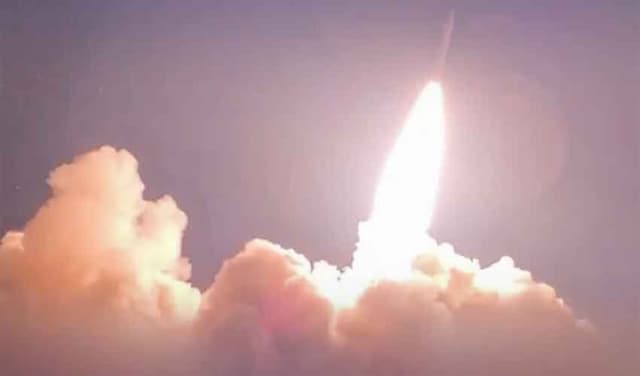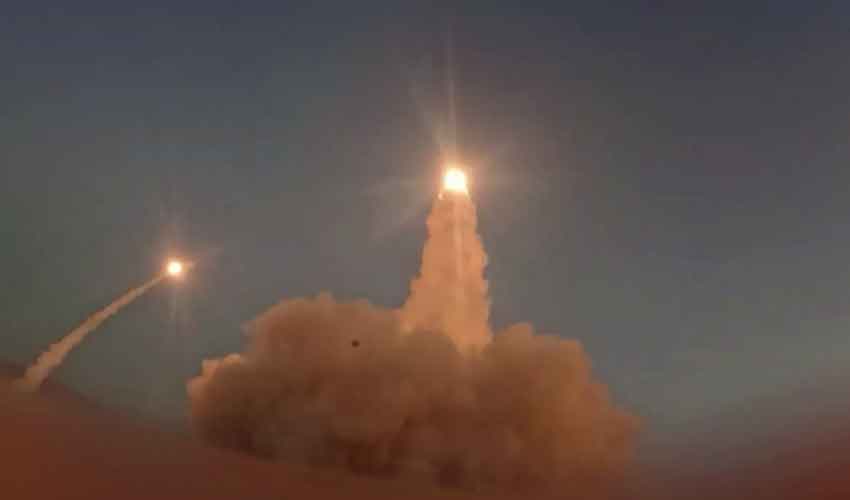
Iran has claimed responsibility for a new wave of drone and missile strikes targeting US-linked military, intelligence and logistical facilities in Bahrain, Kuwait and Jordan, marking another sharp escalation in the ongoing conflict with Washington as Gulf nations activated air defenses and emergency response plans.
Iran's Islamic Revolutionary Guard Corps (IRGC) said its naval forces carried out drone and missile strikes against a US fleet fuel support pier at Al Ahmadi Port in Kuwait and the Sheikh Isa Air Base in Bahrain.
According to Iran's semi-official Tasnim news agency, the IRGC also claimed it destroyed a US intelligence data centre in Bahrain known as Batelco, along with a US signals and telecommunications centre in Kuwait.
The IRGC described the attacks as the 19th wave of "Operation Nasr 2", saying they were launched in retaliation for overnight US airstrikes on Iranian territory.
US military facilities hit
Iranian military statements said the strikes targeted aircraft hangars, fighter jet parking areas and fuel tanks at Bahrain's Sheikh Isa Air Base.
The IRGC claimed the base had been used by the United States to launch military operations against regional targets, particularly Iran.
Iranian state media also reported that a warehouse used for US military drones in Bahrain was struck.
In addition, Iranian media claimed shore-to-sea cruise missiles were fired at a US vessel in the northern Indian Ocean, although there was no independent confirmation or acknowledgement from Washington.
Iranian state media asserted that the Batelco intelligence data centre, described as being used by the United States to coordinate military operations, was completely destroyed by ballistic missiles and dozens of drones.
The IRGC also claimed its naval forces destroyed the US fleet's fuel support dock at Al Ahmadi Port in Kuwait and a US communications facility.
However, these claims have not been independently verified by international authorities or the United States.
Bahrain intercepts aerial attacks
Bahrain's Defence Forces said they intercepted and destroyed several Iranian aerial attacks after air raid warning sirens sounded repeatedly across the kingdom.
The kingdom's Interior Ministry urged residents to remain calm and move to the nearest safe location as sirens were activated for the fifth time within a few hours.
The Bahraini military said all defence systems remained at the highest level of readiness, adding that the deliberate use of missiles and drones against civilians and private property constituted a violation of international humanitarian law.
Kuwait reports infrastructure damage and injuries
Kuwait temporarily suspended operations at Kuwait International Airport after Iranian missile and drone attacks prompted the temporary closure of the country's airspace.
Kuwait Airways later announced that most flights had resumed after the disruption.
Kuwait Petroleum Corporation confirmed that one of its vital oil sector facilities came under repeated Iranian attacks, resulting in injuries and significant material damage.
Also Read: Iran warns of full-scale offensive if US strikes continue
The company said injured workers received medical treatment while the affected site was evacuated in coordination with relevant authorities.
Kuwait's Fire Force also reported that several firefighters and a worker were injured while responding to fires at two locations hit during the attacks.
Power and water facilities affected
Kuwait's Ministry of Electricity, Water and Renewable Energy confirmed that one component of a power generation and water desalination plant caught fire following the latest attacks.
The ministry said several electricity generation units were disconnected as a precaution to protect workers and maintain the stability of the national power grid.
Officials added that emergency and operational plans were activated immediately, allowing electricity and water services to continue while technical teams monitored the situation around the clock.
Earlier reports also indicated that two power generation and desalination plants had been hit.
Kuwait strongly condemned what it described as Iran's "heinous aggression" against the country.
According to state news agency KUNA, the Foreign Ministry said repeated attacks on vital infrastructure demonstrated a systematic campaign targeting civilian facilities and essential services.
The ministry added that Kuwait reserves the right to take all necessary measures to protect its territory, security and critical infrastructure under its right to self-defence.
Jordan says drones intercepted
Jordan's Armed Forces said they intercepted and shot down four drones that entered the country's airspace over the past 24 hours.
Military officials said there were no casualties or material damage.
Meanwhile, the IRGC claimed it launched a "devastating and simultaneous" missile and drone attack on the US-operated Al-Azraq Air Base in Jordan.
Also Read: US-Iran war intensifies as Tehran strikes Gulf nations
Iran alleged that at least two American fighter jets were completely destroyed while several others suffered significant damage.
The IRGC also claimed Jordanian forces had targeted US troops and called on the Jordanian military to attack American forces, describing US military bases as legitimate targets.
Jordan has not confirmed any damage to the airbase or US aircraft.
US and Iran continue exchanging strikes
The latest Iranian attacks followed a seventh consecutive night of US strikes across Iran.
The US military said its latest operations were aimed at degrading Iran's military capabilities, particularly logistics networks, surveillance systems, coastal infrastructure and assets linked to operations in the Strait of Hormuz.
Iranian media reported explosions in Bandar Abbas, Lar, Ahvaz, Sirik, Qeshm and Yazd following the US attacks.
Washington says the campaign is intended to reduce Iran's ability to threaten commercial shipping through the Strait of Hormuz.
In response, Tehran has expanded its attacks against US-linked targets across Bahrain, Kuwait, Qatar, Jordan and other parts of the region.
The latest exchange of attacks comes despite a Pakistan-brokered memorandum of understanding signed in June that aimed to end hostilities and establish a lasting peace agreement between the United States and Iran.
The continuing military exchanges have heightened tensions across the Gulf and raised fears of a broader regional conflict.
US embassies issue new travel warnings
Amid the escalating security situation, the US Embassy in Beirut advised American citizens not to travel to Lebanon and urged those considering travel through the Middle East to reconsider their plans.
The embassy said the regional security environment remains highly volatile with the potential for sudden escalation.
The US Embassy in Jerusalem issued a similar advisory, warning Americans against travelling to Gaza, northern Israel and areas near the Egyptian border, except through the Taba crossing.