In Pakistan, faith is already part of the migration story. The trouble is that it is mostly working for the smugglers. They stamp their pitch with the language of blessing and sell a lethal journey as a kind of martyrdom, while the one institution that has moved every other hard message in this country, the mosque, has barely entered the fight. This is the story of a missing sermon.
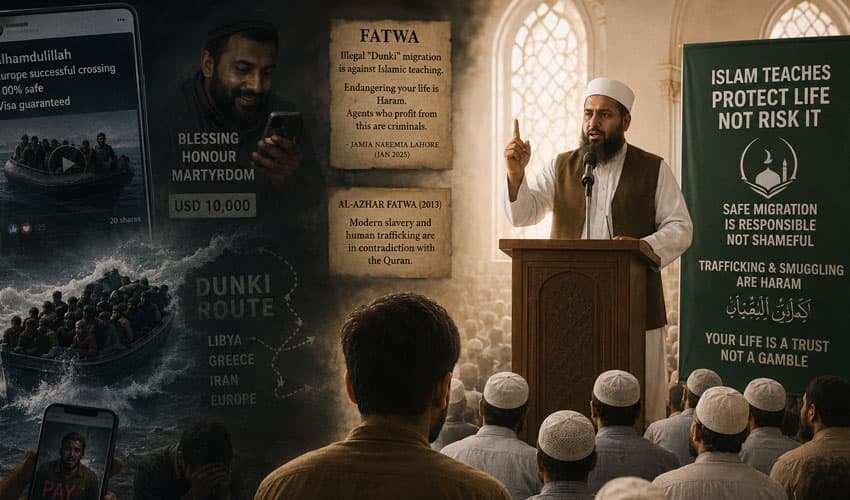
The recruitment post does not read like a threat. It reads like a promise, and it opens with the name of God. On the feeds where the trade advertises, a video of a successful crossing is captioned "Alhamdulillah," praise be to God, as though the sea itself had granted a blessing. The word does quiet, powerful work. It tells a frightened family that the journey their son is about to attempt is not only survivable but sanctioned.
This is the part of the crisis that enforcement cannot reach, because it lives in belief rather than logistics. And in the districts of central Punjab where the "dunki" trade is thickest, belief is exactly where the smugglers have set up their strongest position.
A narrative the traffickers already own
The genius of the trade is not only logistical. It is moral. It has built a story that makes leaving feel righteous and staying feel shameful.
Reporting by Dawn into the mechanics of the trade documents a standardised vocabulary in the recruitment feeds, including the religious branding that frames the crossing as blessed. Researchers who study these communities describe something even more potent. A death on the route, one migration researcher told the paper, is frequently cast not as a tragedy but as a "martyrdom narrative," a sacrifice for the family's uplift, while the young man who stays behind for a local job is seen as a failure. In that inverted moral economy, the most dangerous journey in the region is reframed as the most honourable one.
The scale of what this narrative feeds is not small. The dunki economy has been valued at around 10 billion dollars, and the human cost surfaces in the worst headlines: the periodic boat disasters off Libya, Greece and Morocco that carry Pakistani names, and the ransom videos filmed in safe houses in Iran, where smugglers torture captives and send the footage home to squeeze their families. The belief that the journey is blessed is what keeps families paying the first instalment.
A channel that has moved everything but this
Here is the paradox at the centre of this story. Pakistan possesses, and has repeatedly used, the single most effective tool imaginable for changing minds at the village level. It simply has not pointed that tool at trafficking.
That tool is the mosque, and the proof is polio. For years, vaccine refusal in parts of Khyber Pakhtunkhwa was among the hardest public-health problems in the world, driven by rumour and mistrust. What turned it was religious authority. Clerics issued fatwas declaring the vaccine permissible, imams urged parents from the Friday pulpit, and vaccination teams carried fatwa pamphlets endorsed by nearly every school of Islamic thought. As one Peshawar imam put it, for some families a visit from the imam is all it takes.
The channel proved to be reusable. During the COVID-19 campaign, religious scholars in the northwest recorded some 17,000 videos to counter vaccine hesitancy. They produced around 1,300 more for dengue prevention, and folded mpox warnings into Friday sermons when the first case appeared. In December 2023 more than a hundred scholars convened at a National Ulema Conference in Islamabad and pledged to carry the message from their mosques.
Trafficking and unsafe migration are almost entirely absent from that list. It is not for lack of a theological basis. In January 2025, clerics at Lahore's Jamia Naeemia issued a fatwa condemning illegal "dunki" migration, ruling that knowingly endangering one's life this way runs against core Islamic teaching, and condemning the agents who profit from the desperate. More than a decade earlier, in December 2013, Al-Azhar in Cairo, one of the most authoritative institutions in Sunni Islam, declared modern slavery and human trafficking to be in contradiction with the Quran. The UN Office on Drugs and Crime has published an entire framework on how Islamic law, with its flat prohibition on exploitation, aligns with international anti-trafficking commitments.
The message exists. The messengers exist. Even the state's own awareness materials reach for the argument: UNODC-supported campaigns in Punjab and Balochistan have distributed hundreds of thousands of flyers carrying the line that trafficking and migrant smuggling are "illegal, unethical and un-Islamic." What is missing is the delivery. A poster is not a sermon. A single fatwa reported once in the press is not the sustained, mosque-by-mosque mobilisation that turned polio around.
What enforcement can and cannot do
None of this is to say the state has been idle. On the supply side, the results are real and measurable.
Pakistan's Federal Investigation Agency says it offloaded around 40,000 passengers in 2025 under a risk-based approach that the European Union has publicly recognised. According to Frontex, the EU's border agency, irregular migration from Pakistan to the bloc fell by around a quarter over 2025, and by roughly 64 percent in the first two months of 2026 compared with the same period a year earlier. Border enforcement, visa checks and route disruption can bend the curve.
But enforcement acts on the journey, not on the conviction that sends people toward it. You can offload a passenger at the airport; you cannot offload the belief that leaving is a sacred duty and staying is a disgrace. That belief is formed long before the airport, in the same social space where the recruiter operates, and where, in Pakistan, the most trusted voice is not the FIA officer. It is the man at the front of the prayer hall.
The sermon that has not been given
If the smugglers have weaponised faith, the counter is not to remove faith from the conversation. It is to reclaim it.
The most direct step is to treat safe migration the way polio was treated: as a subject for the pulpit, backed by a clear, unified religious ruling and carried into ordinary Friday sermons rather than left to a one-off press conference. The Ministry of Religious Affairs, which already sets policy for pilgrims travelling to Iran, Iraq and Saudi Arabia, and which co-hosted the ulema conferences on polio, is the natural convener. The theological groundwork, from Jamia Naeemia to Al-Azhar, is already laid.
The second step is to meet the martyrdom narrative directly, because that is the real target. A sermon that simply calls smuggling illegal will lose to a recruiter who calls the journey blessed. A sermon that reframes the story, that a father's duty is to protect his son's life rather than gamble it, and that there is no honour in a death engineered by a man selling seats on a boat, speaks the same moral language the traffickers have hijacked, and speaks it with more authority.
The third step is the one that connects this story to the wider crisis. The same trust that a recruiter exploits, the cousin who vouches, the elder who nods, the blessing invoked, is precisely what a mosque network can counter, because it operates on the same currency. It is the cheapest and most far-reaching early-warning system Pakistan already owns.
The recruitment post will keep opening with the name of God. The question this story asks is why the people entrusted with that name have not yet been asked, at scale, to answer it.
Reporting note: this feature draws on Dawn's reporting into the mechanics of the "dunki" trade (2026); the Jamia Naeemia fatwa as reported by the Pakistan Observer (2025); Al-Azhar's 2013 fatwa via the World Economic Forum; UNODC materials on Islamic law and on anti-trafficking campaigns in Pakistan; polio-campaign reporting by Gavi, End Polio Pakistan, Foreign Policy and Dawn; and Frontex and FIA figures via The Nation (2026). Marked slots indicate where original field interviews are required before publication. Direct quotes carried from other outlets must be verified against the original before publishing, and any fatwa should be quoted from its own text, not a news paraphrase.