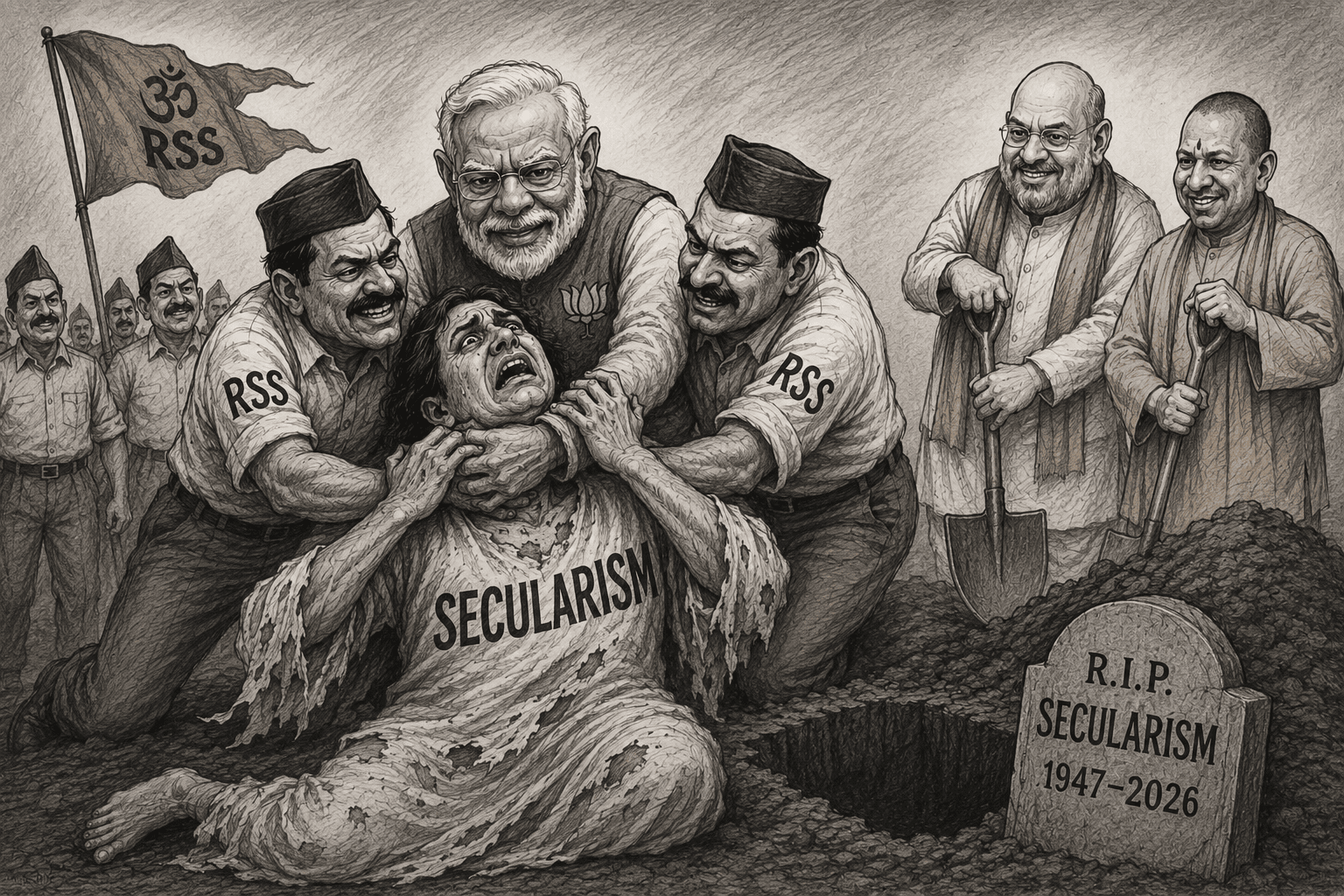
The only beautiful thing about India was its secularism. It was the claim the country got to hold over its own worst instincts — a Muslim minority population of more than 200 million, a constitution that promised them equal citizenship, a state that at least performed neutrality even where it did not practice it. The Indian constitution still says secular, and the passport still says Republic of India. Everything else has stopped saying it.
Cockroaches and Minorities: India’s Two Educations
India has run a controlled experiment on dissent for almost a decade. Muslims, especially Kashmiris, as well as Dalits, Sikhs and Christians were the control group. However, by accident, the sample size has grown this summer. A satirical protest started by university-age kids furious over a rigged entrance exam has now been tear-gassed, baton-charged and hospitalised on the road to Parliament. Ironically, the country is now discovering, as if for the first time, what its minorities have been describing for years – tyranny.
The Cockroach Janta Party came into being in May as a joke after India's chief justice compared the country's unemployed youth to "parasites" and "cockroaches" during a Supreme Court hearing.
Following the comment, a 30-year-old named Abhijeet Dipke, fresh off a degree in the United States, put out a call on social media asking what would happen if all the cockroaches came together. For a country with the world's largest youth population, sitting on paper leaks, cancelled exams and a labour market that cannot absorb its own graduates, it was just natural for the youth to answer Dipke’s call.
By July, more than 10,000 protesters were marching on Parliament. The Rashtriya Swayamsevak Sangh (RSS) inspired government of Narendra Modi responded with tear gas, batons, a demolished protest camp, the forcible hospitalisation of a 59-year-old hunger striker, and the withholding of the movement's account on microblogging website “X” (formerly Twitter) just five days after its creation.
No, none of this has anything to do with religion. The Cockroaches are agitating for the education minister's resignation, for an exam system that is not for sale, and for jobs that don’t exist. Their grievance is economic and generational; hence the intensity.
But this is one of those anger-filled protests that the state cannot easily narrate away. The Modi government has again made the mistake of reaching for the same toolkit it has used on Shaheen Bagh, on Kashmir after Article 370, on farmers camped outside Delhi for a year, and on journalists charged under sedition and the Unlawful Activities (Prevention) Act for doing their jobs.
The government believes that tear gas, batons and water cannons used to manage restive minorities in India would work just as efficiently and effectively on a restive majority the moment that majority becomes inconvenient. That is the point of convergence.
Expired Explanations & Arguments
The Hindu population of India, for years, has shrugged off the argument from Muslim citizens that the state treats their assertion of rights as a law-and-order problem. Citizenship protests were framed as anti-national, bulldozers through Muslim neighbourhoods were framed as anti-encroachment drives, and detentions under laws written for terrorism were framed as due process.
Each time, the Modi government offered an explanation that wend along the lines of “these are special cases, this is how a young republic protects itself, and don't generalise from the periphery”.
But this time, the Cockroaches are Hindu, consisting largely of upper- and middle-castes, coming precisely from the demographic that the BJP has spent years cultivating as its base. Shockingly for them, the state greeted them exactly the way it has always greeted people it decided did not belong at the negotiating table.
Uncomfortable Shoes
Rahul Gandhi called it "brutalities against young students" on the day after the crackdown. However self-serving an opposition leader's outrage may always be, this time the people agreed with him, particularly lawyers. A public interest litigation is now before the Delhi High Court over the police's conduct, and the Supreme Court Bar Association has condemned the crackdown and demanded an independent inquiry.
The opposition leader is not wrong about the mechanism, which is the same one Kashmiris have lived under since August 2019, and the one that met the anti-CAA sit-ins of 2020. The only thing that changed is the audience. Now, the dissidents in the shoes of minorities are mostly degree-holding Hindus, and they don’t like it.
Moreover, the ‘Godi media’ and its lapdog anchors have failed to spin the protests into a story about outsiders, infiltrators or foreign funding, again because the ones they will be throwing the accusations at are Hindu protesters.
Soft Corner for Minorities? Unlikely!
This saga does not prove that Gen Z has suddenly discovered solidarity with the Muslims whose citizenship was quietly made conditional, or with the Kashmiris still living under the largest peacetime troop deployment on earth. Dipke himself has gone out of his way to keep the Cockroach movement narrowly focused and non-violent, distancing it from the uprisings in Nepal and Bangladesh precisely because he understands how easily this government reaches for the word "chaos" whenever a protest threatens to widen its aperture.
What the convergence does prove is that the crackdown was never really about who the protesters were. The Islamophobic RSS ideology that built its politics on the idea of India as fundamentally, permanently a Hindu nation has, in the process, built a state that cannot actually distinguish between a Hindu student demanding a fair exam and a Muslim family demanding to keep its citizenship.
What Next?
There is a version of this moment that ends in reforms, with the education minister resigning and the exam system getting cleaned up. The other version, the one worth actually hoping for, is where enough of India's Hindu middle class connects what happened to them at Jantar Mantar this month to what has been happening in Kashmir and in bulldozed neighbourhoods for decades.
It is painful to see that secularism in India has died. What survives today is a secular vocabulary operating a Hindu-majoritarian state. The gap between the two has become the most honest description of the country there is.
That is Hindutva's country, built patiently and more or less openly over the last 12 years. No, India has not fallen. It just got ‘renovated’ into Hindustan with the help of bullets, batons and bulldozers. The only remaining question is how much longer the old name gets to stay on the door.