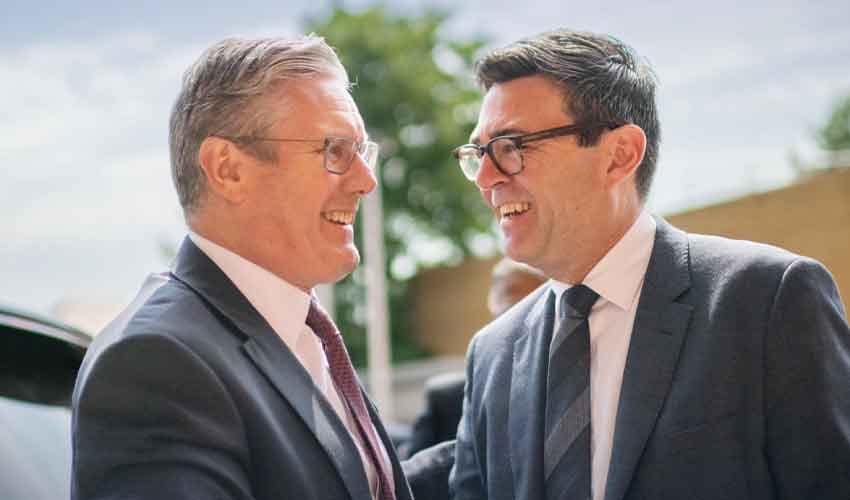
Andy Burnham officially became the United Kingdom's new prime minister on Monday after meeting King Charles at Buckingham Palace, marking a major political transition as Britain welcomes its seventh prime minister in just 10 years.
The Labour leader has vowed to "rewire" Britain by focusing on the issues that matter most to people, including the cost-of-living crisis, sluggish economic growth and struggling public services.
Burnham's appointment became official after outgoing Prime Minister Keir Starmer tendered his resignation to King Charles.
Buckingham Palace confirmed the final constitutional step in the transition, stating: "His Majesty received in audience the Rt. Hon. Andrew Burnham MP and requested him to form a new Administration. The Rt. Hon. Andrew Burnham MP accepted The King's offer and kissed hands upon his appointment as Prime Minister."
The title "Rt. Hon." stands for "Right Honourable," a formal designation used for members of the Privy Council, including Britain's prime minister.
Starmer bids farewell after stepping down
Before leaving 10 Downing Street, Starmer delivered his farewell speech, describing his time in office as "the privilege of my life."
"My work is done," Starmer said, adding that he was leaving office "with good grace" and "a smile."
He also offered his full support to Burnham, saying: "As I now pass the baton to Andy Burnham, I wish him every success. He has my full support."
Starmer added that he believed Britain was "stronger and fairer" than it had been two years earlier and concluded his speech by thanking the public before ministers and aides applauded him.
Burnham promises new direction for Britain
Shortly after taking office, Burnham was expected to deliver a speech outside Number 10 outlining what his office described as "a more stable and responsible politics."
Presenting his leadership as a moment of national reflection, Burnham plans to acknowledge Britain's challenges while arguing that only political stability can deliver lasting improvements.
Last Friday, he described his election as Labour leader as "the most significant change moment in our politics for 40 years."
Burnham has pledged to rapidly improve living standards and reshape Britain's political system so that "life is more affordable and all people and places are lifted from where they are now."
His message is aimed not only at voters but also Labour lawmakers, many of whom believe he is better positioned than Starmer to counter the growing popularity of Nigel Farage's Reform UK.
Cabinet appointments become Burnham's first major test
One of Burnham's earliest and most closely watched decisions will be the formation of his cabinet, particularly the appointment of a finance minister.
Political observers note that disagreements between prime ministers and finance ministers have contributed to the collapse of previous British governments.
Energy Security and Net Zero Secretary Ed Miliband was initially viewed as a leading contender, although reports of internal opposition have weakened his chances. Home Secretary Shabana Mahmood has since emerged as the favourite for the role.
Burnham has urged Labour members to ignore speculation, insisting he has not yet finalized his cabinet.
Burnham's policy agenda is expected to face immediate scrutiny.
Plans requiring all employees to hold digital identity documents -- introduced to combat illegal migration -- were abandoned on Sunday after a cross-party parliamentary committee labeled the scheme a "fiasco."
Attention is also expected to focus on future decisions regarding taxation, government spending, energy policy and the regulation of utility companies.
Burnham has advocated stronger public oversight of underperforming utilities, including Thames Water, Britain's largest water company, which has faced criticism over mounting debt and repeated sewage leaks.
Deputy Labour Leader Lucy Powell suggested on Sunday that Thames Water could be placed under "special measures," effectively bringing it under government control.
Powell said Burnham intends to "refocus and reprioritise the government's resources" toward addressing the cost-of-living crisis and restructuring the economy.
Britain enters another chapter of political change
Burnham becomes Britain's seventh prime minister in a decade, highlighting a prolonged period of political instability that followed the 2016 Brexit referendum.
Despite Britain's reputation for political continuity, repeated leadership changes have prevented several prime ministers from completing full terms.
The last leader to serve a complete five-year term was Conservative Prime Minister David Cameron, who was elected in 2010 and re-elected in 2015 but resigned after the Brexit referendum.
Britain's recent prime ministers
Political turbulence has seen a rapid succession of leaders over the past decade:
-
David Cameron (2010–2016): Resigned after Britain voted to leave the European Union in the Brexit referendum, which he had called while campaigning to remain in the bloc.
-
Theresa May (2016–2019): Stepped down after failing to secure parliamentary approval for her Brexit agreement.
-
Boris Johnson (2019–2022): Resigned following ministerial revolts sparked by scandals, including breaches of COVID-19 lockdown rules, renovations to his official residence and the appointment of a minister accused of sexual misconduct.
-
Liz Truss (2022): Resigned after only six weeks when her economic policies triggered financial market turmoil, earning lasting attention as the prime minister who "failed to outlast a lettuce."
-
Rishi Sunak (2022–2024): Britain's first prime minister of Indian heritage took office after replacing Truss but resigned after Labour's landslide election victory in 2024.
-
Keir Starmer (2024–2026): Left office after being removed by Labour lawmakers, paving the way for Burnham's leadership.
Burnham now inherits an extensive list of challenges, including weak economic growth, rising household costs, pressure on public services and concerns over utility companies.
His leadership will be closely watched as Britain looks for greater political stability and economic recovery after years of frequent leadership changes.

.jpg&w=256&q=75 "Holiday announced on July 22")